

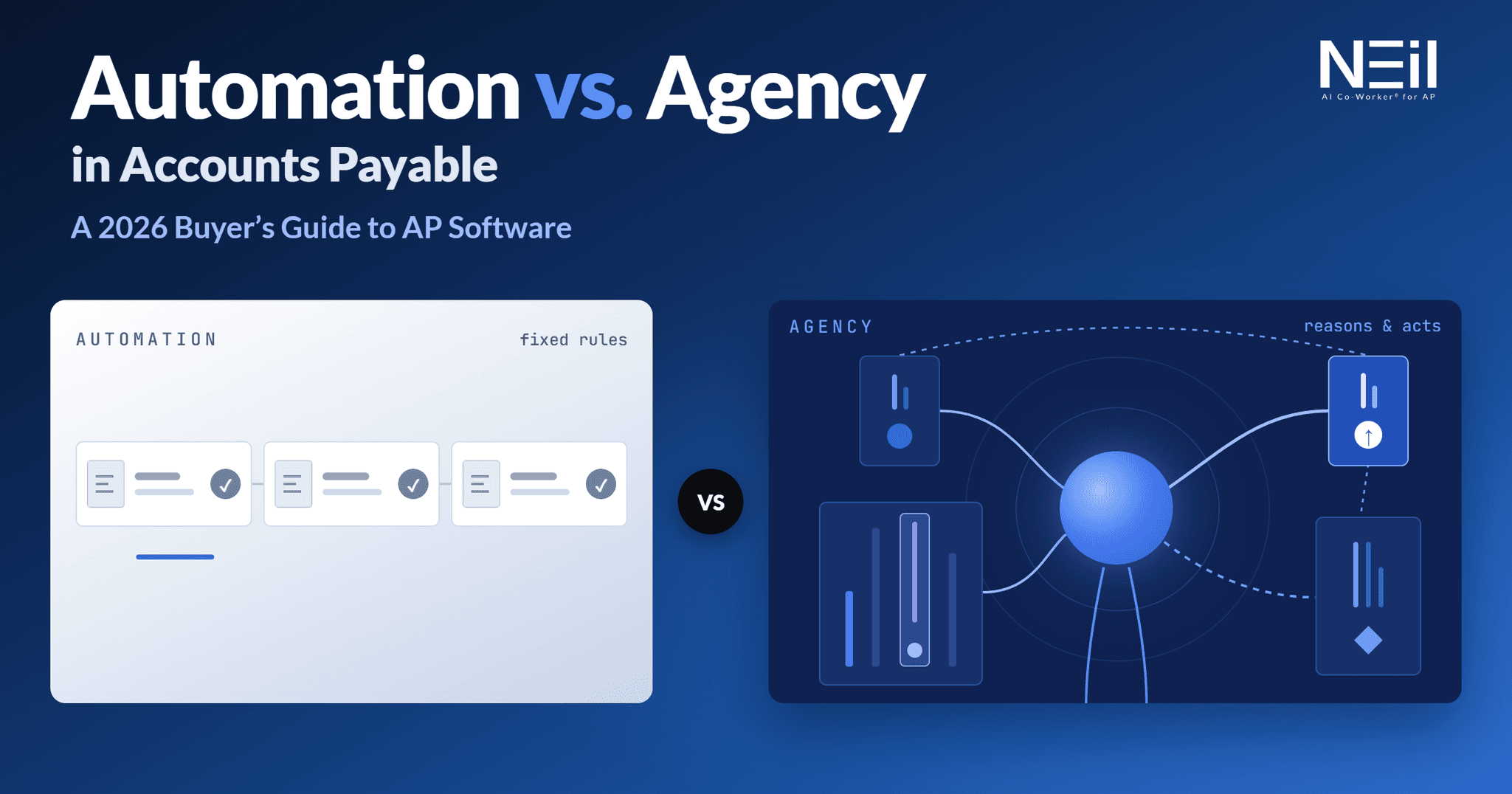
- Automation made AP faster. Agency makes AP run itself.Every generation of AP tools (capture, workflow, bots, copilots) still needs people to operate it. On average, only about a third of invoices are processed straight through (Ardent Partners, 2025), and the median cost to process an invoice is about $21 (APQC).
- Agency is the ability to reason, decide and act end to end, not just read, route or suggest. That is what separates an AI Co-Worker® from AP automation software.
- Neil is the AI Co-Worker for Accounts Payable.Neil supervises a team of specialized AI agents that run the full AP cycle on any ERP and bring in people only when judgment is needed: 90%+ touchless at steady state, under $1 per invoice, live in 6–8 weeks. Neil runs today at 45+ customers, including global media, manufacturing and pharmaceutical enterprises.
- When another tool may fit better:if your core need is mass cross-border payouts or card-led spend, or you are a single-ERP, English-language, US mid-market team focused on making your current AP team faster, we say where below.
If you are evaluating AP automation software alternatives, the usual checklist (extraction accuracy, approval routing, number of integrations) misses the question that now decides the outcome: who does the work?
Over three decades, accounts payable software has reached almost every mid-market and global enterprise. Companies have deployed optical character recognition (OCR), intelligent document processing, configurable routing engines, robotic process automation (RPA) bots and ERP-native approval modules. Yet the economics have barely moved. Ardent Partners’ State of ePayables 2025 puts the average straight-through processing rate at 35%, and only 51% for best-in-class teams. APQC’s benchmarks put the median cost of processing a single invoice at roughly $21.
Replacing AP software is rarely about invoice extraction alone. A platform may capture data correctly and route approvals on time, yet still leave people chasing missing information, investigating discrepancies, answering supplier emails and resolving exceptions that fall outside the standard workflow. This guide compares Neil, the AI Co-Worker for Accounts Payable, with SAP Ariba Invoicing, Oracle Fusion Payables, OpenText VIM, Newgen, HighRadius, Tipalti, Ramp, Stampli and AppZen: where each fits, where each stops, and why the market is moving from automation to agency.
Three Decades of Automation, Still Short of Touchless
Every wave of AP technology solved a real problem, and every wave left the same one behind. Capture tools read invoices but don’t act on them. Workflow engines route invoices but send exceptions back to people. Bots follow scripts but break when a format changes. Copilots draft and suggest, and a person still clicks.
The result is a ceiling. Most AP estates run two or three of these waves at once, and the gaps between them are filled by people: re-keying, chasing approvals, answering vendors. That human glue is why straight-through rates stall well below half for most teams, and why adding another tool to the stack rarely moves the number.
The Automation Era vs. the Agentic Era
The clearest way to compare vendors is to ask who does the work. We call the answer agency: the ability to reason, decide and act, not just read, route or suggest.
| Wave | Era | What it does | Typical examples | Who still does the work |
|---|---|---|---|---|
| Capture | 1990s | Reads documents; does not act on them | Early OCR and capture tools | People match, code, approve, post and chase |
| Workflow | 2000s | Routes and matches on rules you configure | OpenText VIM, Newgen | People resolve exceptions and maintain the rules |
| Bots | 2010s | Follows fixed scripts; fragile when inputs change | First-generation RPA | People fix what the scripts did not anticipate |
| Copilots and task agents | 2023 | Automate single steps inside one suite or ERP | Stampli, Tipalti, SAP Ariba Invoicing | A person still owns the outcome |
| AI Co-Worker | Agentic era 2024- | Reasons, decides, acts and talks to vendors, across any ERP and any channel | Neil | People supervise and judge true exceptions |
Vendor names illustrate typical positioning; trademarks belong to their respective owners.
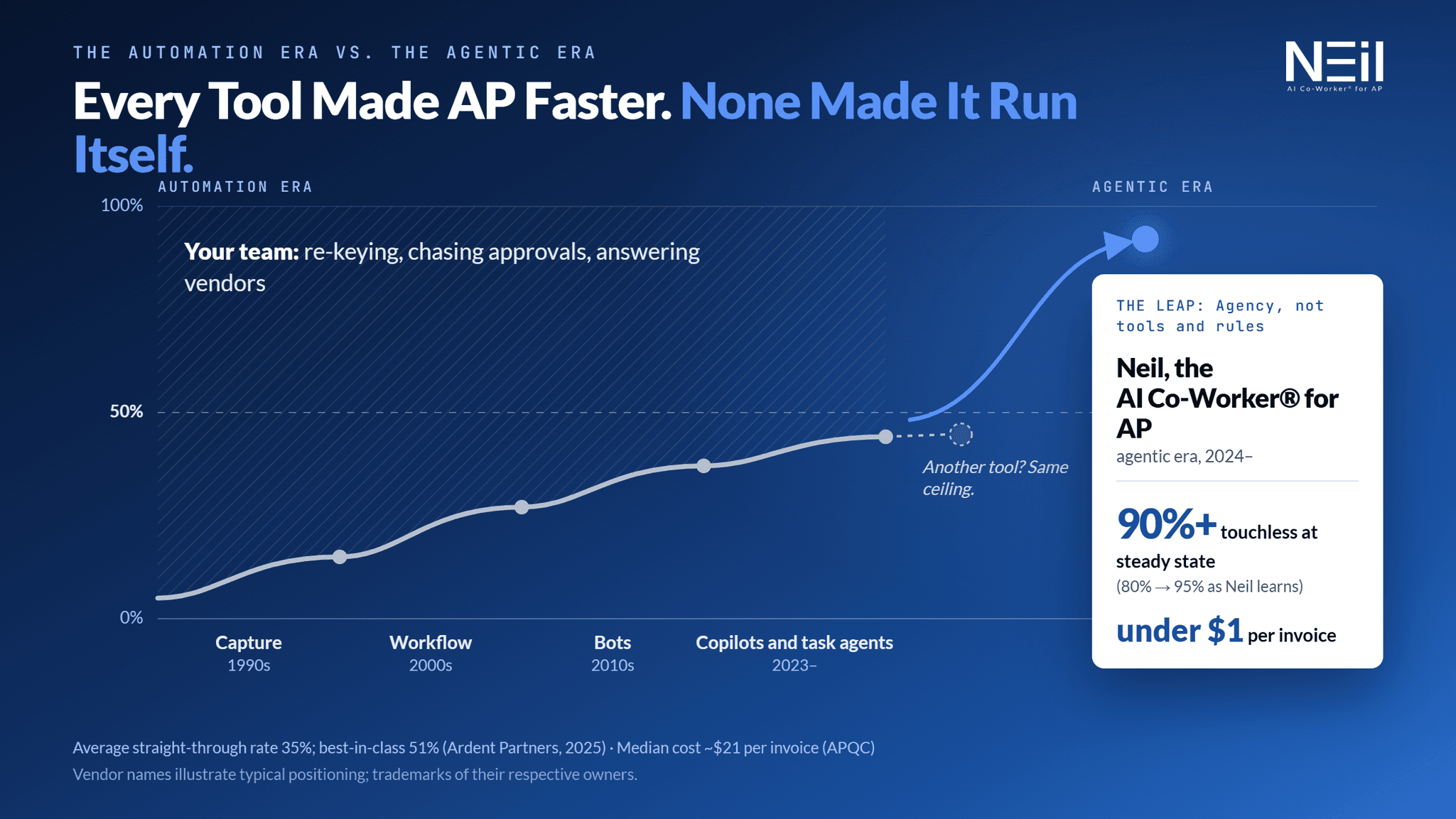
The first four waves are the automation era: tools you operate, and they plateau. The fifth is a leap, not the next step on the same curve. Touchless processing (an invoice going from receipt to ready-to-pay with no human touch) starts at around 80% with Neil and climbs toward 95% as Neil learns your invoices, at under $1 per invoice.
Agents Are Not Agency
Almost every AP vendor now says “agent”. That makes the label useless to a buyer, so test the scope instead. Most AP agents automate a single step inside one suite or ERP: capture an invoice, suggest a general ledger (GL) code, draft a reply. An AI Co-Worker takes on a role, not a task: Neil owns the whole AP cycle across any ERP and any channel, and is accountable for every invoice.
Four questions separate the two:
- Scope: does the agent complete one step, or the whole cycle from intake to ERP posting?
- Boundary: does it stop at the edge of one suite or ERP, or work across every system you run?
- Exceptions: does it recommend a fix for a person to apply, or resolve the exception and escalate only what needs judgment?
- Learning: does it run on a shared general-purpose model, or learn your invoices so touchless keeps climbing?
What to Look for in AP Automation Software in 2026
Before shortlisting, establish where your current process loses time and what the replacement must change. Use these right criteria in every vendor conversation to select the best accounts payable automation solution.
| Evaluation criteria | What to establish |
|---|---|
| Autonomous processing | Which end-to-end activities can the system complete without a person handling each step? |
| Exception resolution | Can it investigate discrepancies, obtain missing information and resolve eligible cases, or does it mostly flag problems? |
| ERP coverage | Does it support your whole ERP estate, including multiple systems and legal entities? |
| Vendor and Internal helpdesk | Does a 24×7 multilingual helpdesk answer payment queries and retrieve missing details automatically, for vendors and your own teams? |
| Learning | Does the touchless rate keep rising on your invoice mix after go-live, or plateau once rules are tuned? |
| Operating economics | Does cost per invoice stay flat as volume and complexity grow, or does headcount grow with it? |
| Trust and control | Are there guardrails, audit trails, segregation of duties and certified security for autonomous work? |
| Time to value | How long from contract to production posting, including integration and training? |
AP Automation Software Alternatives Compared
No competitor combines all six of the capabilities that define an AI Co-Worker for AP: agency(does the work), AI-native architecture with no legacy debt, fine-tuned small language models in your environment, a 24×7 multilingual helpdesk for vendors and internal teams, 6–8 week go-live on any ERP, and global by default. Every vendor below misses at least two.
| Vendor | Where it comes from | Where it stops short |
|---|---|---|
| SAP Ariba Invoicing | SAP’s native invoicing hub | Exceptions beyond configured rules go to people; SAP-managed SaaS only |
| Oracle Fusion Payables (Payables Agent) | Agents embedded in Oracle Fusion | Validation exceptions become invoice holds that people must clear; works only inside Fusion |
| OpenText VIM | Workflow inside SAP | SAP-only; exceptions route to people by role |
| Newgen | BPM and low-code platform | AP is one application configured on a horizontal platform; OCR and workflow foundation with GenAI added |
| HighRadius | Receivables-first finance platform | GenAI AP suite launched in 2024; outcome pricing as a share of savings |
| Tipalti | Global mass payments | Agents prepare payables; payment runs funded before payments are released |
| Ramp | Corporate card and spend | Card-led platform; built for US SMB and mid-market |
| Stampli | Ap collaboration software | AI prepares the work; people approve, post and pay |
| AppZen | Expense audit | AP is a newer expansion; AP inbox focused on vendor email |
Neil vs. SAP Ariba Invoicing: Rules That Route, or Agents That Resolve?
SAP Ariba Invoicing (formerly SAP Ariba Central Invoice Management) is SAP’s native invoice hub, with large language model (LLM) capture, Joule copilot support, native posting to SAP backends and e-invoicing compliance through SAP Document and Reporting Compliance. For SAP-centric estates it is a natural option to evaluate.
The difference is what happens after capture. Ariba Invoicing auto-handles the cases you pre-configure (tolerance matches, auto-accept rules, goods-receipt re-checks); everything else becomes a task for a person. SAP now markets AI invoicing agents, including an exception agent it describes as handling exceptions“autonomously or by guiding users with resolution options”. How many of those agents are generally available, and in which tenants,is worth confirming in writing. The product is SAP-managed SaaS only, and optional multi-model extraction uses third-party LLMs.
Neil’s agents reason through exceptions and escalate only what needs judgment. Neil learns your invoices: corrections and rules are captured in your dedicated instance, and an optional dedicated model can be fine-tuned on your data, exclusively yours while licensed. Neil runs on SAP S/4HANA, SAP ECC and SAP Ariba alongside every other ERP you operate, and Neil’s agents have been in production for over a year at global multi-entity, multi-country enterprises.
Choose SAP Ariba Invoicing if you are greenfield on S/4HANA Cloud Public Edition, single-ERP, committed to Ariba and SAP Business Network, with low exception volume. Look harder at Neil if you run ECC, S/4HANA private cloud or classic Ariba, are facing a migration, run more than one ERP, or carry a heavy exception and vendor-query load.
Ask the vendor: Which invoicing agents are generally available in your tenant today, and who is live on them? When a variance exceeds tolerance, who resolves it: an agent or a person?
SAP routes exceptions to your team. Neil resolves them.
Neil vs. Oracle Fusion Payables: Holds Inside the ERP, or Exceptions Resolved Before They Land?
For an organisation standardised on Oracle Fusion, the prebuilt Payables Agent is an attractive starting point. It operates inside an established environment where systems, permissions and finance processes are already aligned, and Oracle positions it around standardised invoice processing, policy compliance and duplicate detection.
The pain starts after the invoice is in Oracle. Fusion’s invoice validation checks matching, tolerances, accounts, tax and funds, and places a system hold on the invoice for every exception it finds. A held invoice can’t be paid, and holds such as an invalid account or a distribution variance also block accounting. Oracle’s own documentation is explicit about who clears them: for many system holds, “you must correct the exception condition by updating the invoice or purchase order, and then validating the invoice to release the hold.” Each tolerance raises its own hold, so one invoice line can carry several.
In practice, that work lands on people outside the automated flow. Oracle practitioners describe AP staff and buyers who each see only part of the picture: buyers can’t release holds in the user interface, and AP often“can do little more than call the Buyer” before raising a purchase order (PO) change order, re-validating and releasing. The same Oracle user-group guidance shows how quickly the queue grows: in one worked example, tightening a single tolerance left 3,700 invoice lines on hold, against 899 with the looser setting, and teams set targets just to clear holds within 30 days. Oracle’s descriptions of the Payables Agent don’t describe it resolving these holds; exceptions are still flagged for people.
Neil works upstream of the hold. Neil’s agents validate every invoice against the PO, receipt, contract, tax rules and approval policy before posting, resolve the exception (or obtain the missing information from the vendor or buyer), and post to Oracle ready to pay. The result is 60–80% fewer exceptions, and only the cases that need judgment reach a person, with the evidence attached. Neil also covers what lives outside the ERP: vendor and internal queries, supporting documents arriving by email, and AP across entities that run on SAP, NetSuite or Microsoft Dynamics alongside Oracle.
Choose Oracle Fusion Payables if you are fully standardized on Fusion, hold volumes are low and vendor-query load is light. Look harder at Neil if your hold queue and aging report are where AP time goes, or you need one AP operating model across multiple ERP systems.
Ask the vendor: How many invoices are on hold today, how old is the oldest, and which of those holds does the Payables Agent resolve without a person?
Oracle puts exceptions on hold. Neil resolves them before they land.
Neil vs. OpenText VIM: Workflow Inside SAP, or Autonomy on Any ERP?
OpenText Vendor Invoice Management (VIM) is a mature workflow engine inside SAP with a 20-year installed base, resold by SAP. Core Capture now adds LLM extraction, and VIM supports Joule approvals. For large SAP shared-service centers, it is a proven choice.
VIM remains workflow, not autonomy: exceptions route to people by role, and the AI flags while people fix. VIM runs only inside SAP, from ECC 6 to S/4HANA, so mixed-ERP groups and non-SAP subsidiaries need a second AP tool. New countries, rules and formats mean SAP and VIM specialist hours, and OpenText’s own packaged FasTrak service is a 3-4 month OpenText Professional Services project covering invoice types for one country.
Neil’s agents resolve exceptions themselves, answer vendors and internal teams 24×7, and go live in 6–8 weeks on any ERP, including your SAP estate.
Choose OpenText VIM if you are single-ERP SAP with low change volume and a long VIM contract ahead. Look harder at Neil if you face a VIM renewal, an ECC-to-S/4HANA migration, post-acquisition ERP diversity, or a review of services spend.
Ask the vendor: What is the touchless rate on our invoice mix, measured after go-live, and how many consultant hours did the last VIM change take?
Neil vs. Newgen: A Purpose-Built AP Co-Worker or a BPM Platform?
Newgen’s business process management (BPM), document management and low-code capabilities support workflow automation across many business functions, with particular heritage in banking, financial services, insurance and government. Organisations already invested in the platform may be able to extend it into accounts payable.
Newgen’s AP solution is an application configured on NewgenONE, a horizontal BPM and low-code platform. Its document capture uses multi-engine OCR with voting logic, with workflow, RPA and newer GenAI agents added over time, and AP shares the platform with banking, insurance and government modules. Deployments can run through systems integrator (SI) partners, and G2 users report around four months on average to implement.
Neil uses vision models and fine-tuned small language models to read any format or language without template mapping, and coordinates the whole invoice lifecycle as agents, not as configured workflow steps.
Choose Newgen if you run NewgenONE across many processes and want AP on the same platform. Look harder at Neil if your immediate objective is AP itself, you are outside financial services, or multi-country and multilingual AP is a real requirement.
Ask the vendor: When a new vendor invoice format arrives next month, who configures it, and what does it cost? Who owns delivery: Newgen or the SI?
Newgen sells a platform. Neil delivers the AP outcome.
Neil vs. HighRadius: AP Specialist or Finance Platform?
HighRadiusis a credible agentic AI platform for finance operations, with more than 1,500 customers and 190+ agents, about 30 of them for AP (per HighRadius, October 2026). For large enterprises standardising order-to-cash, AP and treasury on one platform, it belongs on the shortlist.
Neil’s proposition is more focused: using agentic AI to run the operational work of accounts payable. HighRadius built its business on receivables from 2006 and launched its GenAI AP suite in 2024. Neil’s agents coordinate across the whole invoice lifecycle rather than treating intake, validation, matching and exceptions as separate tasks. That matters because accurate extraction does not resolve a matching discrepancy, and posting an invoice does not answer a supplier’s question about its status.
The differences buyers feel are speed, predictability and service. HighRadius’s outcome-based pricing charges $0 for implementation and $0 subscription until go-live, after which HighRadius“earns a fraction of the actual savings realised by the client”, against baselines agreed upfront. Neil goes live in 6–8 weeks on a predictable annual license and runs a 24×7 multilingual helpdesk for vendors and internal teams; HighRadius offers supplier-query and email agents, but not a 24×7 helpdesk for both.
Choose HighRadius if you are a global enterprise consolidating order-to-cash, AP and treasury on one platform. Look harder at Neil if AP itself is the priority, speed to go-live matters, or you prefer a predictable license to a share of savings.
Ask the vendor: How long will the AP deployment take, end to end, in writing? Who defines the savings baseline, and what share of savings do you pay, for how long?
An AP specialist with a predictable license, not a share of savings.
Neil vs. Tipalti: AP Automation or Global Payments?
Tipalti began in global mass payouts and grew into AP. For businesses paying large international supplier or contractor networks across many currencies, its payments capability is a genuine strength, and its newer AI agents are real.
Payment execution is only one part of accounts payable. Before an invoice is ready to pay, it has to be validated, matched against a purchase order or receipt, approved and posted, and every discrepancy needs resolving. Tipalti’s agents focus on preparing payables: capture, matching and approvals. Neil focuses on the full workload: intake, validation, matching, exception handling, ERP posting and vendor communication, then makes invoices ready to pay and tracks payment status in your ERP.
There is also a working-capital point. Tipalti requires payment runs to be funded before payments are released; funding by ACH debit takes about four business days. Neil needs no pre-funded settlement account: payments run through your existing banking and ERP process.
Choose Tipalti if mass global payouts are your primary problem and AP volume is secondary. Look harder at Neil if your bottleneck is invoice processing, tax compliance (VAT, GST, withholding tax), exception resolution or vendor queries. Neil can connect to Tipalti via API if you want to keep it for payouts.
Ask the vendor: What is your measured touchless rate on our invoice mix, and how far ahead must cash leave our account to fund each payment run?
Tipalti is payments-first. Neil is AP-first.
Neil vs. Ramp: Spend Management or Complex AP?
Ramp combines corporate cards, spend management and travel with bill pay and AP agents, and its simplicity is a real strength for US SMB and mid-market teams.
Requirements change when AP involves multiple legal entities, non-standard and multi-page invoices, complex approval chains, several currencies and ERP estates beyond basic setups. Ramp’s platform is built around its corporate card: its AP agents identify bills from vendors that accept cards and complete those card payments, and card spend is central to Ramp’s business model. Advanced workflows and multi-entity support sit on paid tiers, and there is no vendor helpdesk.
Neil’s scope is transforming AP: invoice processing, validation, matching, exception handling, ERP posting and vendor communication, in 50+ languages, multi-currency and multi-entity, with country-specific tax and statutory rules handled natively. Neil has no card program to steer how your vendors are paid.
Choose Ramp if you are US-based, card-led, and your AP is largely single-entity and English-language. Look harder at Neil if you are multi-entity, multi-currency or global, or if complex invoices and vendor queries are consuming your team.
Ask the vendor: How does the platform handle multi-page, non-PO invoices in foreign currencies, and which ERP integrations need the top tier?
Ramp is card-led. Neil is AP-first.
Neil vs. Stampli: AI Assistance or Autonomous Work?
Stampli centers its platform on collaboration and ease of use, using its AI assistant, Billy, to make human processing faster. People still drive the workflow.
Neil takes an execution-oriented approach. Neil’s specialized AI agents autonomously handle intake, 2-, 3- and N-way matching, exception resolution and ERP posting. While Stampli leaves vendor queries inside a collaboration hub for employees to answer, Neil includes a 24×7 multilingual helpdesk for vendors and internal teams, covering 50+ languages.
Stampli’s pricing is quote-based and keyed to bill volume, with payments and card modules priced separately from the core AP subscription. Because people stay in every approval, exception and vendor query, AP headcount still grows with invoice volume, and some reviewers report the platform slowing at high volume. Neil scales through software agents rather than people, keeping unit cost near-flat at under $1 per invoice.
Choose Stampli if you are US-based, mostly English-language, and want to make your AP team faster rather than reduce the work it does. Look harder at Neil if invoice volume is outgrowing headcount or vendor queries are consuming your team’s time.
Ask the vendor: On invoices with discrepancies and missing information, how many steps does a person still perform, and which actions does the system complete on its own?
Stampli augments your team. Neil does the work.
Neil vs. AppZen: Auditing Spend or Doing AP Work?
AppZen is a well-funded autonomous-finance platform with a strong record in travel and expense (T&E) audit across 500+ enterprises. Its models are tuned for audit reasoning: comparing transactions to policy and flagging risk.
AP processing (intake, exception resolution, posting and vendor communication) is a newer expansion for AppZen. Its AP Inbox Service Center, launched in April 2026, focuses on vendor email. Neil was built to do AP work end to end, and Neil’s helpdesk serves vendors and internal teams over chat as well as email, in 50+ languages, around the clock.
Choose AppZen if your primary need is expense and T&E audit, with AP secondary. Look harder at Neil if exception handling, multi-currency complexity and vendor communication dominate your AP workload. Many organisations will reasonably keep AppZen for audit and let Neil run AP.
Ask the vendor: Can you show a live AP deployment, not expense audit, with autonomous exception resolution?
Why Neil Is the AI Co-Worker® for AP
Across every comparison, the case for Neil rests on six capabilities that are easy to admire and hard to copy. No competitor combines all six.
Agency:
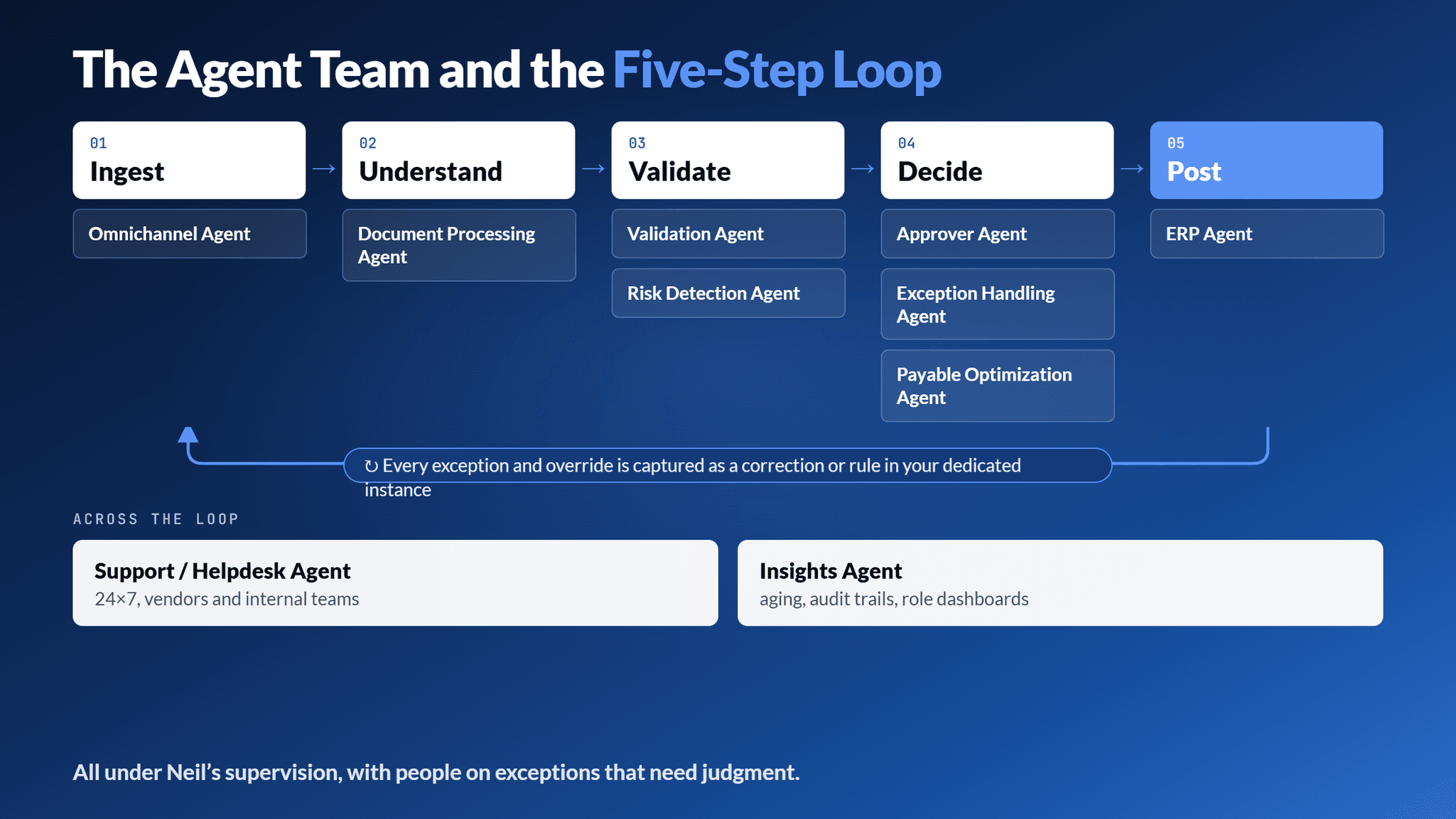
Neil supervises ten role-specialized agents that run a five-step loop (ingest, understand, validate, decide, post) and involve a person only for judgment calls. Every exception and decision is captured as a rule in your dedicated instance, making Neil smarter per customer, invoice, and day without training shared models.
AI-native, with no legacy debt.
Built entirely without legacy AP baggage like OCR, workflow, RPA, or BPM stacks. This results in faster adaptation to new formats, languages, and regulations, with all engineering effort focused purely on agentic AP.
Cost-Efficient Small Language Models
Neil’s agents run on specialized small language models fine-tuned per role, rather than depending on a single general-purpose frontier model.NVIDIA researchers argue that small models are “the future of agentic AI” for repetitive, specialised calls, and estimate they can be 10–30× more cost-effective, provide protection from token-price swings, and enable flexible deployment on E42's cloud, private cloud, or on-premises.
24×7 Multilingual Helpdesk
An automated helpdesk that answers supplier and internal queries—such as payment status, remittances, GRN mismatches, and missing documents—via chat and email in over 50 languages, resolving 90%+ of queries within seconds.
Fast Deployment & Universal ERP Integration
Goes live in 6–8 weeks across 20+ ERPs (including SAP, Oracle, NetSuite, and QuickBooks) using built-in API gateways and MCP connectors, accepting invoices seamlessly from any channel like email, portals, SFTP, EDI, or paper scans.
Global Readiness & Enterprise Trust
Ready out-of-the-box for multi-currency, multi-entity, 50+ languages, and global e-invoicing mandates, all protected under an enterprise-grade trust layer featuring guardrails, immutable audit trails, Vortex governance, and top-tier security certifications like SOC 2 Type II and ISO/IEC 27001.
All of it runs under an enterprise-grade trust layer: guardrails, segregation of duties, immutable audit trails, observability and drift detection, with every model call governed by Vortex, E42’s enterprise AI gateway. Neil is ISO/IEC 27001 and SOC 2 Type II certified and GDPR-compliant, with ISO/IEC 42001 in progress.
Proof: AP That Runs Itself, in Production
Neil is live at 45+ customers and has processed 10M+ invoices. Three global enterprises chose Neil for three different reasons:
- A global media and analytics enterprise (complexity): re-architected global AP into a Control Tower across 36+ countries and 50+ languages, on three ERPs including SAP. Live in 8 weeks, with >99.9% cash-leak prevention.
- A large global manufacturer (volume): 100,000 invoices a month at 95% straight-through processing, so AP never slows production.
- A global pharmaceutical manufacturer (compliance): 50,000 invoices a month, moved from sample-based manual quality checks to 100% AI validation, audit-ready across fragmented systems.
Neil won the Accenture TechNext Challenge 2026 (Finance).
How to Evaluate Neil Against Your Current AP Software
| Metric | What to measure | Typical today | Neil |
|---|---|---|---|
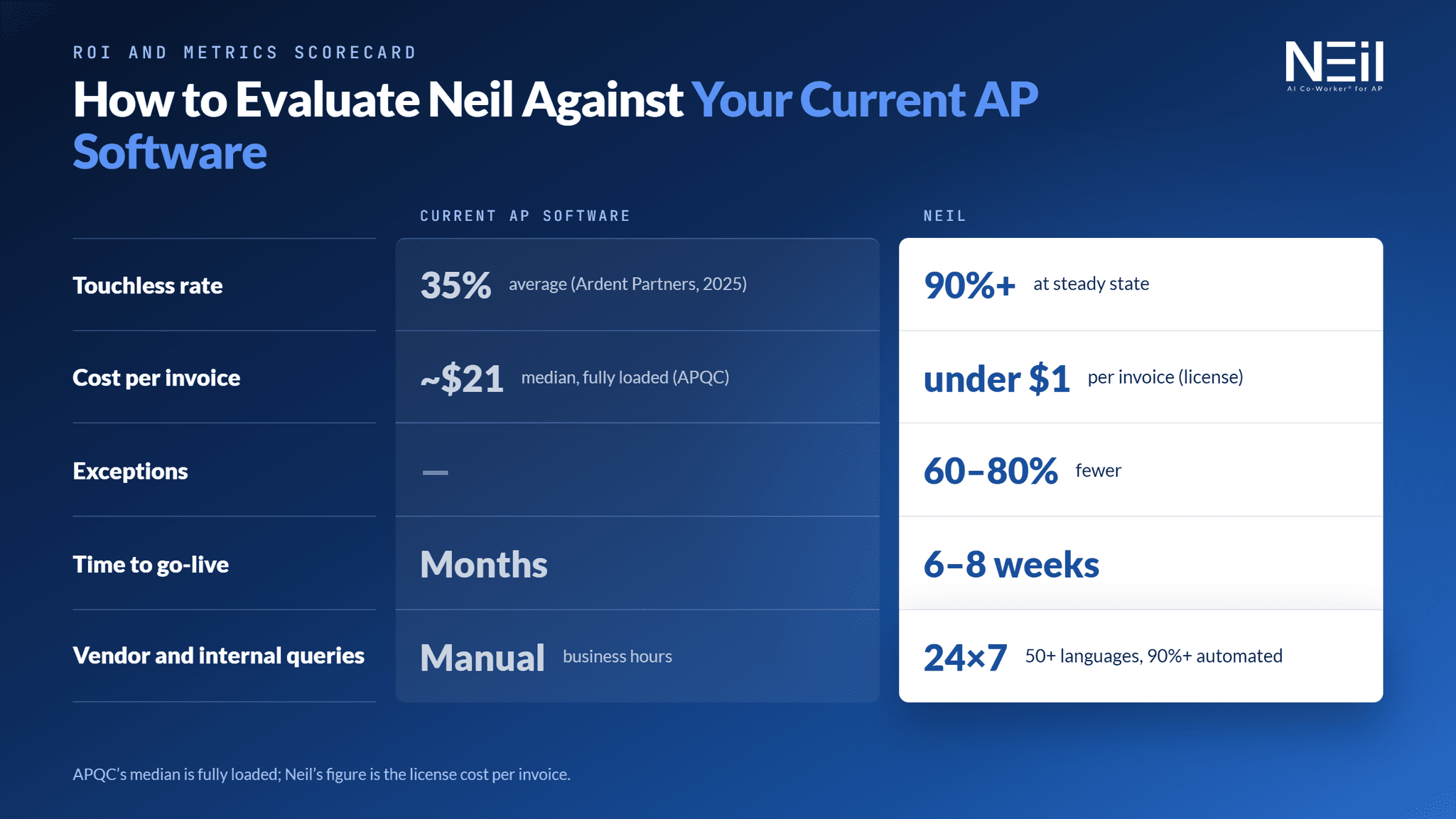
| Touchless rate | % of invoices from receipt to ready-to-pay with no human touch | 35% average; 51% best-in-class (Ardent Partners, 2025) | 90%+ at steady state; climbs from ~80% toward 95% as Neil learns |
| Cost per invoice | Cost to process each invoice | ~$21 median, fully loaded (APQC) | Under $1 per invoice (Neil license)¹ |
| Exceptions | Invoices needing manual intervention or on hold | About two-thirds of invoices are not straight-through (Ardent Partners, 2025) | 60–80% fewer exceptions² |
| Extraction accuracy | Field-level accuracy on your documents | Varies by tool and document | 99%+ field-level |
| Processing time | Time from receipt to ready-to-pay | Days | Minutes; under 30 seconds per page at a global media enterprise, from 24 hours |
| Duplicate and fraud catch | Duplicate and anomalous invoices intercepted before payment | Varies | Above 99.9%³ |
| Vendor and internal queries | % resolved without a person, and how fast | Manual, in business hours | 90%+ within seconds, 24×7, 50+ languages³ |
| Time to go-live | Contract to production posting | Months | 6–8 weeks |
Is Neil the Right AP Automation Alternative for Your Business?
Automation made AP faster; agency makes AP run itself. Where other platforms read, route or suggest, Neil’s supervised agents decide and act: coordinating work across the invoice lifecycle, resolving exceptions within defined boundaries, posting to any ERP and answering vendors around the clock in their own language. Neil’s AI-native architecture, fine-tuned small models and enterprise-grade trust layer are what make that autonomy production-ready.
The case is strongest for organizations that have already automated invoice capture and approvals but still depend on people to investigate discrepancies, chase information and answer suppliers, particularly multi-country, multi-ERP and high-growth estates.
Move your AP from automation to agency. Talk to the Neil team and set your go-live date. Neil is live in 6–8 weeks.
FAQs
Automation follows fixed scripts and requires human intervention for exceptions. Agency means the system reasons, decides, and acts end-to-end, with humans stepping in only to supervise true judgment calls.
What is the difference between automation and agency in accounts payable?
Automation follows fixed scripts and requires human intervention for exceptions. Agency means the system reasons, decides, and acts end-to-end, with humans stepping in only to supervise true judgment calls.
Is Neil a good alternative to existing AP automation software?
Yes, for organizations wanting end-to-end execution rather than just faster invoice processing. Neil handles intake, validation, matching, exception resolution, ERP posting, and vendor communication.
How is Neil different from AP software that now has AI agents?
Most AP tools automate a single step inside one suite. Neil coordinates a team of specialized agents across the entire AP cycle, across any ERP and channel, resolving exceptions instead of routing them back to humans.
Can Neil work with SAP and Oracle?
Yes. Neil is ERP-agnostic and live on 20+ ERPs, including SAP S/4HANA, SAP ECC, SAP Ariba, Oracle Fusion, Microsoft Dynamics, NetSuite, Workday, QuickBooks, Tally and Zoho, through a built-in API gateway, MCP connectors, or flat-file and SFTP.
What is Neil’s implementation timeline?
Neil goes live in 6 to 8 weeks.
What touchless rate and cost per invoice should I expect?
Neil delivers 90%+ touchless processing at steady state, at under $1 per invoice in license cost. Touchless typically starts around 80% and rises toward 95% as Neil learns your invoices, from corrections and rules captured in your dedicated instance. One large manufacturer runs at 95% straight-through processing on 100,000 invoices a month.
Is Neil secure enough for enterprise finance data?
Yes. Neil is ISO/IEC 27001 and SOC 2 Type II certified, GDPR-compliant and VAPT-tested (CERT-In), with ISO/IEC 42001 certification in progress. Each customer’s data is isolated in a dedicated instance with its own database, encrypted (AES-256, TLS 1.3) and never used to train shared models. Neil deploys on E42’s cloud, your private cloud or on-premises.