


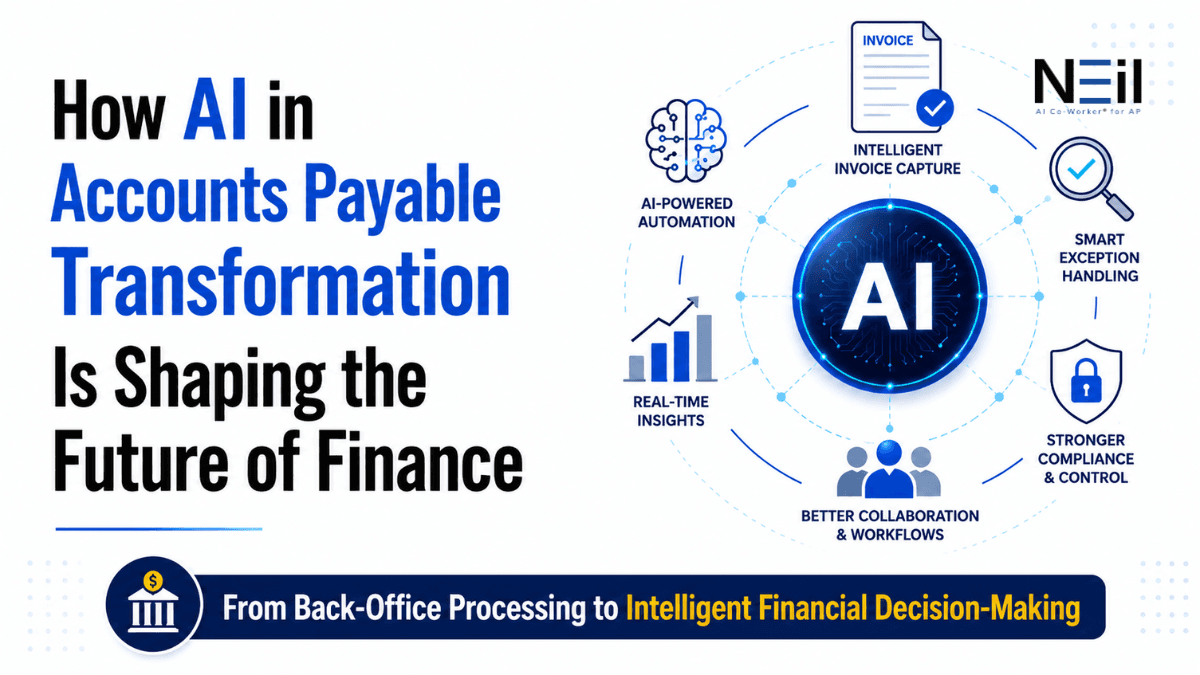
Finance is undergoing its most significant structural transformation in decades. CFOs are no longer just stewards of financial records; they are expected to be architects of organizational intelligence, delivering real-time forecasting, proactive risk management, and strategic insight at scale.
The pressure is immense. Global supply chains are increasingly complex, economic volatility demands faster decisions, and regulatory requirements grow more intricate every year. Yet, many enterprise finance teams still spend the majority of their operational bandwidth on tasks that should have been automated years ago: manual invoice matching, approval chasing, exception resolution, and month-end reconciliation.
AI in accounts payable (AP) is changing this equation. What began as a conversation about reducing manual invoice processing is now a broader transformation toward autonomous finance: self-learning, self-correcting, and continuously intelligent financial operations.
This article explores how AI in AP is becoming the foundation of accounts payable transformation, and what the future of intelligent finance operations looks like.
Why AI in AP Is Becoming the Foundation of Autonomous Finance
Accounts payable sits at the intersection of every major financial workflow. It touches supplier relationships, cash management, spend analytics, working capital strategy, and compliance simultaneously. That makes it far more than a back-office processing function.
For years, AP was treated as a cost center to minimize. AI is repositioning it as a source of strategic intelligence. Every invoice that flows through an AP system carries embedded business data: payment terms, vendor behavior, pricing trends, exception patterns, and cash flow signals. Rule-based automation could process these invoices; AI can extract meaning from them.
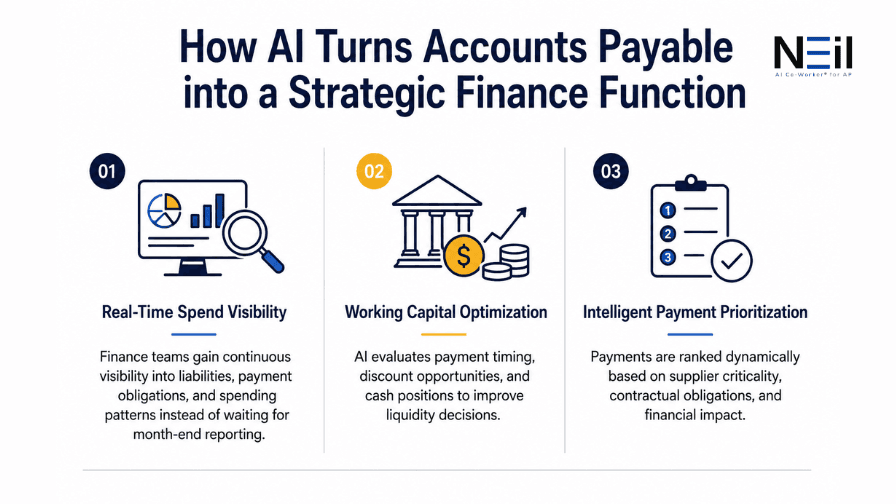
What AI-powered AP enables at a strategic level:
- Spend visibility in real time: Rather than waiting for a monthly close, finance teams can see where capital is flowing across the organization at any given moment.
- Working capital optimization: AI models can dynamically recommend early payment discounts versus payment deferral based on current cash positions and forecasted obligations.
- Cash flow forecasting: Invoice pipelines become predictive inputs, enabling finance teams to model cash needs with greater precision and earlier lead time.
- Payment prioritization: AI can autonomously rank payment urgency based on contractual terms, discount windows, supplier criticality, and liquidity positions.
According to the 2025 Gartner AI in Finance Survey, accounts payable process automation is the second most adopted AI use case in finance functions, implemented by 37% of organizations surveyed — trailing only knowledge management.
From Invoice Processing to Intelligent Financial Decision-Making
The gap between traditional AP automation and AI-driven AP is best understood as the gap between data processing and decision intelligence.
Traditional automation asks: Did this invoice match the purchase order?
AI asks: Should this invoice be approved, flagged, escalated, deferred, or renegotiated — and why?
That distinction has profound implications for how finance teams operate.
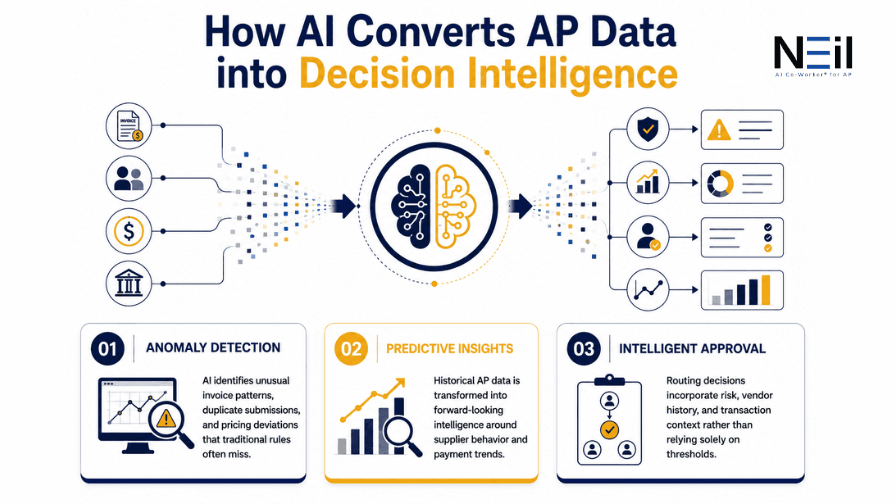
How AI converts Accounts Payable data into decision intelligence:
Anomaly Detection
AI goes beyond rule-based matching to identify statistically unusual invoices—such as duplicate submissions with slight format variations, vendors inflating unit prices by 3%, or invoices timed to coincide with audit periods. AI catches patterns that no human reviewer could hold in working memory across thousands of transactions.
Predictive Insights
AI turns historical AP data into forward-looking intelligence. It identifies which vendors are likely to submit late invoices next quarter or where payment terms are consistently misaligned with cash positions, surfacing patterns before they become operational problems.
Intelligent Approvals
AI routes exceptions not just by value thresholds, but by context—including vendor history, category risk, spend pattern deviations, and organizational hierarchy. This reduces unnecessary escalations while improving decision accuracy.
Spend Analysis and Supplier Risk
AI gives procurement and finance a shared intelligence layer. It continuously analyzes spend across categories, identifies consolidation opportunities, and flags supplier concentration risk before it becomes a supply chain vulnerability.
The Rise of AI Co-Workers in Accounts Payable Transformation?
One of the most significant conceptual shifts in enterprise AI is the move from tools to co-workers. AI is no longer just software that executes rules — it is becoming an active participant in financial workflows.
Neil, our AI Co-Worker for Accounts Payable Transformation is built specifically for AP and finance operations. Unlike traditional automation tools that execute fixed rules, Neil understands the intent behind workflows, adapts to exceptions, and manages entire end-to-end processes with minimal human intervention.
What Neil Does as an AI Co-Worker
- Manages invoice approvals: Neil routes invoices through the right approval chains, escalates exceptions with relevant context, and follows up automatically on pending actions.
- Handles vendor communication: Neil responds to supplier queries, sends payment status updates, and manages exception resolution conversations — reducing the manual burden on AP teams.
- Supports audit readiness: Neil maintains complete audit trails, flags compliance gaps in real time, and generates documentation packages on demand.
- Drives finance reporting: Neil produces AP performance summaries, spend analytics, and cash flow snapshots — delivered as conversational responses, structured reports, or live dashboards.
- Orchestrates exception management: When invoices fall outside policy parameters, Neil investigates, applies resolution logic, and only escalates when genuine human judgment is required.
The human-AI collaboration model that Neil enables is fundamentally different from legacy automation. Finance teams do not manage Neil through configuration screens; they interact with it conversationally, delegate tasks to it, and rely on it to manage workflows end-to-end..
Key Generative AI Capabilities Neil Brings:
- Conversational analytics: Ask questions about spend, cash flow, or vendor performance in plain language.
- AI-generated summaries: Automated AP performance narratives, exception reports, and board-ready insights.
- Policy interpretation: Neil applies finance policy rules contextually across complex invoice scenarios.
- Reporting automation: Structured reports generated on demand, eliminating manual compilation.
- Intelligent recommendations: Neil proactively surfaces optimization opportunities, not just answers to questions.
How Neil Drives Autonomous Finance:
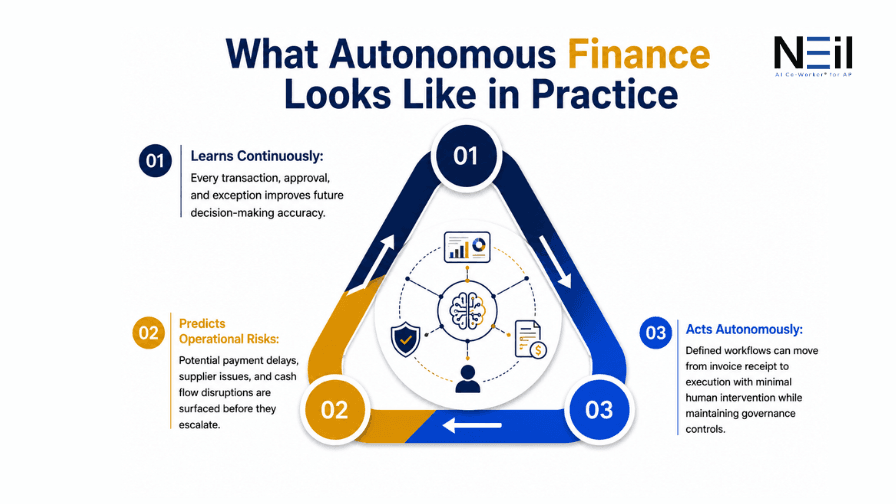
- Learns: Neil continuously improves from transaction data, exception patterns, and approval decisions — becoming more accurate and efficient over time.
- Predicts: Neil anticipates payment delays, cash flow gaps, and supplier risks before they materialize, enabling proactive rather than reactive management.
- Recommends: Neil surfaces optimization opportunities — early payment discounts, supplier consolidation, payment scheduling adjustments — with supporting data.
- Acts: For defined workflow categories, Neil executes end-to-end without human intervention — from invoice receipt through payment release.
Business Impact of AI Adoption in Accounts Payable Transformation
The business case for AI-led finance operations is backed by clear market metrics:
- 25-40% reduction in AP operating costs with AI automation.
- Amongst 1,326 finance leaders, 21% report measurable value.
Future Trends Shaping AI-Powered Finance Operations
Several emerging capabilities will reshape what is possible over the next three to five years:
- Agentic AI: AI agents will move beyond assistance into autonomous execution, handling vendor negotiations and dynamic payment scheduling within defined governance boundaries without human initiation.
- Self-Healing Workflows: Systems will automatically detect and correct process failures—such as broken integrations, format changes from vendors, or regulatory updates—without requiring manual IT support tickets.
- Multimodal AI: This will expand the types of financial data AI can process, incorporating voice-based queries, image-based contract analysis, and video-based audit documentation into the intelligent finance stack.
How Enterprises Can Prepare for AP Transformation
- Identify Automation-Ready Workflows: Start with high-volume, rule-driven workflows like invoice processing and three-way matching where the business case is clear.
- Invest in Finance Data Quality: Clean data is the ultimate precondition for AI success. Prioritize vendor master cleansing and invoice data standardization.
- Create Governance Frameworks: Define clearly which decisions AI can make autonomously and which require human escalation. Governance is what makes AI trustworthy at scale.
- Train Finance Teams for AI Collaboration: Help finance professionals shift their skill sets from transaction management to strategic data interpretation.
Conclusion
The conversation about AI in accounts payable has moved well beyond invoice automation. What is emerging and accelerating is the transformation of finance from a periodic, transactional function into a continuous, intelligent, strategically positioned capability.
The organizations that understand this shift are not asking whether to invest in AI for finance. They are asking how to move faster, how to build the right foundations, and how to position AI as strategic infrastructure rather than point-solution tooling.
The future finance function will be predictive rather than retrospective. It will be autonomous in execution and strategic in focus. It will operate in real time rather than in monthly cycles. And it will be powered by AI co-workers that handle the transactional complexity that currently consumes the time and attention of skilled finance professionals.
The window for building meaningful competitive advantage through AI-led finance operations is open — but it will not remain open indefinitely. The organizations that act with intention today will define what best-in-class finance looks like for the next decade.
Frequently Asked Questions
AI in accounts payable is transforming finance from a periodic, transactional function into a continuous, intelligence-driven operation. By automating invoice processing, enabling predictive cash flow insights, and deploying AI agents that handle end-to-end workflows, AI is positioning AP as the strategic data infrastructure of the modern finance function.
How is AI in accounts payable shaping the future of finance?
AI in accounts payable is transforming finance from a periodic, transactional function into a continuous, intelligence-driven operation. By automating invoice processing, enabling predictive cash flow insights, and deploying AI agents that handle end-to-end workflows, AI is positioning AP as the strategic data infrastructure of the modern finance function.
How does AI improve financial decision-making?
AI improves financial decision-making by converting transactional AP data into actionable intelligence — anomaly detection, predictive spend analysis, supplier risk signals, and cash flow forecasting — enabling finance teams to make faster, better-informed decisions with greater confidence.
How do AI co-workers support finance teams?
AI co-workers handle high-volume, routine finance workflows — invoice approvals, vendor communication, exception resolution, audit documentation — autonomously and continuously. This frees human finance professionals to focus on strategic analysis, supplier strategy, and business partnership rather than transactional processing.
Can AI help reduce invoice fraud and payment risks?
Yes. AI-powered fraud detection analyzes every invoice against full transaction history simultaneously, identifying duplicate submissions, unusual payment patterns, and vendor inconsistencies that manual review would miss. Organizations using AI-driven fraud prevention report a 37% reduction in financial losses from fraudulent activity.
How does AI enable real-time finance operations?
AI enables real-time finance by processing and analyzing data continuously rather than at periodic intervals. This supports live cash position dashboards, continuous cash flow forecasting, instant exception resolution, and dynamic payment prioritization — replacing the monthly cycle model with always-current financial intelligence.