


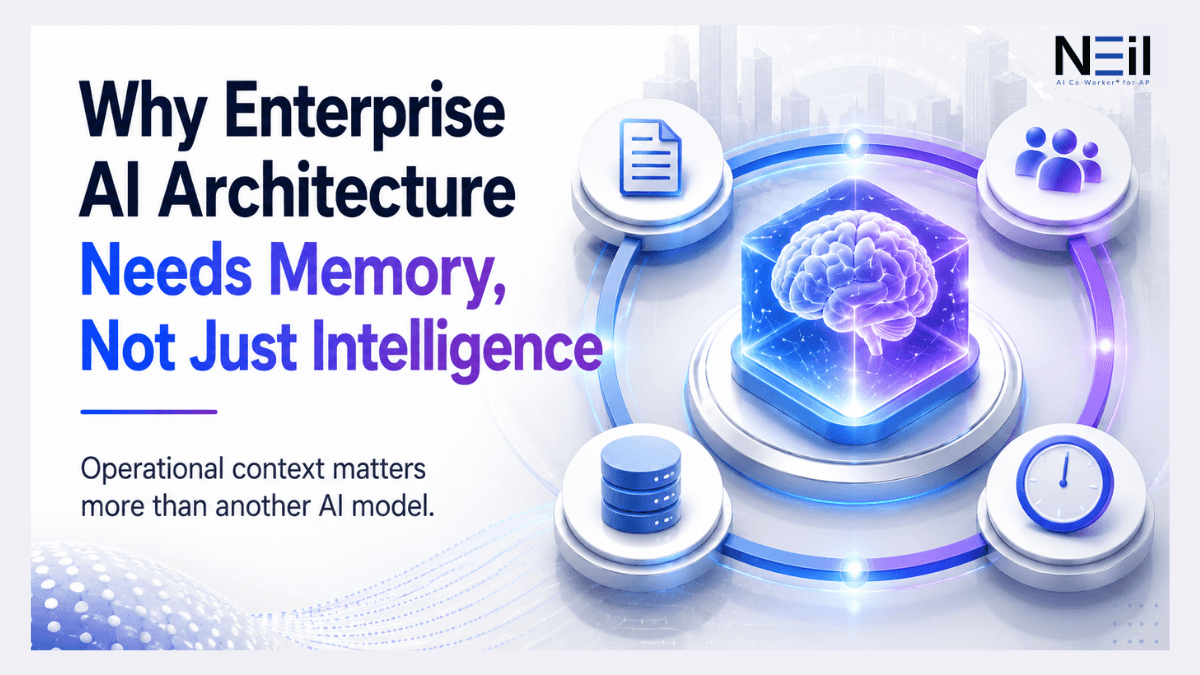
Enterprise AI architecture is the framework that connects AI models, workflow context, governance, and organizational memory so that operational decisions stay consistent over time. Without that framework, even the most advanced language model behaves like a new hire on their first day, capable, but starting from zero on every task.
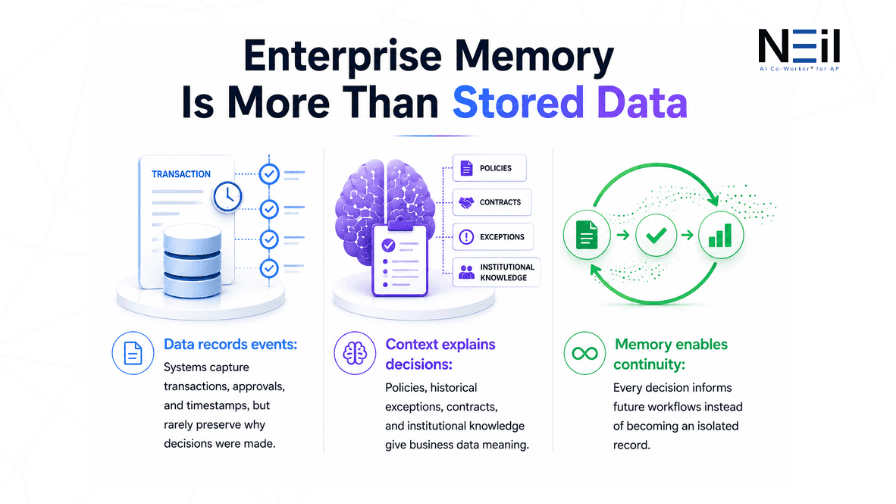
For decades, enterprise software has been optimized around one objective: capturing transactions. Every ERP, procurement platform, CRM, and finance application excels at recording what happened, when it happened, and who was responsible. As organizations digitized, the volume and quality of transactional data improved dramatically. Yet despite increasingly sophisticated systems, enterprises continue to rely on emails, spreadsheets, chat messages, meeting notes, and experienced employees to make operational decisions.
This disconnect exposes a subtle but important limitation. Enterprises have become exceptionally good at storing data but remain surprisingly poor at preserving context. The reasoning behind a vendorexception, the history of a disputed invoice, or the circumstances that justified bypassing a standard approval workflow often disappear once the immediate issue is resolved. The transaction survives. The memory does not.
What Is Enterprise AI Architecture?
Enterprise AI architecture is the underlying system design that lets AI models operate reliably inside a business, combining language understanding, deterministic business rules, workflow state, governance controls, and persistent organizational memory into one coordinated environment. Unlike a standalone model or chatbot, it is built to make every decision explainable, auditable, and consistent with the decision made before it.
Put simply: intelligence is what a model can understand today; architecture is what makes an enterprise more capable tomorrow.
Why Enterprise Systems Lose Organizational Memory
The distinction between storing data and preserving context matters because operational decisions rarely exist in isolation. Every exception inherits context from previous events, organizational policies, contractual obligations, and institutional knowledge accumulated over years. Without that context, enterprise software repeatedly encounters familiar situations as though they were entirely new problems.
This is not a hypothetical gap. Deloitte's 2026 State of AI in the Enterprise survey of over 3,000 IT and business leaders found that around 80% of organizations still lack a mature governance model for agentic AI, meaning most companies cannot yet reliably track which decisions an AI system is authorized to make on its own versus which require human sign-off. Memory and governance are two sides of the same problem: an AI system cannot govern what it cannot remember.
Why Memory Is an Architectural Property, not a Database Feature
When engineers discuss memory, they often think about storage capacity or database persistence. Enterprise memory is fundamentally different. It is less concerned with retaining information than with preserving meaning across time, people, and processes.
Distributed systems offer a useful analogy. A distributed database does not simply replicate data across nodes. It also maintains consistency, ordering, conflict resolution, and state synchronization. Without those mechanisms, identical datasets can produce contradictory outcomes. Enterprise operations face an analogous challenge. Business processes span departments, applications, jurisdictions, and approval hierarchies. The difficulty is not storing individual decisions but maintaining a coherent operational state as those decisions evolve.
Three characteristics distinguish genuine enterprise memory:
- Operational continuity: Every decision should inherit relevant context from previous workflow states rather than beginning with an empty history.
- Institutional persistence: Business knowledge should survive employee transitions instead of remaining embedded in individual experience.
- Governed interpretation: Context must remain traceable, auditable, and aligned with organizational policies rather than depending on informal assumptions.
These characteristics explain why organizations with identical ERP implementations often produce dramatically different operational outcomes. Competitive advantage frequently emerges from accumulated organizational knowledge rather than software configuration alone.
The Hidden Cost of Stateless Automation
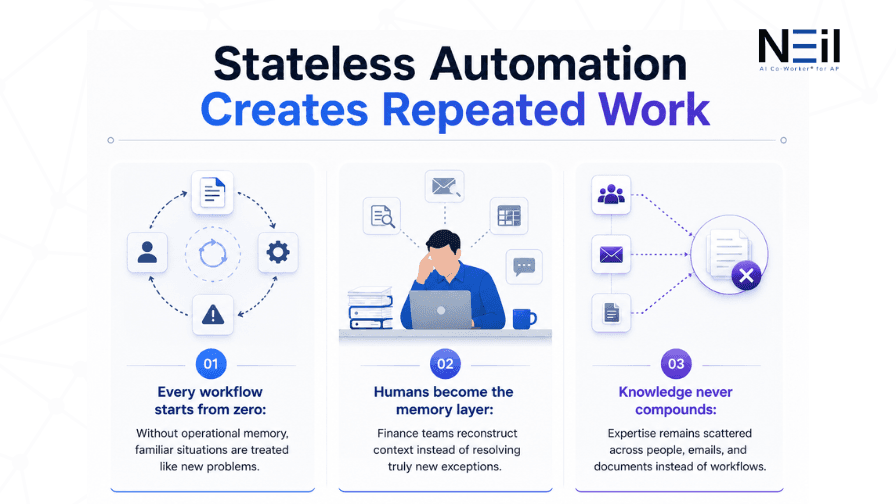
Much of enterprise automation has historically focused on accelerating repetitive tasks. Documents are classified, fields are extracted, validations are executed, and predefined rules determine the next action. These capabilities undoubtedly improve efficiency, but they largely treat each workflow instance as an independent event.
Accounts payable illustrates this limitation particularly well. Two invoices may appear structurally identical while representing entirely different business situations. One vendor may have an established payment exception due to contractual terms negotiated years earlier. Another invoice may require additional scrutiny because previous deliveries consistently contained pricing discrepancies. Neither distinction is obvious from the document itself.
Manufacturing provides an instructive comparison. Modern production lines do not merely monitor machine outputs; they continuously incorporate historical maintenance records, equipment behavior, environmental conditions, and previous failure patterns into operational decisions. Enterprise workflows demand a similar understanding of historical state. Automation that ignores accumulated operational memory eventually shifts complexity back to human operators, who become the living repository of organizational context.
This explains why experienced finance professionals routinely resolve situations that appear ambiguous to software. They are not simply interpreting invoices. They are reconstructing years of organizational memory before making a decision.
| Traditional Systems | Memory-Driven Enterprise AI |
|---|---|
| Stores transactions | Preserves context |
| Executes fixed rules | Learns from historical workflows |
| Treats decisions in isolation | Makes context-aware decisions |
| Relies on manual exception handling | Applies intelligent exception resolution |
| Knowledge stays with individual employees | Knowledge becomes organizational memory |
Context Is Distributed Across the Enterprise
Organizational memory rarely exists in one system. Instead, it is fragmented across applications, documents, conversations, policies, and human expertise. Every department contributes part of the enterprise’s operating context, yet no single application possesses a complete view.
This resembles an operating system coordinating multiple independent processes. Individual applications execute their own responsibilities, but the operating system maintains shared state, schedules execution, resolves conflicts, and ensures consistent behavior across the entire environment. Enterprises face an equivalent orchestration challenge. Procurement, finance, legal, compliance, and supplier management each maintain partial knowledge that only becomes meaningful when interpreted collectively.
Several architectural capabilities become essential when enterprise memory is treated as a systems problem rather than a storage problem:
- Workflow state awareness: Decisions should incorporate historical process progression instead of evaluating isolated events.
- Knowledge persistence: Policies, exceptions, and operational decisions should accumulate into reusable organizational context.
- Deterministic governance: Every recommendation should remain explainable through traceable business rules, evidence, and historical reasoning.
- Exception intelligence: Human attention should focus on genuinely novel situations instead of repeatedly resolving familiar operational patterns.
The objective is not to eliminate human judgment. It is to ensure that human expertise compounds rather than evaporates after every completed workflow.
Why Large Language Models Alone Cannot Solve Enterprise Operations
Large language models have significantly expanded what enterprise software can understand from unstructured information. They interpret documents, summarize conversations, extract entities, and generate natural language explanations with remarkable flexibility. These capabilities represent meaningful progress, but they should not be mistaken for enterprise memory.
A language model predicts probable responses from learned statistical relationships. Enterprise operations demand something fundamentally different. They require deterministic reasoning grounded in workflow state, business policies, historical decisions, regulatory obligations, and continuously evolving organizational knowledge. These requirements extend beyond language understanding into systemsarchitecture.
Control theory Control theory offers a useful comparison. A controller does not simply observe current inputs. It continuously evaluates system state, historical behavior, predefined constraints, and expected outcomes before determining the next action. Enterprise AI requires an equivalent architectural discipline. Language understanding is one component within a broader operational system that must prioritize consistency, governance, and accountability over probabilistic fluency.
This distinction increasingly defines the difference between experimental AI deployments and enterprise-grade operational systems.
LLM vs. Enterprise AI Architecture
| LLM (Standalone) | Enterprise AI Architecture |
|---|---|
| Predicts text | Supports business decisions |
| General-purpose reasoning | Policy-driven reasoning |
| Temporary, session-based context | Persistent operational memory |
| No workflow awareness | Workflow state awareness |
| Limited governance | Auditable and explainable by design |
How Multi-Agent Enterprise AI Preserves Organizational Memory
Once enterprise memory is recognized as an architectural capability, the requirements for operational AI become considerably clearer. Rather than relying on a single generalized model to perform every task, organizations benefit from architectures where specialized capabilities collaborate while remaining governed by consistent operational oversight; .a pattern Gartner refers to as proportional, autonomy-based governance rather than a single uniform control layer applied to every AI agent. Gartner's own research warns that treating agent governance as one-size-fits-all is a leading cause of enterprise AI agent failure, and it projects that by 2027, 40% of enterprises will demote or decommission autonomous AI agents because governance gaps only surfaced after something went wrong in production.
Modern enterprise AI increasingly relies on this kind of supervised, multi-agent architecture to preserve workflow state, governance, and operational memory. Instead of one model attempting every task, a supervising layer coordinates specialized agents, each responsible for a narrow piece of the process, while a shared memory layer keeps them aligned.
Neil, the AI Co-Worker® for Accounts Payable, reflects this architectural direction. Instead of approaching invoice processing as a sequence of disconnected automation steps, Neil supervises specialized AI agents responsible for invoice intake, document understanding, validation, purchase order matching, vendor verification, approvals, exception handling, ERP synchronization, and vendor communication. Each agent performs a focused operational responsibility while contributing to a shared understanding of workflow state.
This supervised multi-agent architecture allows Small Language Models (SLMs), deterministic validation logic, enterprise policies, and historical operational context to work together rather than compete for decision authority. Governance remains embedded throughout the workflow through audit trails, explainable reasoning, orchestrated decision paths, and human intervention reserved for meaningful exceptions instead of routine processing.
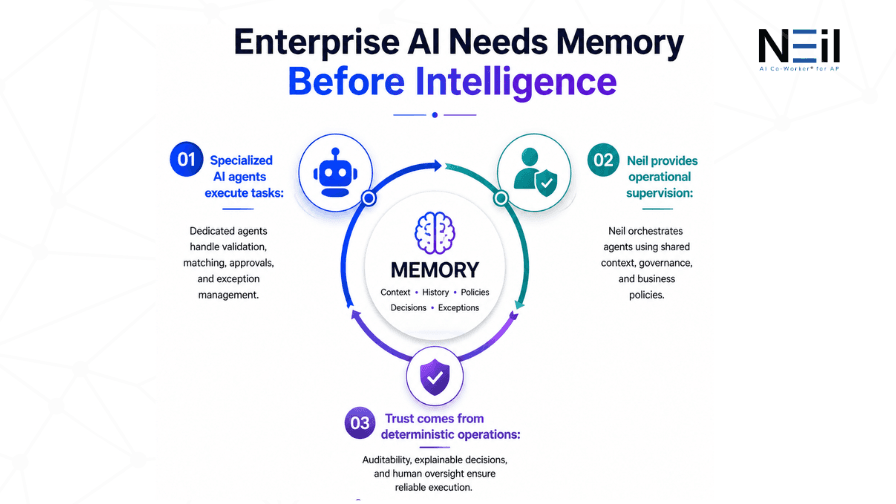
The result is not simply faster invoice processing. It is an operational environment where organizational knowledge accumulates over time instead of being recreated with every transaction.
Building Enterprise AI That Learns from Every Decision
The next phase of enterprise AI is unlikely to be defined by larger models or more sophisticated prompts. Those developments will continue, but they address only one dimension of the problem. The more consequential shift will occur when enterprise systems begin preserving operational memory with the same rigor that they preserve financial records.
Organizations have long understood that data is an enterprise asset. The more difficult realization is that context is equally valuable, because it determines how that data is interpreted, governed, and acted upon. Enterprises that successfully capture organizational memory will not simply automate existing workflows more efficiently. They will create operational systems that become progressively more informed, more consistent, and more resilient as experience accumulates.
That is a different way of thinking about enterprise AI altogether. Intelligence may determine what a system can understand today, but memory determines whether the organization becomes more capable tomorrow.
FAQs
Enterprise AI architecture is the system design that combines AI models, workflow context, governance controls, and organizational memory so that operational decisions remain consistent, explainable, and auditable across the business — rather than relying on a single model to reason from scratch each time.
What is enterprise AI architecture?
Enterprise AI architecture is the system design that combines AI models, workflow context, governance controls, and organizational memory so that operational decisions remain consistent, explainable, and auditable across the business — rather than relying on a single model to reason from scratch each time.
Why does enterprise AI need memory?
Without memory, every AI-driven decision starts from zero, ignoring prior exceptions, vendor history, and organizational policy. Enterprise memory lets each new decision inherit relevant context from previous workflow states, reducing repeated errors and inconsistent outcomes.
How is enterprise memory different from a database?
A database stores records. Enterprise memory preserves meaning — the reasoning, policies, and historical context behind those records — so that context stays consistent and traceable across time, people, and processes, similar to how a distributed system maintains state consistency rather than just replicating data.
Can LLMs replace enterprise memory?
No. LLMs are strong at interpreting unstructured information, but they predict responses from statistical patterns rather than persisting deterministic, policy-grounded organizational knowledge. Enterprise memory requires a broader systems architecture — workflow awareness, governance, and historical state — that sits alongside the model, not inside it.
How does enterprise AI make operational decisions?
It combines language understanding with deterministic validation logic, historical workflow data, and enterprise policy, then routes decisions through governed, auditable paths — escalating to a human only when a situation is genuinely novel.
Why do enterprise AI systems repeat the same exceptions?
Most automation treats each workflow instance as independent, with no mechanism to recall how a similar exception was resolved before. Without persistent memory, the system — and often the human reviewing it — has to reconstruct the same reasoning repeatedly.