


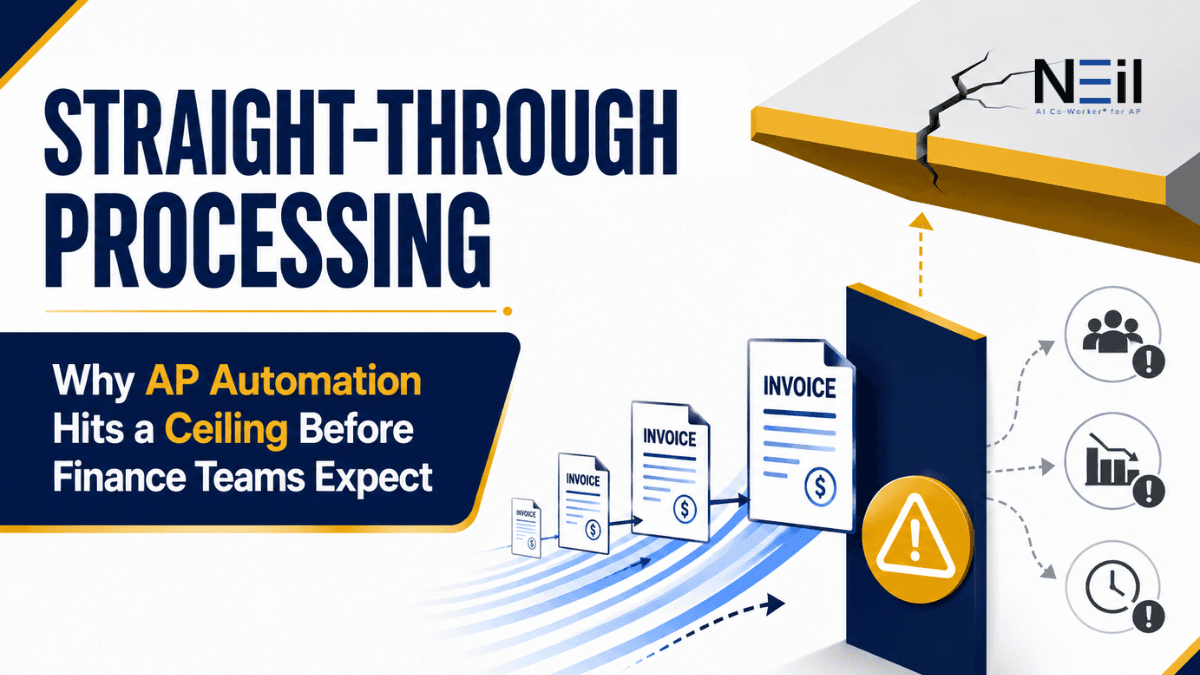
Accounts Payable automation is often evaluated through one defining metric: straight-through processing. It has become the benchmark finance leaders use to assess automation maturity because it captures a simple but powerful question: how many invoices can move from receipt to ERP posting without human intervention?
For many organizations, early automation gains create the impression that this number will continue rising predictably. Invoice capture improves, approval routing becomes digital, and standard validation rules eliminate repetitive manual checks. Straight-through processing climbs quickly. Then progress slows.
Finance teams often find themselves trapped at a plateau where meaningful improvement becomes increasingly difficult. Despite investment in automation tooling, a large share of invoices continues to require intervention because workflows begin encountering complexity that rule-based systems cannot interpret with confidence. This is where many Accounts Payable transformation efforts begin to reveal their structural limits.
The challenge is not that automation stops functioning. It is that enterprise AP environments introduce operational variability that deterministic workflows were never designed to absorb. Straight-through processing stalls when systems can execute predefined instructions efficiently but fail to reason through contextual ambiguity. The distinction matters because, at scale, straight-through processing is where AP transformation either compounds into operating leverage or regresses into exception-driven manual effort.
What Is Straight-Through Processing in Accounts Payable, How Does it Work and Why Does It Matter?
Straight-through processing in Accounts Payable refers to the percentage of invoices that move through the entire payable workflow without requiring human intervention. This includes invoice ingestion, data extraction, validation, approval routing, and final ERP posting.
Unlike basic invoice automation metrics, straight-through processing reflects workflow continuity. An invoice is only considered truly straight-through when it completes the entire operational cycle autonomously. This makes it one of the clearest indicators of whether AP automation is functioning as a connected operational system rather than isolated task automation.
The most critical stages that determine AP straight-through processing include:
- Invoice extraction accuracy: Data must be captured correctly across layouts, formats, and languages.
- Validation reliability: Invoice values must align with purchase orders, goods receipt records, and tax logic.
- Workflow routing precision: Approval chains must resolve dynamically and correctly.
- ERP posting continuity: Transactions must complete without interface-level interruption.
What makes straight-through processing particularly important is its disproportionate operational leverage. A workflow may automate invoice ingestion successfully, but if invoices repeatedly fail validation or routing, overall AP efficiency remains structurally constrained.
Why Does Straight-Through Processing Stall Faster Than Finance Teams Expect?
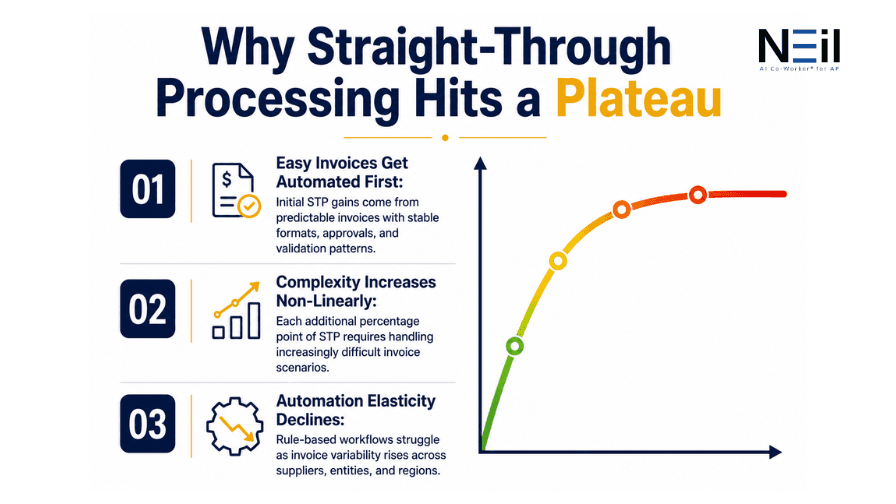
Straight-through processing rarely improves in a smooth upward curve. This is one of the least appreciated realities of enterprise AP automation.
Finance leaders often assume that if automation can move from 30 percent straight-through processing to 60 percent, reaching 80 or 90 percent should simply require incremental optimization. In practice, AP workflows behave differently.
The first gains typically come from automating predictable invoices. These invoices arrive in stable formats, follow established approval paths, and align closely with deterministic validation rules. The remaining invoices are operationally more complex, creating diminishing automation elasticity.
Consider a practical example. Suppose an enterprise processes 40,000 invoices each month. At 60 percent straight-through processing, 24,000 invoices complete autonomously while 16,000 require intervention. If the organization seeks to improve to 80 percent straight-through processing, it must automate the 8,000 most operationally difficult invoices remaining in the workflow.
These are rarely routine cases. They often involve multi-line purchase order complexity, partial receipt mismatches, regional tax interpretation, supplier-side structural variation, and approval routing ambiguity. The economics become nonlinear. Each incremental percentage point of improvement requires significantly greater contextual intelligence than the last.
This is why straight-through processing often stalls. The complexity of the remaining invoices grows faster than the capability of static workflow logic.
What Causes Straight-Through Processing to Stall in Modern AP Workflows?
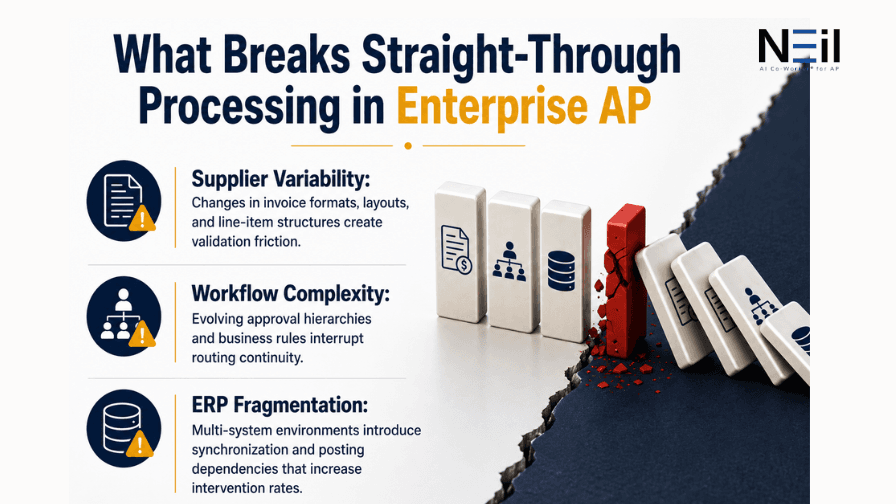
Most straight-through processing plateaus are not caused by poor automation implementation. They are caused by automation rigidity.
Manual Accounts Payable systems were designed around deterministic assumptions. They expect invoices to conform to historical templates, validation thresholds to remain static, and workflow dependencies to behave predictably. Enterprise finance rarely behaves this way.
Modern Accounts Ppayable environments introduce continuous operational variation:
- Supplier invoice variability: Vendors frequently revise formatting, field placement, and line-item structure, to avoid invoice variability.
- Regulatory complexity: Regional tax treatment evolves across jurisdictions and entities.
- ERP ecosystem fragmentation: Multi-system environments introduce posting dependencies and field-mapping complexity.
- Approval governance drift: Organizational restructuring changes workflow ownership and routing paths.
Rule-based automation interprets these deviations as workflow failure rather than operational variance requiring contextual interpretation. Instead of reasoning through uncertainty, it escalates it. This creates structural friction that interrupts straight-through processing and pushes invoices back into manual handling.
How Does Straight-Through Processing Affect AP Unit Economics?
One of the most overlooked dimensions of straight-through processing is its economic impact.
Most automation ROI models focus on cost reduction through labor savings. While useful, this framing often understates the strategic value of improving straight-through processing. The deeper economic variable is processing continuity density.
A touchless invoice may cost between $1 and $3 to process. An invoice requiring manual review may cost $18 to $35 when analyst intervention, escalation coordination, reconciliation effort, and audit documentation are considered.
At enterprise scale, this difference becomes significant. An organization processing 250,000 invoices annually at 65 percent straight-through processing still manually handles 87,500 invoices. At an average intervention cost of $20 per invoice, this represents $1.75 million in operational drag.
The secondary consequences are equally important:
- Delayed liability recognition: Cash forecasting becomes less precise.
- Missed payment optimization: Discount windows are lost.
- Vendor friction: Payment inconsistency erodes supplier confidence.
- Close-cycle instability: Reconciliation effort increases materially.
This is why improving straight-through processing is not merely an efficiency objective. It is a working capital optimization strategy.
How Are Modern Finance Teams Improving Straight-Through Processing?
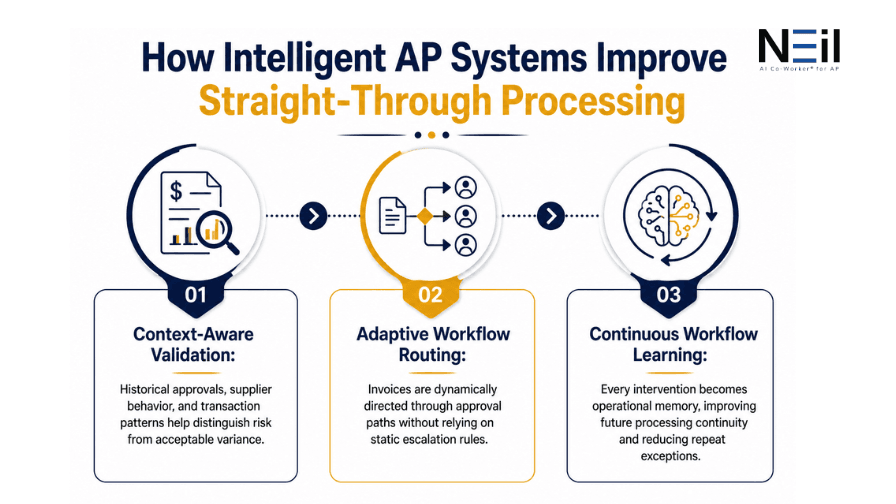
The shift from static automation toward intelligent workflow orchestration is redefining how finance teams improve straight-through processing. By deploying Neil, the AI co-worker for AP Transformation, organizations are bringing cognitive reasoning to three core capabilities:
Three capabilities are proving especially effective.
Context-Aware Validation
Modern systems evaluate invoice data against historical approvals, supplier behavior, transaction patterns, and operational precedent. This contextual understanding enables systems to distinguish acceptable variance from genuine risk. A quantity mismatch that would traditionally trigger escalation may be resolved automatically if historical context suggests operational consistency.
Adaptive Workflow Routing
Traditional approval routing often creates unnecessary interruption because workflows rely on static escalation paths.
Adaptive routing improves workflow continuity by enabling:
- Faster approval resolution: Invoices reach the correct approver immediately.
- Lower routing friction: Dynamic ownership changes are absorbed seamlessly.
- Reduced workflow interruption: Approval continuity improves.
- Higher processing stability: Fewer invoices stall unnecessarily.
Continuous Workflow Learning
Sophisticated AP systems capture manual corrections as operational memory. Every intervention becomes learning data. Over time, workflows internalize resolution logic and progressively reduce repeat intervention. This is the point at which automation begins evolving into operational intelligence.
What Should CFOs Measure Beyond Straight-Through Processing?
Straight-through processing cannot be evaluated in isolation.
The most useful supporting metrics include:
- Exception density: Percentage of invoices requiring intervention.
- Validation confidence accuracy: Reliability of automated decision-making.
- Approval latency: Average time invoices spend awaiting workflow resolution.
- Posting success rate: ERP continuity across final transaction execution.
- Intervention recurrence: Frequency of repeated workflow breakdowns.
These metrics reveal whether straight-through processing is structurally resilient or merely temporarily inflated.
Why Does Higher Straight-Through Processing Matter Beyond Accounts Payable?
The strategic impact of improved straight-through processing extends beyond invoice processing itself.
Higher workflow continuity improves broader financial performance by enabling:
- Better cash flow predictability: Cash flow management and liability recognition becomes faster.
- Stronger vendor trust: Payment consistency improves.
- Cleaner audit readiness: Workflow continuity reduces reconciliation complexity.
- Faster close cycles: Operational friction declines across month-end processing.
This is why AP straight-through processing increasingly sits at the center of enterprise finance transformation strategy.
Neil is purpose-built to sustain and scale processing continuity, Neil functions as an intelligent orchestration layer. By bringing contextual decision intelligence and operational memory to your workflows, Neil prevents straight-through processing from hitting a structural plateau.
That is where true straight-through processing maturity begins.
FAQs
Straight-through processing in accounts payable refers to invoices moving from receipt to final ERP posting without requiring manual intervention. It is important because high straight-through processing reflects workflow maturity, reduces operational cost, improves liability visibility, strengthens payment predictability, and enables scalable AP performance. Platforms like Neil improve straight-through processing by applying contextual intelligence across invoice validation, routing, and exception resolution.
What is straight-through processing in accounts payable, and why is it important?
Straight-through processing in accounts payable refers to invoices moving from receipt to final ERP posting without requiring manual intervention. It is important because high straight-through processing reflects workflow maturity, reduces operational cost, improves liability visibility, strengthens payment predictability, and enables scalable AP performance. Platforms like Neil improve straight-through processing by applying contextual intelligence across invoice validation, routing, and exception resolution.
Why does AP straight-through processing stall after initial automation gains?
Many AP straight-through processing initiatives stall because traditional systems rely heavily on static rules. These systems perform well with predictable invoice structures but struggle when supplier variability, approval complexity, tax ambiguity, or ERP fragmentation introduces operational uncertainty. Neil addresses this by functioning as an intelligent AP orchestration layer that continuously adapts to workflow variance.
How can finance teams improve invoice straight-through processing?
To improve invoice straight-through processing, finance teams need more than basic invoice digitization.
The most effective approaches include:
- Context-aware validation
- Adaptive workflow routing
- Continuous workflow learning
- Predictive exception prevention
Neil enables these capabilities through intelligent workflow orchestration that continuously learns from invoice history and operational decisions.
What causes straight-through processing failures in enterprise AP automation?
Straight-through processing failures usually emerge when workflows encounter complexity that deterministic automation cannot interpret. Common causes include supplier-side invoice variation, tax interpretation complexity, ERP synchronization issues, approval hierarchy drift, and validation ambiguity. Neil overcomes these limitations through contextual decision intelligence.
How does Neil improve straight-through processing differently?
Traditional automation tools execute predefined workflow rules.
Neil improves straight-through processing by functioning as an AI Co-Worker for Accounts Payable transformation. It combines workflow memory, contextual invoice understanding, intelligent routing, and historical learning to make informed decisions dynamically. This enables stronger workflow continuity and lower manual intervention across complex enterprise AP environments.
What is predictive straight-through processing in intelligent AP automation?
Predictive straight-through processing refers to the ability of intelligent AP systems to identify likely workflow interruptions before they occur. By analyzing supplier behavior, historical validation outcomes, ERP dependencies, and transaction patterns, systems can intervene proactively.
Neil applies predictive workflow intelligence to strengthen straight-through processing continuity and reduce avoidable invoice intervention at scale.