


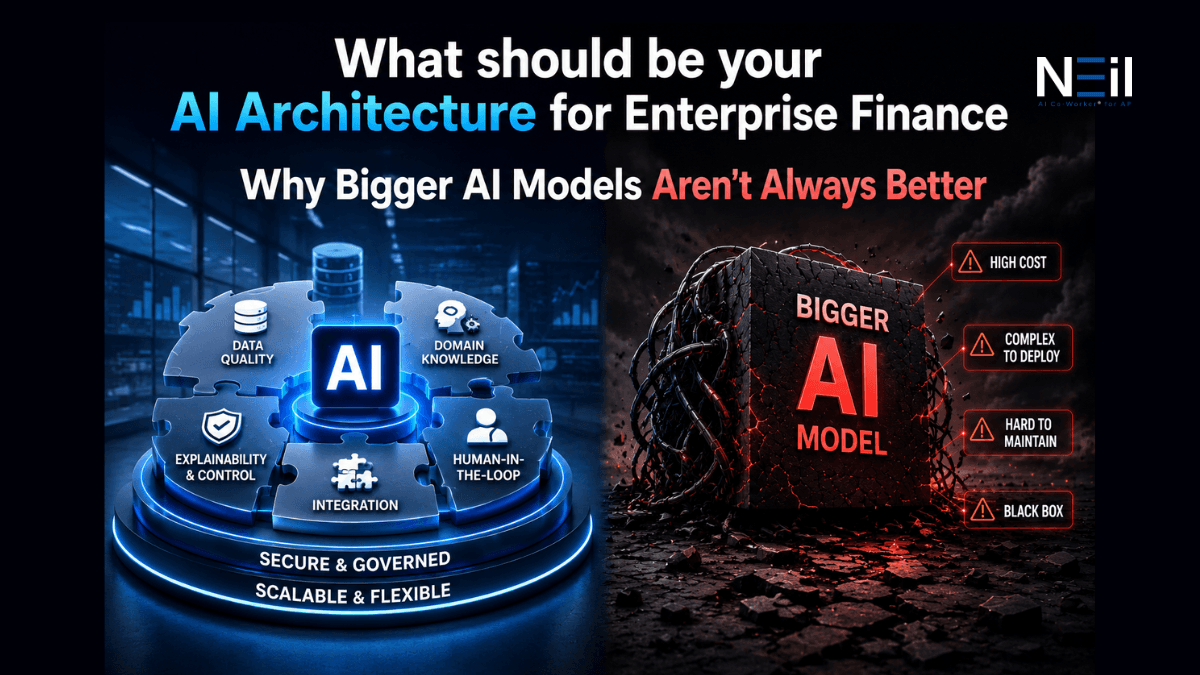
For most of enterprise software’s history, progress has been measured using numbers that eventually stopped mattering.
Enterprise Resource Planning vendors once competed by counting features. The platform with the longest product brochure was assumed to be the most capable, even if customers rarely deployed more than a fraction of what they purchased. Cloud computing followed a similar trajectory. Migration itself became the objective until organizations gradually realized that moving every workload to the cloud was no more sensible than keeping every workload on-premises. In both cases, the industry spent years optimizing the wrong variable before arriving at a more practical question: which architecture best fits the problem being solved?
Artificial intelligence is approaching the same inflection point. As enterprises move AI out of demos and into production finance operations, the conversation is shifting from "how large is the model" to "how is the system architected", and that shift is exactly what AI architecture for enterprise finance is about.
What is AI Architecture for Enterprise Finance?
AI architecture for enterprise finance refers to how intelligence is structured, distributed, and governed across a finance function, as opposed to which single model powers it. Rather than routing every decision through one large, general-purpose model, a well-designed enterprise finance AI architecture assigns each financial task to the model best suited for it, coordinates those models through orchestration, and applies consistent governance across the entire workflow.
This distinction matters because finance was never designed to maximize intelligence; it was designed to minimize uncertainty.
Why Enterprise Software Often Optimizes the Wrong Metric
Much of today’s conversation revolves around model size. Every release is compared through parameter counts, benchmark scores, reasoning evaluations, and increasingly larger context windows. The underlying assumption feels intuitive. If a model demonstrates broader reasoning capabilities, then enterprise software should naturally become better by adopting the largest model available.
That assumption begins to weaken the moment AI leaves demonstrations and enters production.
Enterprise finance is one of the clearest examples of why.
The systems responsible for paying suppliers, reconciling accounts, applying taxes, managing approvals, and closing financial periods were never designed to maximize intelligence. They were designed to minimize uncertainty. Almost every control inside a finance function exists to reduce interpretation before money moves. Approval hierarchies remove discretion. Purchase orders constrain purchasing decisions before invoices arrive. Three-way matching narrows acceptable outcomes even further. Tolerance thresholds define exactly how much variation the business is willing to accept before a transaction becomes someone else’s responsibility.
Taken together, these controls reveal something that rarely appears in conversations about enterprise AI.
Why AI Architecture Matters More Than Model Size in Enterprise Finance
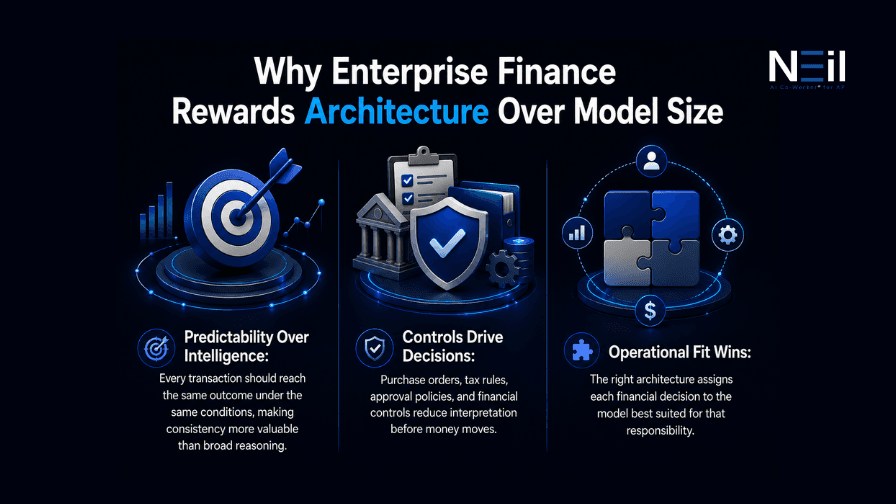
Finance is not an exercise in making decisions. It is an exercise in eliminating as many decisions as possible.
That distinction changes what intelligence actually means.
A conversational assistant benefits from interpreting intent, adapting its tone, and exploring unfamiliar ideas. An Accounts Payable system does not. The same invoice presented under the same conditions should produce the same outcome every single time. If identical transactions begin receiving different treatment because the underlying model interpreted them differently, the system has become more expressive but considerably less predictable. In financial operations, predictability is rarely viewed as a limitation. It is the property upon which governance, compliance, and auditability depend.
This difference often gets lost because enterprise AI is discussed as though intelligence were a single, measurable capability. It is not. Intelligence inside production systems is always constrained by the operating environment around it. A model capable of discussing constitutional law, writing software, explaining protein folding, and translating twenty languages is undeniably impressive. None of those capabilities necessarily improve the way an organization validates invoice tolerances or detects duplicate payments. Breadth becomes valuable only when the problem itself demands breadth.
Most financial workflows do not.
They demand something closer to disciplined repetition.
One Invoice, Eight Different Problems
An invoice arriving inside an Accounts Payable function looks like one piece of work. Operationally, it is anything but.
Before payment is ever approved, that invoice passes through a chain of decisions that have remarkably little in common with one another. One system extracts information from the document itself. Another verifies that the supplier exists, and that banking information matches trusted records. Purchase orders are compared against receipts. Tax structures are validated according to local regulations. Duplicate detection searches historical transactions for anomalies that would be almost impossible for a human reviewer to notice at scale. Approval workflows evaluate organizational policies before the transaction is finally prepared for posting into the ERP and preserved for future audit.
From a finance team’s perspective, this feels like one continuous process.
From the perspective of system architecture, it resembles a collection of specialized services cooperating toward a common outcome.
That observation matters because it exposes a subtle flaw in the way enterprise AI is often described. We speak about deploying intelligence into Accounts Payable as though intelligence itself were the unit of work. It isn’t. The work consists of many narrowly defined reasoning problems, each operating under different constraints, and each demanding different forms of expertise.
Characteristics separating to distinguish these decisions
Several characteristics distinguish these decisions from the kind of open-ended reasoning frontier models are designed to excel at.
- Operational boundaries remain fixed: Vendor validation, tax logic, duplicate detection, and purchase order matching all operate within clearly documented business rules that change gradually rather than unpredictably.
- The same decisions repeat continuously: High-volume finance functions execute identical invoice validation steps hundreds of thousands of times each month, making consistency and latency operational concerns rather than purely technical ones.
- Every decision must remain explainable: Months after payment has been released, finance teams may still need to reconstruct why a transaction passed, failed, or entered an exception queue.
Once those characteristics become the design objective, the conversation shifts almost naturally away from model capability and toward system architecture.
It becomes difficult to justify solving every one of these problems with the same model simply because that model happens to be the most intelligent available.
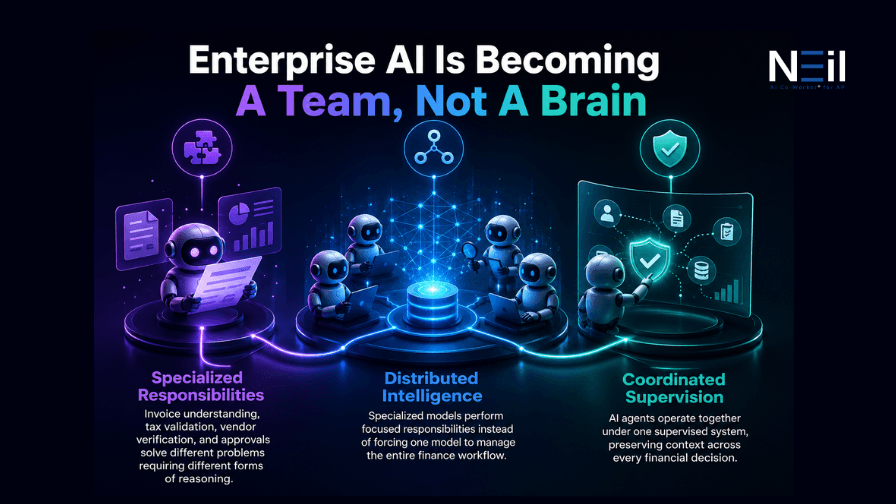
Enterprise AI Is Becoming a Team, Not a Brain
There is a tendency to think about enterprise AI the same way we think about consumer AI: as one increasingly capable system that simply becomes better over time. The mental model is understandable because most people interact with AI through a single interface. You ask a question, the model responds, and the conversation continues. Intelligence appears centralized.
Enterprise systems have almost never worked that way.
A finance organization would be remarkably inefficient if every decision passed through one exceptionally knowledgeable individual. No CFO hires a single person because they understand procurement, taxation, treasury, regulatory reporting, audit, accounts payable, financial planning, and cash management equally well. Those responsibilities are deliberately distributed across specialists because specialization reduces operational risk. It also makes the organization easier to manage. Teams evolve independently, processes improve at different speeds, and expertise develops where it is needed instead of being concentrated in one place.
Enterprise AI is beginning to follow the same path.
The interesting question is no longer how intelligent one model can become. It is how intelligence should be distributed across a system.
That shift sounds subtle until you view an enterprise workflow through that lens. The objective stops being to build one model capable of solving every problem. Instead, the objective becomes identifyingwhich decisions genuinely require broad reasoning and which are better handled by systems designed for narrow, repeatable tasks.
Accounts Payable illustrates this surprisingly well. Reading an invoice is not the same problem as validating tax identifiers. Matching a purchase order is not the same problem as detecting anomalous supplier behaviour. Routing approvals through organizational hierarchies has very little in common with identifying duplicate invoices across historical records. Each decision operates over different data, follows different business rules, and carries different consequences when something goes wrong.
Treating those responsibilities as one AI problem is a little like expecting the database, identity provider, workflow engine, and reporting platform inside an ERP to all be the same service. Enterprise software moved away from that architecture years ago because specialization proved easier to maintain, easier to secure, and easier to scale.
Why Small Language Models Are Central to Enterprise AI Architecture
This is the architectural observation sitting quietly beneath NVIDIA’s paper on Small Language Models. The paper is often discussed in terms of parameter counts or inference costs, but its more interesting implication is structural. Agentic systems rarely perform one long reasoning task. They perform thousands of short, specialized ones. Each agent executes a narrowly defined responsibility before handing context to another component. Intelligence becomes distributed across the workflow rather than concentrated inside a single model.
Once that happens, model selection becomes much more pragmatic.
- A frontier model may still be the right choice for interpreting an unfamiliar supplier contract, analysing regulatory changes, or helping an analyst investigate an unusual payment dispute. Those problems reward broad reasoning because there is no predetermined path to the answer.
- A fine-tuned small language model is the right tool for validating invoice fields, applying tax rules, checking tolerance limits, flagging duplicate suppliers, or classifying payment exceptions, problems where the acceptable outcomes are already well understood.
The model does not become more valuable because it knows more about the outside world. It becomes more valuable because it behaves consistently inside the world it has been asked to operatewithin.
This is why enterprise finance AI architectures increasingly resemble distributed systems more than conversational assistants: different models handle different kinds of reasoning, orchestration governs how information moves between them, and governance determines where human review becomes mandatory.
Three practical outcomes follow from this approach
- Models become easier to evaluate. Narrow operational responsibilities produce clearer performance metrics because each model solves a well-defined problem rather than many unrelated ones.
- Infrastructure scales more predictably. High-frequency decisions no longer consume expensive computational resources designed for problems that rarely appear inside operational workflows.
- Governance becomes more manageable. Organizations can monitor, retrain, or replace individual models without introducing unintended changes across unrelated finance processes.
Notice that none of these benefits depend on proving that Small Language Models are universally superior to frontier models.
They depend on recognizing that enterprise systems rarely ask one question. They ask thousands of different questions, each deserving an answer proportionate to its complexity.
The discussion therefore changes from Which model is the smartest? to Which model belongs here?
That is a much more interesting engineering problem.
From Models to Agency: How Agentic AI Applies This in Practice
The discussion around Large Language Models and Small Language Models is often framed as though enterprises will eventually standardize on one or the other. That is unlikely to happen because production systems are rarely built around a single technology. They are built around the operational responsibilities they are expected to perform.
This is where agentic AI introduces a genuinely different operating model. Instead of asking one general-purpose model to reason across an entire business function, agentic AI distributes responsibilities across specialized agents while maintaining coordinated supervision over the full workflow. Agency emerges from coordination, not from one model becoming increasingly capable.
Neil is the AI Co-Worker® for Accounts Payable.
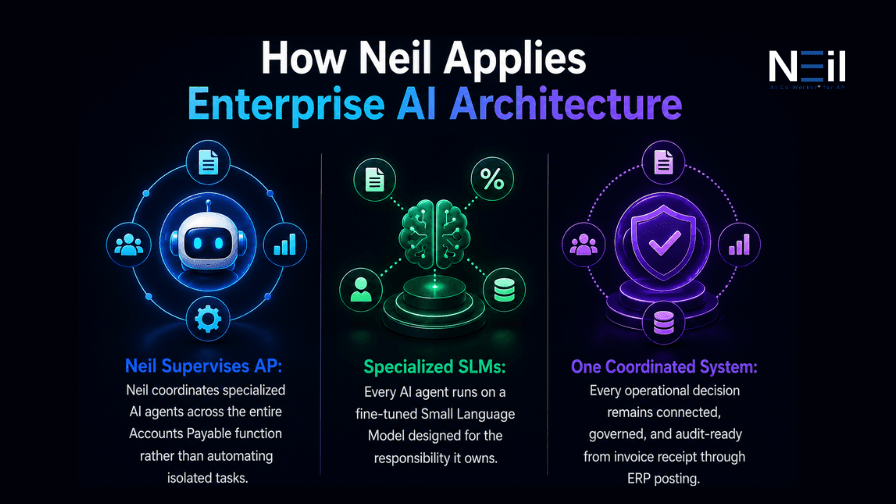
Neil, our AI Co-Worker® for Accounts Payable was built around exactly this principle. Under Neil’s supervision, specialized AI agents receive invoices, understand documents, validate e-invoice compliance, perform purchase order matching, verify vendor information, coordinate approvals, resolve exceptions, synchronize validated transactions with enterprise systems, and support vendors through a multilingual helpdesk. Each agent owns a distinct operational responsibility while Neil supervises how those decisions come together across the entire Accounts Payable function.
That architecture also explains why Small Language Models are becoming increasingly important in enterprise finance.
Each specialized AI agent within Neil runs on a fine-tuned Small Language Model aligned to the responsibility it owns. Rather than expecting one general-purpose model to reason across every operational decision, each agent operates within a well-defined domain where accuracy, consistency, and repeatability matter more than broad world knowledge. That gives Neil's architecture a few concrete advantages beyond inference economics:
- Individual agents can evolve as regulations, supplier behavior, or financial controls change, without introducing variation elsewhere in the workflow
- Each responsibility can be monitored, evaluated, and governed independently
- Neil continues supervising accounts payable as a single, coherent operating system rather than a set of disconnected automations
This reflects a broader shift taking place across enterprise AI. Earlier generations of automation focused on completing individual tasks faster. Agentic AI is beginning to supervise business functions. That shift raises the standard considerably. Systems are no longer evaluated solely by how intelligently they answer questions. They are evaluated by whether they can coordinate decisions, operate within business controls, remain explainable under audit, and preserve predictable behaviour as operational complexity grows.
NVIDIA’s work on Small Language Models points in this direction.
The paper argues that specialized models provide a more efficient foundation for agentic systems, but the broader implication is architectural. Enterprise AI is gradually moving away from concentrating intelligence inside a single model and toward systems where specialized intelligence is distributed across well-defined operational responsibilities. Neil follows that same architectural philosophy. Rather than relying on one model to understand every aspect of Accounts Payable, Neil supervises specialized AI agents, each running on fine-tuned Small Language Models, combining specialization with coordinated agency across the entire function.
Enterprise finance has always rewarded systems that are predictable, explainable, and resilient under scale. As Agentic AI becomes part of production finance operations, those same principles are beginning to shape how intelligent systems are designed. The conversation is becoming less about building larger models and more about building systems where intelligence is applied deliberately, supervised effectively, and aligned to the operational responsibility it is expected to own.
FAQs
It is the structural design that orchestrates specialized AI models, data pipelines, and governance frameworks across finance workflows. Instead of relying on a single monolithic model, it defines how distinct models interact, route information, and maintain auditable decision trails.
What is AI architecture for enterprise finance?
It is the structural design that orchestrates specialized AI models, data pipelines, and governance frameworks across finance workflows. Instead of relying on a single monolithic model, it defines how distinct models interact, route information, and maintain auditable decision trails.
Why doesn't enterprise finance benefit from the largest available AI model?
Finance workflows demand zero variance and maximum predictability, whereas large frontier models prioritize broad reasoning and creative interpretation. Applying a massive model to rigid tasks introduces unnecessary hallucinations, high latency, and audit risks.
What are small language models (SLMs), and why are they used?
SLMs are compact, highly efficient models fine-tuned for narrow, domain-specific tasks. They are used in finance because they deliver superior accuracy, lower latency, and lower operational costs for deterministic tasks (e.g., tax validation) compared to large models.
How many AI decisions does a single invoice actually involve?
Typically eight discrete decisions, each governed by distinct compliance rules:
- Data extraction
- Vendor validation
- Purchase Order (PO) matching
- Tax validation
- Duplicate detection
- Approval routing
- ERP synchronization
- Audit logging
How does AI governance work with multiple specialized models?
Governance is enforced at the orchestration layer. Each specialized model is monitored and updated independently, while a supervisory system tracks the end-to-end data flow to ensure every automated decision is explainable and compliant.