


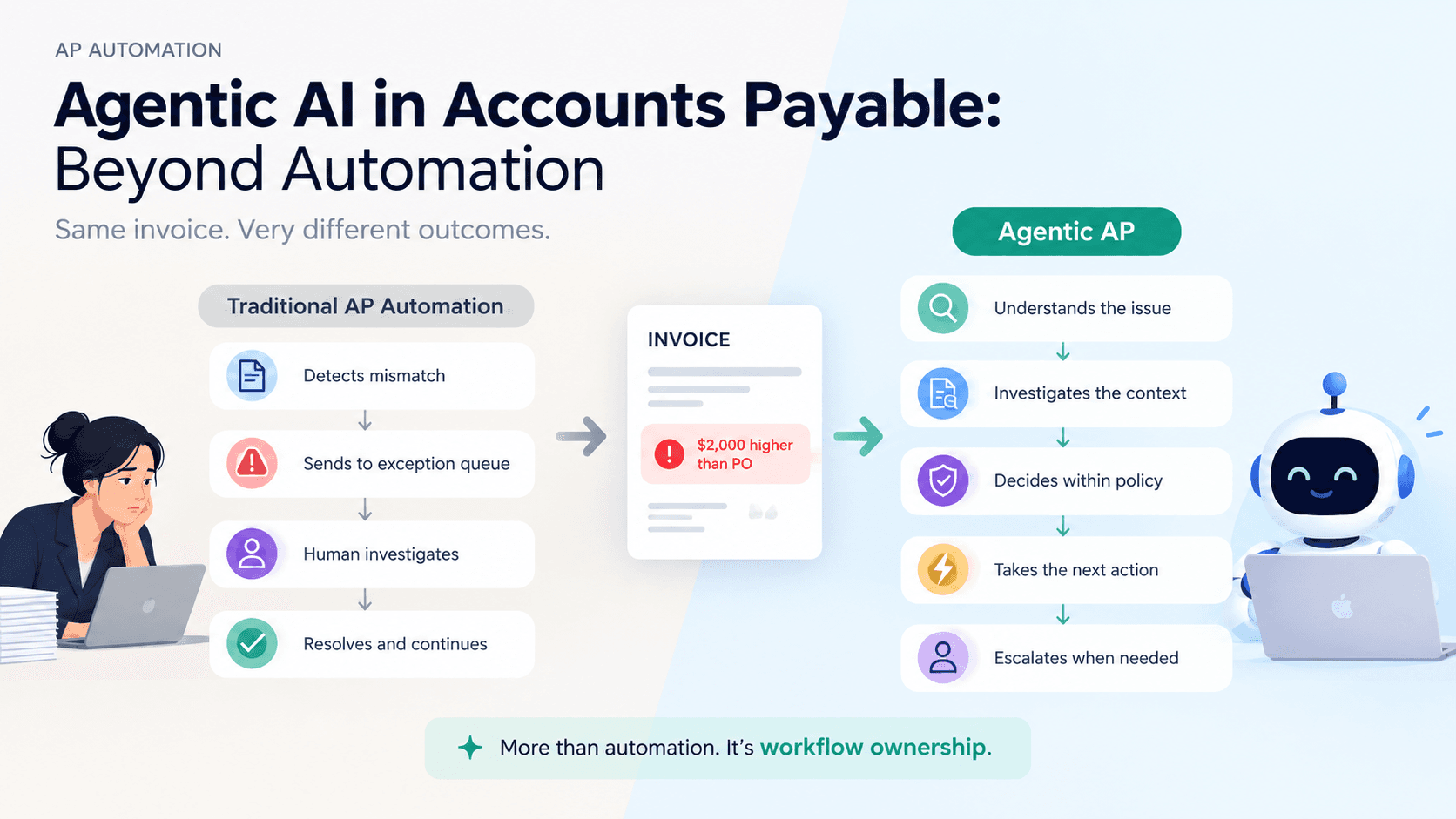
An invoice arrives at 9:12 AM.
The system reads it, extracts the details, matches it against the purchase order and checks the goods receipt.
Everything looks fine.
But if an invoice is $2,000 higher than the PO.
The system flags the mismatch.
And then?
Someone from the AP team has to take over.
This is where the difference between traditional AP automation and agentic AI in accounts payable starts to matter.
Automation can follow a process but an Agentic AI is designed to figure out what to do when it doesn’t.
The question is no longer just “Can AI process an invoice?”
It is: “What happens when the invoice doesn’t follow the script?”
Why traditional AP automation breaks down on invoice exceptions
Accounts payable automation has already changed how finance teams process invoices.
Invoices can be captured automatically. Data can be extracted. Purchase orders and receipts can be matched. Approvals can be routed. Information can be posted to an ERP.
But most AP processes still have one difficult part: exceptions.
An invoice may have:
- A price that doesn’t match the PO
- A missing purchase order
- A quantity difference
- A duplicate invoice
- A receipt that has not been recorded
Traditional automation is generally good at identifying these situations. The problem is what happens next.
A system may move the invoice to an exception queue, send an alert or ask an AP employee to investigate. The workflow has effectively stopped until someone decides what to do.
This is not a rare edge case. According to Ardent Partners’ State of ePayables 2025 research, almost 1 in 5 invoices (18.4%) becomes an exception at the average AP team, and Ardent says exceptions are typically the biggest single reason AP costs and processing times stay high. The best AP teams, the top 20% ranked by cost and speed, have exception rates 47% lower than the rest of the market.
That is the gap agentic AI is trying to address.
What is agentic AI in accounts payable?
Agentic AI in accounts payable refers to AI systems that can do more than execute predefined steps. Instead of simply following a fixed sequence, an AI agent can use information from the workflow to determine the next appropriate action.
IBM describes agentic AI as a system that can accomplish a specific goal with limited supervision, unlike traditional AI models that operate within predefined constraints.
For example, if an invoice does not match its purchase order, an agent can:
- Identify what is different.
- Look for additional information that explains the difference.
- Check the relevant business rules or policies.
- Determine whether the exception can be resolved within those rules.
- Take the next approved action.
- Escalate the case when human judgment or authorization is required.
The important distinction is not that the system is “more intelligent.” It is that the system is designed around the outcome of the workflow, rather than simply completing one predefined task.
Traditional AP automation vs. agentic AI
The difference is clearest when something goes wrong. The left column shows how traditional, rules-based automation typically behaves; products vary.
| Traditional automation | Agentic AP |
|---|---|
| Follows predefined rules | Works toward a defined outcome |
| Automates individual tasks | Coordinates the workflow |
| Detects exceptions | Investigates exceptions |
| Sends problems to a person | Can take the next approved action |
| Stops when information is missing | Can look for the context it needs |
| Follows a fixed path | Can adapt to the situation |
| People handle many exceptions | People focus on exceptions requiring judgment |
The difference can be summed up simply:
Traditional automation is built to follow the path. Agentic AI is built to move the workflow forward.
That does not mean every AP decision should be automated.
It means the system can potentially handle more of the work before a person needs to step in.
The AP Exception Test: 5 questions to ask any AP vendor
Don’t start by asking “How many invoices can the system process?” Ask “What does the system do when the invoice doesn’t follow the expected path?” We call this the AP Exception Test.
1. Understand: what exactly is wrong with the invoice?
Can the system identify what is wrong? For example, an invoice of $12,000 against a $10,000 PO: it needs to recognize the $2,000 variance.
2. Investigate: what explains the difference?
Can it look for information that may explain the difference, such as the goods receipt, contract, previous invoices or tax information?
3. Decide: what do policy and business rules allow?
Can it determine what the relevant policy says? For example, perhaps the company allows a certain price variance under specific conditions.
4. Act: can the workflow continue without waiting for a person?
If the situation falls within an approved rule, can the workflow continue without anyone moving it forward manually?
5. Escalate: when must a person decide?
If the decision requires human authority, does the system know when to stop and involve the right person? Agentic AI does not mean “AI makes every decision.”
Example: a $2,000 invoice mismatch, with and without agentic AI
Handled by traditional automation
Invoice ≠ PO. The system flags the mismatch and the invoice enters an exception queue. An AP analyst checks the receipt, contract or vendor communication, decides what should happen, and the workflow continues.
Handled by an agentic workflow
The system detects the same mismatch but, instead of stopping, investigates the available records and policies to find the cause. If the situation falls within an approved rule, the workflow continues. If not, the case goes to the right person with the relevant information already gathered.
What should AI handle in accounts payable, and where should humans step in?
A useful AP strategy is about deciding where AI and humans are each most useful.
| AP activity | AI can handle | Human steps in when... |
|---|---|---|
| Invoice intake | Receive and classify invoices | Something needs investigation |
| Data extraction | Read and validate invoice data | Information is unclear or conflicting |
| PO matching | Match invoices, POs and receipts | The mismatch needs judgment |
| Exception handling | Investigate routine exceptions | The case falls outside policy |
| Approval routing | Send to the right approver | A decision requires authority |
| Vendor queries | Answer routine payment questions | The issue needs human intervention |
| Payment | Prepare the transaction | Authorization is required |
This is where the conversation around AI in accounts payable becomes more practical: the goal is to reduce the manual work needed to move an invoice from received → validated → approved → posted → paid.
How does agentic AI change the role of AP teams?
If agentic AI can handle more of the workflow, AP teams can spend less time on repetitive investigation and more on:
- Complex exceptions
- Supplier relationships
- Policy decisions
- Fraud and risk management
- Process improvement
- Working capital initiatives
- Compliance
- Strategic finance operations
This matters most for organizations running AP across multiple countries and ERPs, such as global capability centers.
Why the goal is not “no humans”
The goal of AI in finance is not to remove people from the process. It is to let technology handle the routine workflow so people can focus on decisions that need them. That still takes boundaries: policies, visibility, and a clear way to involve people when a situation falls outside them. NIST’s AI Risk Management Framework makes a similar point for AI generally: human oversight processes should be defined, assessed and documented. For more, see AI Agent vs Human Agency: Who Holds the Power?.
What to look for in an agentic AI accounts payable solution
“Agentic AI” is becoming a common term, so the label itself isn’t enough. When evaluating a solution, ask practical questions.
1. What happens when an invoice fails validation?
Does the system simply create an exception, or can it investigate and determine the next step?
2. Can it work across the complete workflow?
Can it support intake, validation, matching, approvals, exceptions, ERP posting and reconciliation, not just invoice capture?
3. Can it use context?
The relevant information may sit across a PO, GRN, contract, ERP record, vendor communication or company policy.
4. Can it take action?
Understanding an exception is useful. The bigger question is whether the system can act within defined controls.
5. Does it know when to involve a person?
It should know when to escalate, and route the case to the right person with enough context to decide.
6. Can you see what happened?
Any system taking action within AP should provide visibility into the workflow, actions taken and points where a person intervened.
To weigh the criteria for choosing a vendor, see how to select the best accounts payable automation solution.
How Neil applies agentic AI to accounts payable
Neil by e42.ai is built around moving beyond individual AP tasks toward end-to-end workflow ownership. Neil is an AI Co-Worker® for Accounts Payable: a supervised team of specialized agents that runs the workflow end to end, from invoice intake through ERP posting. See the full scope on the Neil solution page.
Its AP workflow covers:
- Multi-channel invoice intake
- Document detection and extraction
- PO, GRN, tax and policy validation
- 3-way matching
- Approval routing
- Exception handling
- 24×7 multilingual vendor helpdesk
- ERP posting and synchronization
- Reconciliation and reporting
When something goes wrong, the system needs to know what happens next. That is the problem agentic AP is designed to address.
Back to the $2,000 invoice. Neil matches it against the PO and goods receipt and checks the variance against your business rules and policies. Within policy, Neil resolves it and the invoice moves on to approval and ERP posting. Outside policy, Neil routes it to the right person for a human decision.
Neil already runs AP at scale: at a global media-measurement leader it covers 39 countries and 28 currencies, and cost per invoice fell from $3.33 to $1.18.
To see how Neil’s agentic architecture handles exceptions, read Neil 1.0.1: What It Takes to Build an AI Co Worker You Can Actually Trust.
So how do you tell if an AP system is truly agentic?
When you evaluate an AP automation platform, start with an exception: the invoice doesn’t match the PO. What happens next? Can the system understand it, investigate it, work out what policy allows, act, and recognize when a human needs to decide? That is the real test.
The future of accounts payable isn’t just about processing invoices faster. It’s about building AP workflows that keep moving even when the process doesn’t go as planned.
See how Neil handles your exceptions. Bring a real exception and see what happens next. Talk to us or explore the Neil solution.
FAQs
Traditional AP automation follows predefined rules and sends exceptions to a person. Agentic AI works toward an outcome: it can investigate an exception, check policy, take the next approved action and escalate when judgment is needed.
What is the difference between AP automation and agentic AI?
Traditional AP automation follows predefined rules and sends exceptions to a person. Agentic AI works toward an outcome: it can investigate an exception, check policy, take the next approved action and escalate when judgment is needed.
Does agentic AP work with my existing ERP?
Neil is ERP-agnostic. It works with SAP, Oracle, Dynamics and custom ERPs, and posts validated, approved entries into your ERP. Scope depends on your ERP and configuration.