


Finance teams have heard the pitch a hundred times: automate your accounts payable process, cut costs, go paperless. But the real story in 2025 is bigger than that. Accounts payable automation has quietly evolved from a time-saving tool into a strategic lever—one that touches cash flow forecasting, vendor trust, regulatory compliance, and how finance teams spend their time. This guide breaks down what modern AP automation software actually does, what results organizations are seeing, and what it genuinely takes to move from manual chaos to an intelligent, self-improving payables function.
What is Digital Transformation in Accounts Payable?
Digital transformation in Accounts Payable is the process of replacing manual, paper-based AP workflows such as invoice capture, validation, approval routing, and payment, with AI-driven, automated systems that reduce human intervention, improve accuracy, and give finance teams real-time control over their payables.
At its core, AP automation handles four interconnected stages of the payable cycle:
- Invoice capture — Digitally extracting data from invoices received by email, portal, or paper — using AI-based data extraction and intelligent document processing (IDP).
- Validation — Automatically matching invoices against purchase orders and receipts
- Approval — Routing invoices through dynamic, rule-based or AI-driven approval workflows
- Payment — Scheduling and executing payments in line with vendor terms, optimizing for early payment discounts and cash flow planning.
What are The Real Challenges in Accounts Payable Today?
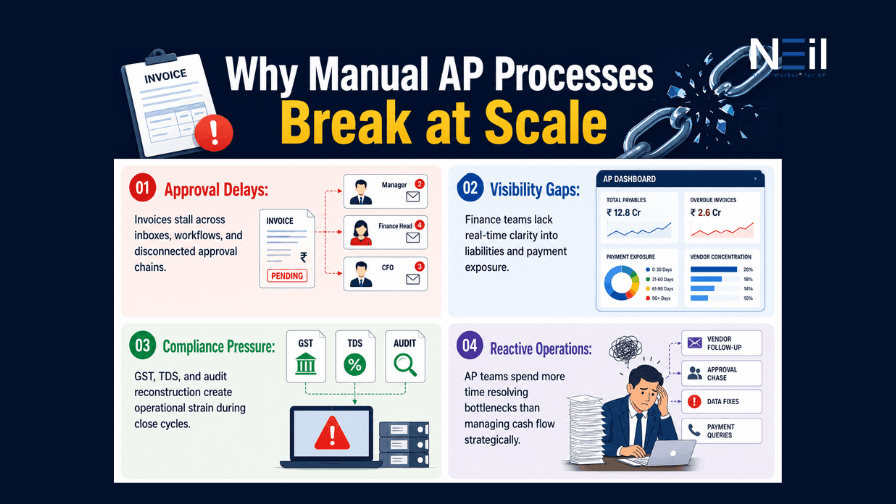
Most finance leaders know manual AP is inefficient. What they underestimate is how structurally broken it is.
The real damage happens in the gaps. An invoice arrives, sits in someone's inbox for three days, gets forwarded to the wrong approver, and eventually surfaces two weeks later when the vendor calls asking why payment is late. Meanwhile, the finance team has no real-time view of what is approved, what is pending, or what the cash outflow for the next fortnight actually looks like.
That visibility gap is expensive. It means missing early payment discounts. It means rushed month-end reconciliations. And for Indian businesses navigating GST compliance and TDS obligations, it means reconstructing audit trails under pressure, which is exactly the kind of work that keeps controllers up at night.
AP today is not a back-office function. It directly shapes three things that matter at the leadership level:
- Cash flow: You cannot manage working capital (cash flow) well if you do not know what you owe and when.
- Compliance: GST reconciliation, input tax credit eligibility, and audit readiness all depend on accurate, timestamped payables records.
- Vendor relationships: Late payments and unresolved disputes do not stay in the finance department — they surface in procurement conversations and contract renewals.
From Rule-Based Automation to AI-Driven AP: What Has Actually Changed
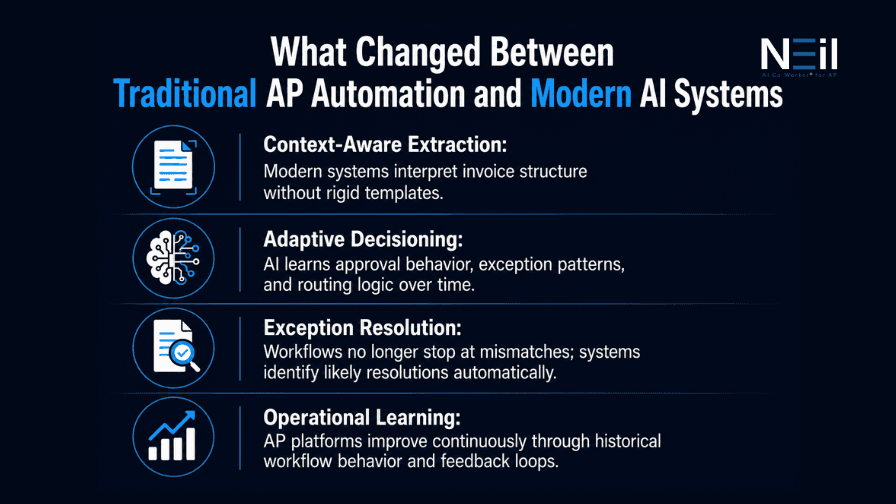
Here is where a lot of conversations get muddled. People use "AP automation" to describe everything from basic OCR scanning to genuinely intelligent, learning systems. Those are not the same thing.
First-generation AP tools were rule-based. They could handle a standard invoice from a vendor whose format you had already configured. Anything unusual like a new vendor, a slightly different layout, a line item that did not match the PO exactly, required human intervention. The exception queue was always full.
Modern AP automation software combines several technologies that shift the paradigm from rule-following to decision-making:
- Intelligent Document Processing (IDP) goes beyond OCR to understand document structure, extract contextual data, and handle varied invoice formats without template setup
- Natural Language Processing (NLP) reads vendor communications, identifies payment disputes, and flags anomalies in invoice descriptions
- AI and Machine Learning enable the system to learn from historical approvals, predict routing decisions, and continuously improve accuracy without manual reprogramming
- Cognitive Process Automation (CPA) handles exception resolution, the one area where traditional automation consistently fails
Latest digital transformation Accounts Payable tools don't just execute predefined rules; remove manual decision-making. The system does not just process invoices — it learns when to approve, how to resolve exceptions, and when to escalate.
Key Benefits of Accounts Payable Automation
The case for AP automation is no longer theoretical. Organisations that have moved to intelligent AP systems report measurable, substantial outcomes:
- 80% faster invoice processing — What takes 10–14 days manually collapses to hours. Straight-through processing for standard invoices requires zero human touchpoints.
- Up to 60% reduction in processing cost — Every manual touchpoint carries a cost: staff time, error correction, exception handling, and audit preparation. Automation eliminates most of these.
- Real-time financial visibility — AP automation platforms provide live dashboards of outstanding liabilities, approval status, and payment schedules. Finance leaders can make cash management decisions based on facts, not estimates.
- Improved vendor relationships — Faster, predictable payments strengthen supplier trust and often unlock better terms. Vendors who know they'll be paid on time are more likely to offer early-payment discounts.
- Stronger compliance posture — Every transaction is logged, timestamped, and audit-ready. Regulatory requirements like GST reconciliation, TDS deduction tracking, or internal controls, are met systematically rather than reactively.
Measuring ROI of AP Automation
Traditional ROI metrics like "hours saved" or "headcount reduction" no longer capture the full value of modern AP automation. The industry has moved to a more sophisticated set of KPIs:
| KPI | What It Measures | Industry Benchmark |
|---|---|---|
| Touchless Invoice Rate | % of invoices processed without human touch | 70–85% (top performers) |
| Straight-Through Processing (STP) | % completing end-to-end without exception | 60–75% |
| Invoice Cycle Time | Days from receipt to payment-ready | <3 days (vs. 10–15 manual) |
| Exception Rate | % of invoices requiring manual intervention | <10% in mature deployments |
| Early Payment Discount Capture | % of available discounts actually taken | 85%+ with automated scheduling |
These KPIs should be tracked continuously, not just at go-live. Autonomous AP systems improve over time , your metrics should reflect that trajectory.
Key Features to Look for in AP Automation Software
As you evaluate platforms in 2026, the feature bar has risen significantly. Here is what genuinely differentiates modern Accounts Payable Automation software:
- AI-based data extraction — Not just OCR that reads text, but intelligent extraction that understands context, handles unstructured formats, and learns from corrections. Look for systems that improve accuracy the more invoices they process.
- Seamless ERP integration — Your AP automation solution must integrate natively with your ERP (SAP, Oracle, Microsoft Dynamics, Tally, etc.), not just export CSV files. Real-time sync eliminates reconciliation overhead.
- Real-time analytics and dashboards — Finance leaders need live visibility into liability positions, approval bottlenecks, and payment schedules. Static reports are a step backward.
- Automated exception handling — The system should resolve common exceptions (price variances within tolerance, missing PO references for known vendors) autonomously, escalating only genuinely complex cases.
- Compliance and audit trail — Every action should be logged with user, timestamp, and decision rationale. This is non-negotiable for GST audits, internal controls, and financial reporting integrity.
- Scalability without proportional headcount growth — The right platform handles 10x invoice volume without requiring 10x staff. This is the fundamental economic case for automation.
Where AI in Accounts Payable Makes the Biggest Difference
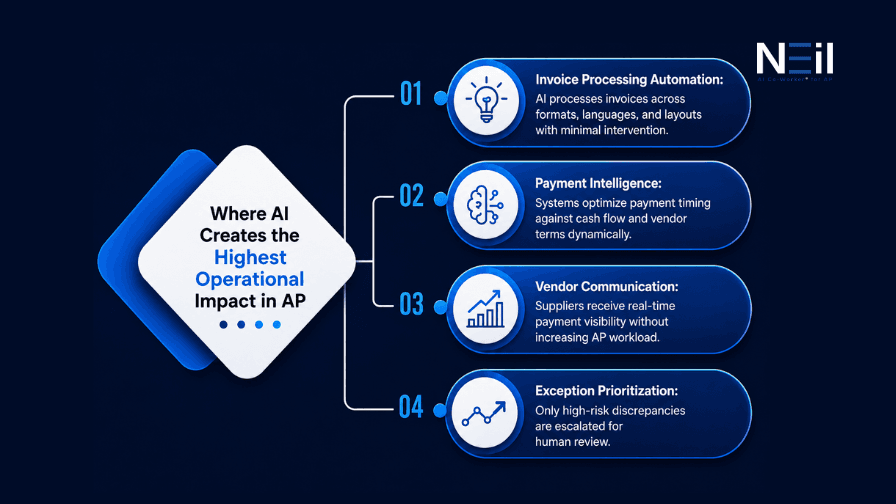
AI is not a single feature inside an AP platform, it is a layer that transforms multiple workflows simultaneously. Understanding where AI in accounts payable creates the most impact helps finance teams set realistic expectations and prioritize implementation:
Invoice processing automation
AI reads and classifies invoices across formats in structured PDFs, scanned paper, portal submissions, without needing preconfigured templates for each vendor.
Exception resolution
Instead of dumping mismatches in a queue, AI identifies the root cause (price variance, duplicate, missing PO number ) and routes it to the right person with suggested fixes already attached.) and routes it to the right person with suggested fixes already attached.
Vendor communication
Automated status updates, payment confirmations, and query responses keep suppliers informed without burdening the AP team with inbound calls and emails.
Payment scheduling
AI matches payment timing to vendor terms, cash position, and discount windows — so you are not paying early out of habit or late out of disorganization.
How to Actually Implement AP Automation Without Wasting the First Six Months
Technology is only half the transformation. Organisations that extract maximum value from AP automation follow a clear implementation discipline:
Start with process standardisation
Automation amplifies existing processes, both good and bad. Before deploying AI, document and standardise your invoice receipt, coding, and approval workflows. Clean inputs produce clean outputs.
Design for AI-human collaboration, not replacement
The most effective AP teams use automation to eliminate repetitive processing while focusing human attention on judgment-intensive exceptions, vendor relationship management, and strategic analysis. So, define clearly which decisions humans should own and which the system should handle autonomously. This clarity also helps with change management.
Invest in vendor onboarding
The quality of your AP automation is partly determined by how well your vendors submit invoices. Structured onboarding programmes that guide suppliers toward electronic invoicing and standardised formats dramatically improve automation rates.
Build continuous learning into your operating model
Autonomous AP systems improve through feedback. Establish a regular review cadence where exception patterns are analysed, rules are refined, and model performance is monitored. The accuracy improvements compound quickly.
Measure relentlessly
Organizations that pilot on a single invoice category like utilities, recurring vendors, or a single entity, before full deployment consistently report faster time-to-value and higher adoption rates. A contained pilot surfaces integration issues and process gaps without the complexity of a full rollout.
Why Neil, The AI Co-Worker for Accounts Payable Transformation Outperforms Traditional Automation Tools
There is an important distinction that many organisations miss when evaluating AP solutions: the difference between an automation tool and an AI coworker.
Traditional automation tools execute tasks. They process invoices according to rules you define, within workflows you configure, for exceptions you anticipated. When something falls outside those parameters, it stops and waits for a human. Whereas, Neil, our AI Co-Worker for Accounts Payable Transformation does something fundamentally different. It learns from your enterprise data such as your historical approvals, your vendor patterns, your exception resolutions, and develops the judgment to handle novel situations. It doesn't just automate the routine; it scales the expertise of your best AP analysts across every invoice, every vendor, every workflow.
Organisations that deploy Neil in AP report:
- Significantly higher touchless invoice rates because the system handles edge cases that rule-based tools cannot
- Faster ROI because the system improves continuously without expensive reconfiguration
- Scalability without headcount growth because the AI handles volume spikes autonomously
- Strategic value beyond cost savings, the AI generates insights about vendor performance, payment optimisation opportunities, and process improvement areas
The Future of Accounts Payable
The next few years will move AP further than the last decade did. Three developments are worth watching closely:
Generative AI in AP is moving from experimental to operational. GenAI models can draft vendor communications, generate exception resolution recommendations, summarise audit trails in plain language, and assist AP analysts in navigating complex reconciliations.
Predictive cash flow is emerging as a natural extension of AP automation. Systems with full visibility into invoice pipelines and payment schedules can forecast short-term cash positions with precision, giving treasury teams a significant planning advantage.
Autonomous finance, where AP, AR, and treasury functions are integrated into a single AI-managed financial operating layer is the horizon that leading finance organisations are already building toward.
Organizations building these capabilities today are not just getting more efficient. They are building a structural advantage in working capital management and financial agility that will be difficult for slower-moving competitors to close.
FAQs
Digital transformation in Accounts payable is the process of replacing manual AP workflows like invoice capture, validation, approval routing, and payment, with AI-driven, automated systems that reduce human intervention, improve accuracy, and give finance teams real-time visibility and control over their payables operations.
What is digital transformation in accounts payable?
Digital transformation in Accounts payable is the process of replacing manual AP workflows like invoice capture, validation, approval routing, and payment, with AI-driven, automated systems that reduce human intervention, improve accuracy, and give finance teams real-time visibility and control over their payables operations.
How is AP digital transformation different from basic AP automation?
Basic AP automation digitizes existing manual tasks such as scanning invoices, routing them by email. Digital transformation goes further: it redesigns the entire AP workflow using AI, learning systems, and integrated platforms that make decisions, handle exceptions, and connect AP to procurement, treasury, and compliance in a unified data environment.
What is the difference between OCR and AI-based invoice processing?
OCR reads text from scanned documents but needs vendor-specific templates and struggles with format variations. AI-based extraction using Intelligent Document Processing understands invoice context regardless of layout, it can handle non-standard invoices, infer missing fields, and improve accuracy over time without reconfiguration.
Is accounts payable automation worth it for small and mid-sized businesses?
It depends on invoice volume. For businesses processing fewer than 100 invoices a month, manual processes with good tooling may be sufficient. Once you cross 200–300 invoices monthly, your business should favour automation as most organizations in that range see a ROI within 6 to 12 months, factoring in time savings, error reduction, and early-payment discounts they were previously missing.