


Finance teams have long operated in the background, processing invoices, managing approvals, reconciling payments that are often buried under volumes of paperwork and siloed systems. But the accounts payable (AP) function is undergoing a seismic shift. AI in accounts payable is no longer a futuristic concept reserved for tech-forward companies. It is rapidly becoming the operating standard for enterprises that want to move faster, cut costs, and make smarter financial decisions.
The numbers tell a compelling story. Organizations still relying on manual AP processes spend an average of $15–$16 per invoice, with cycle times stretching to 25 days or more. Meanwhile, early adopters of AI-led AP automation are reporting cost reductions of 60–80%, near-zero error rates, and touchless processing rates above 85%. The gap between those who adopt and those who delay is growing wider by the quarter.
But this transformation is about more than speed and savings. AI in accounts payable is fundamentally redefining what the AP function can be; shifting it from a cost center to a strategic asset. From intelligent invoice capture to predictive cash flow management, AI is enabling finance teams to operate with a level of intelligence and autonomy that was simply not possible before.
In this guide, we explore the full scope of AI's role in accounts payable transformation — what it is, how it works, why it matters, and where it is headed next.
Why Traditional Accounts Payable Processes Fail at Scale
To understand why AI in accounts payable is so important, you should first understand the fundamental limitations of traditional AP processes.
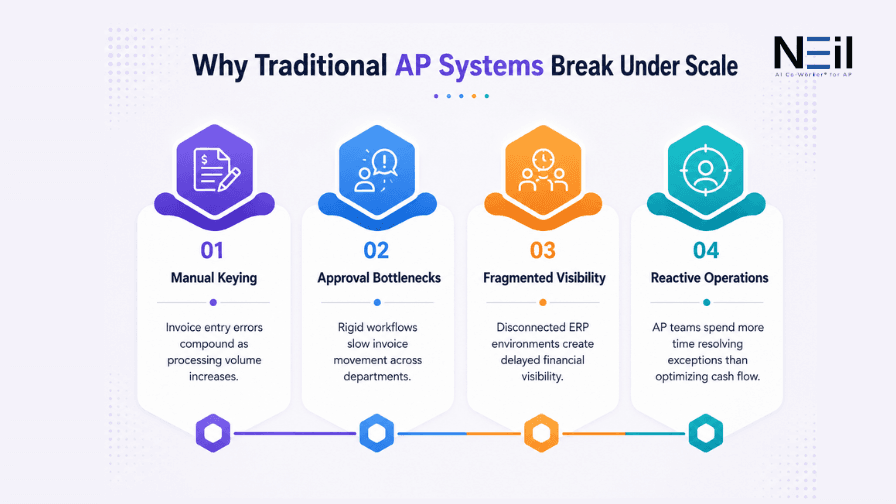
Traditional AP processes fail at scale because they rely on manual data entry, rigid rule-based systems, and disconnected workflows — leading to high error rates, processing delays, and spiraling operational costs.
Most legacy AP environments are built on three flawed pillars:
- Manual data entry from paper or PDF invoices, prone to transcription errors and duplicate submissions
- Rigid approval hierarchies that create bottlenecks, especially during high invoice volumes
- Fragmented ERP systems that lack real-time visibility into outstanding liabilities and cash positions
The consequences are significant and measurable:
| Challenge | Business Impact |
|---|---|
| Manual invoice keying | 2–5% error rate per invoice |
| Approval bottlenecks | 25+ day average payment cycle |
| Duplicate invoices | $50,000–$300,000 annual losses for mid-market firms |
| Late payments | Damaged vendor relationships, lost early payment discounts |
| Fraud vulnerability | AP fraud is among the most common financial crimes |
| Compliance gaps | Regulatory penalties, failed audits, reputational risk |
For enterprise organizations processing thousands of invoices monthly, these inefficiencies compound rapidly. The result is an AP function that is perpetually reactive, constantly firefighting, and strategically blind — unable to provide the insights finance leadership needs to optimize working capital or manage cash flow proactively.
What Is AI in Accounts Payable?
AI in accounts payable refers to the application of artificial intelligence technologies — including machine learning, natural language processing, computer vision, and generative AI — to automate, optimize, and intelligently manage the end-to-end invoice and payment lifecycle.
Unlike traditional accounts payable automation, which relies on predefined rules and static workflows, AI introduces dynamic, context-aware intelligence into AP operations. Where OCR (Optical Character Recognition) simply reads characters off a page, AI understands the meaning, intent, and relationships within a document and acts accordingly.
| Traditional AP Technology | AI-Powered AP Technology |
|---|---|
| OCR-based data extraction | Intelligent document processing with semantic understanding |
| Static, rule-based workflows | Dynamic, adaptive AI workflows that learn from behavior |
| Manual exception handling | AI-driven exception prediction and resolution |
| Rigid approval hierarchies | Predictive, context-aware approval routing |
| Reactive fraud checks | Proactive AI anomaly detection and fraud prevention |
| Periodic reporting | Real-time predictive analytics and cash flow intelligence |
The result is an AP function that doesn't just process invoices faster — it processes them smarter. AI in accounts payable enables systems to learn from historical patterns, adapt to new invoice formats, flag anomalies before they become problems, and continuously improve without manual reprogramming.
How AI Is Transforming Accounts Payable Process?
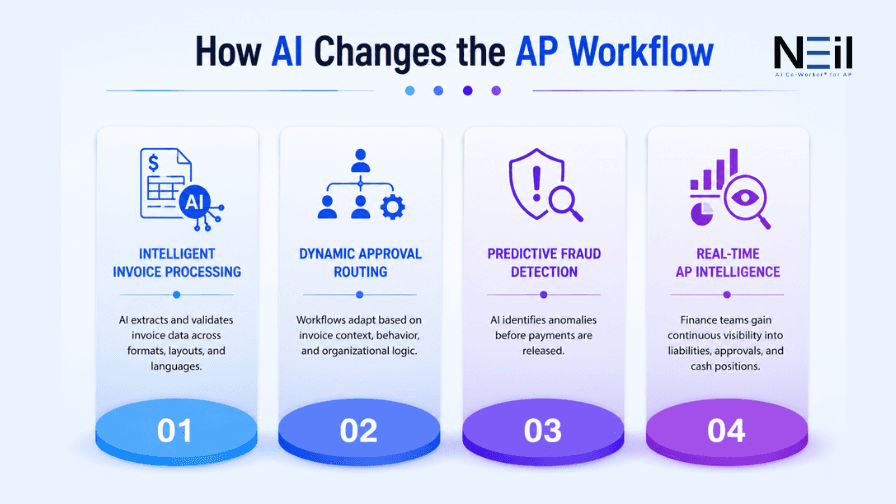
Invoice processing is the cornerstone of modern AP transformation. Here is how AI is reshaping each stage of the accounts payable lifecycle:
Intelligent Invoice Capture
AI-led systems can ingest invoices in virtually any format like PDF, image, EDI, XML, email attachment, or more, and extract structured data with near-perfect accuracy. Unlike OCR, intelligent document processing uses computer vision and NLP to understand context, identify fields like vendor name, invoice number, line items, and tax amounts, and map them to the correct ERP fields automatically.
Automated Invoice Matching
AI enables sophisticated three-way matching, comparing invoices against PO and goods receipt notes at scale and speed. Beyond basic matching, AI can handle partial matches, quantity discrepancies, and price variances intelligently, routing exceptions for human review only when genuinely needed.
AI-Based Approval Workflows
By analyzing historical approval patterns, invoice characteristics, and organizational policies, AI can route invoices to the right approver instantly, and even predict approval outcomes before routing occurs.
Fraud Detection and Compliance
By analyzing patterns across thousands of invoices simultaneously, AI systems can identify anomalies that human reviewers would never catch like duplicate invoices with slight variations, unusual vendor banking changes, invoice amounts just below approval thresholds, and more.
Predictive AP Analytics
Perhaps the most strategically valuable capability AI brings to accounts payable is predictive intelligence. AI systems can analyze payment histories, outstanding liabilities, and cash positions to forecast cash flow, optimize payment timing, and identify early payment discount opportunities, thus, turning AP into a genuine value center.
Key Technologies Powering AI in Accounts Payable
Modern AI-powered AP automation is not built on a single technology. It is an orchestration of multiple AI capabilities working in concert:
| Technology | Role in AP Automation |
|---|---|
| Machine Learning (ML) | Learns from historical invoice data to improve extraction and matching accuracy over time |
| Natural Language Processing (NLP) | Natural Language Processing (NLP) Understands unstructured text in invoices, emails, and vendor communications |
| Computer Vision | Reads and interprets invoices in any visual format, including scanned documents |
| Intelligent Document Processing (IDP) | Combines OCR, NLP, and ML for holistic invoice understanding and data extraction |
| Generative AI | Powers conversational interfaces, auto-generated summaries, and AI copilot capabilities |
| Agentic AI | Orchestrates end-to-end AP workflows autonomously, making decisions and escalating intelligently |
| Predictive Analytics | Forecasts payment timing, fraud risk, and cash flow positions |
| ERP Orchestration | Integrates AI outputs seamlessly into SAP, Oracle, NetSuite, and other ERP environments |
The most advanced AP platforms today combine all of these capabilities into a unified, intelligent system, one that can handle the complete invoice lifecycle with minimal human intervention and maximum business intelligence.
What is Straight-Through Processing in Accounts Payable?
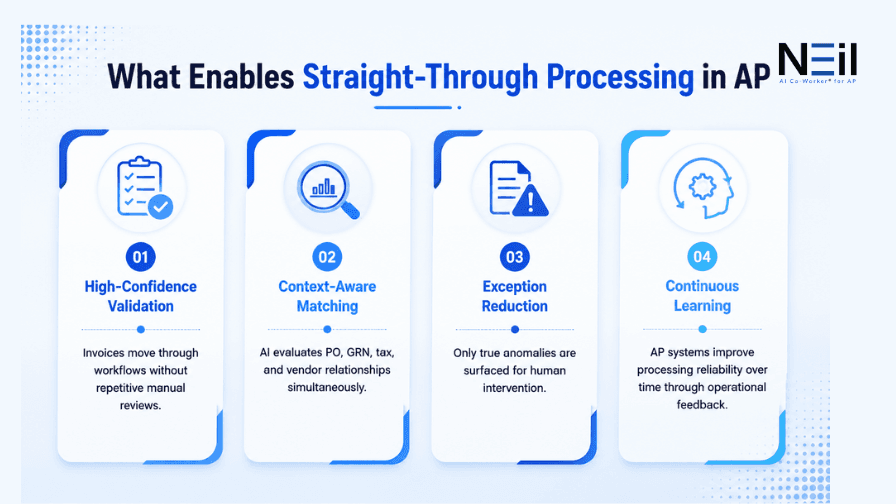
Straight-through processing (STP) in AP refers to the complete automation of an invoice from receipt to payment posting, zero human touchpoints, zero exceptions, zero delays. Itrepresents the highest level of AP maturity achievable with today's AI technologies.
While touchless processing focuses on eliminating manual effort, STP goes further, it ensures the invoice is not just processed without humans, but processed correctly the first time, every time. AI enables STP by combining high-confidence data extraction, intelligent validation, predictive matching, and autonomous approval decisions.
Here are the KPIs finance leaders use to measure AP automation maturity:
| KPI | Pre-AI Benchmark | AI-Enabled Benchmark |
|---|---|---|
| Invoice cycle time | 20–30 days | 2–5 days (70–90% reduction) |
| Touchless processing rate | 15–30% | 80–90% |
| Straight-through processing rate | 5–15% | 60–80% |
| Data extraction accuracy | 85–90% | 98–99.5% |
| Cost per invoice | $10–$15 | $2–$5 (40–60% reduction) |
| Invoice exception rate | 20–35% | 5–10% |
| Duplicate/fraud detection rate | 60–70% | 95–99% |
Benefits of AI in Accounts Payable
The business case for AI in accounts payable extends well beyond cost savings. Here is the full spectrum of value AI delivers across AP operations:
Operational Efficiency
- Invoice cycle time reduced from weeks to days
- Finance team capacity freed for strategic analysis and vendor management
- Elimination of manual data entry and its associated errors
Financial Impact
- 40–60% reduction in cost per invoice
- Increased early payment discount capture through optimized payment timing
- Reduced late payment penalties and supplier relationship strain
- Improved working capital management through real-time AP visibility
Risk and Compliance
- Near-elimination of duplicate payments and overpayments
- Proactive fraud detection before payments are released
- Automated audit trails and compliance documentation
- Consistent policy enforcement across all invoice types
Strategic Value
- Real-time AP data feeds into cash flow forecasting and treasury operations
- Predictive analytics enable proactive supplier negotiation strategies
- Finance leadership gains a strategic tool, not just an operational function
How Neil Enables Intelligent Accounts Payable Operations
Understanding the technology is one thing. Choosing the right implementation partner is entirely different. Neil, our AI Co-Worker for AP Transformation, represents a new generation of AI-native AP solution. It is built not around incremental automation, but around genuine intelligence.
Where legacy AP tools automate individual tasks, Neil orchestrates the entire AP function as an intelligent, adaptive system. Here is what that looks like in practice:
- Intelligent invoice processing that handles any format, language, or currency without manual configuration
- AI-led approval workflows that learn from organizational behavior and continuously optimize routing decisions
- Deep ERP integrations with SAP, Oracle, NetSuite, and Microsoft Dynamics — ensuring seamless data flow without rekeying
- Human-in-the-loop workflows that intelligently surface only genuine exceptions for human review
- Predictive AP analytics that give finance leaders real-time visibility into liabilities, cash positions, and payment optimization opportunities
- Multilingual invoice handling across 30+ languages, supporting global operations natively
- Finance workflow orchestration that connects AP to procurement, treasury, and compliance functions
Neil is designed for enterprises that are not just looking to reduce invoice processing costs, but to transform accounts payable into a strategic, intelligent finance function that creates measurable business value.
The Future of AI in Accounts Payable
The evolution of AI in accounts payable is still in its early chapters. What comes next is a shift from automation to true autonomy, agentic AI systems that orchestrate entire AP workflows end-to-end, conversational finance interfaces that let CFOs query liabilities and approve exceptions in natural language, and self-learning platforms that grow smarter with every invoice they process. Longer term, AI will extend beyond AP into integrated working capital management, with real-time predictive models optimizing payment timing, discount capture, and cash positioning simultaneously. The trajectory is clear: accounts payable is evolving from a transactional back-office function into an intelligent, strategic finance capability — and the organizations building that foundation today will be the ones setting the pace tomorrow.
Ready to Transform Your Accounts Payable Function?
Explore how Neil AI enables intelligent, autonomous AP operations. Book a demo today.
FAQs
AI in accounts payable refers to the use of artificial intelligence technologies, including machine learning, NLP, computer vision, and generative AI to automate and optimize the end-to-end invoice and payment lifecycle. Unlike traditional automation, AI systems learn from data, adapt to new formats, and make intelligent decisions autonomously.
What is AI in accounts payable?
AI in accounts payable refers to the use of artificial intelligence technologies, including machine learning, NLP, computer vision, and generative AI to automate and optimize the end-to-end invoice and payment lifecycle. Unlike traditional automation, AI systems learn from data, adapt to new formats, and make intelligent decisions autonomously.
How does AI improve invoice processing?
AI improves invoice processing by enabling intelligent data extraction from any invoice format, automating three-way matching, dynamically routing approvals, detecting fraud proactively, and providing predictive analytics; all with minimal human intervention. The result is faster cycle times, lower costs, and fewer errors.
What is intelligent invoice processing?
Intelligent invoice processing combines computer vision, NLP, and machine learning to extract, validate, and process invoice data with contextual understanding, going far beyond basic OCR to handle complex, non-standard invoice layouts across any format or language.
What is touchless invoice processing?
Touchless invoice processing refers to the complete handling of an invoice, right from receipt to payment, without any manual human intervention. AI systems capture, validate, match, approve, and schedule payment automatically, with human involvement reserved only for genuine exceptions.
How does AI reduce invoice processing errors?
AI reduces errors by eliminating manual data entry, applying consistent validation rules across every invoice, cross-referencing data against vendor masters and purchase orders automatically, and flagging anomalies before they result in incorrect payments. Leading AI AP systems achieve data extraction accuracy above 98%.
What is straight-through processing in AP automation?
Straight-through processing (STP) in AP refers to the complete automation of an invoice from receipt to ERP posting, zero manual touchpoints, zero exceptions. STP rates of 60–80% are achievable with advanced AI-powered AP platforms, compared to 5–15% in traditional environments.
How does AI help prevent invoice fraud?
AI detects invoice fraud by analyzing patterns across thousands of transactions simultaneously, identifying duplicate invoices with subtle variations, unusual vendor banking changes, amounts clustered just below approval thresholds, and other behavioral anomalies that human reviewers are unlikely to catch in time.
Can AI integrate with ERP systems?
Yes. Advanced AI-powered AP platforms integrate natively with major ERP systems including SAP, Oracle, NetSuite, and Microsoft Dynamics. These integrations enable seamless data flow between the AI AP layer and the ERP, ensuring accurate posting, real-time visibility, and consistent financial records without manual rekeying.
Which industries benefit most from AI in accounts payable?
Manufacturing, retail, healthcare, logistics, GCCs, shared service centers, and SaaS companies are among the highest-benefit industries. Any organization processing high volumes of invoices, managing complex vendor ecosystems, or operating across multiple geographies and currencies stands to gain significantly from AI-powered AP automation.
What technologies power AI in accounts payable?
AI-powered AP platforms combine machine learning, natural language processing, computer vision, intelligent document processing, generative AI, agentic AI, predictive analytics, and ERP orchestration into a unified intelligent system.