


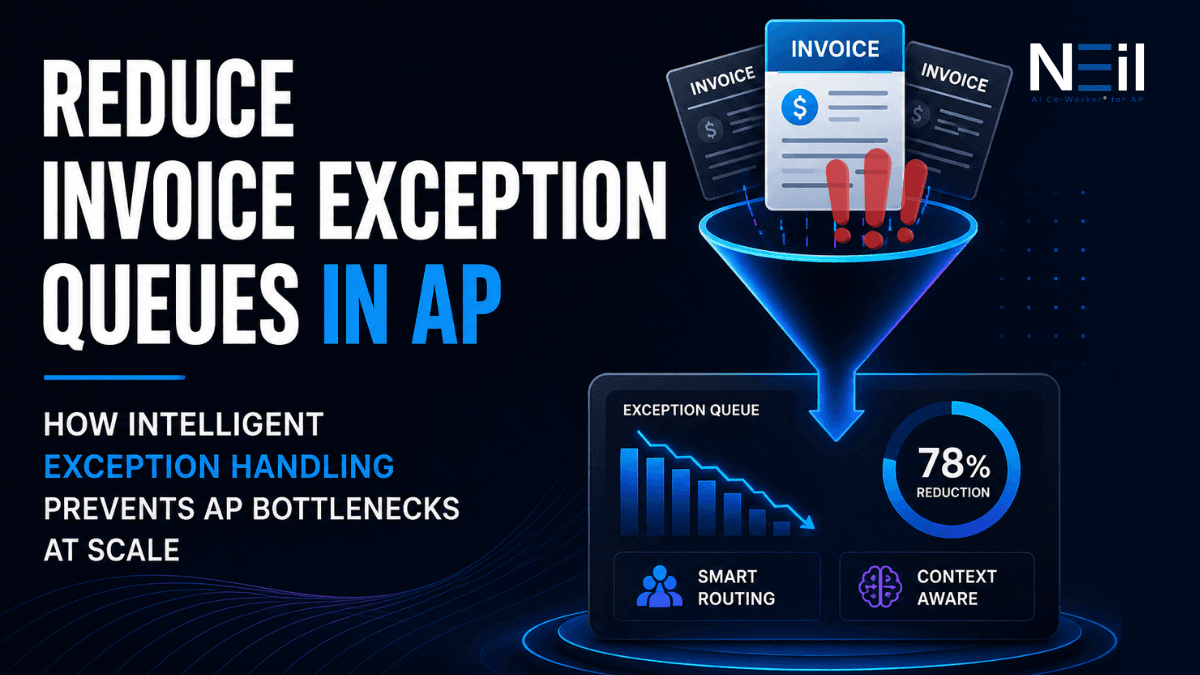
Accounts Payable automation is often discussed through the language of efficiency. Vendors promise faster invoice processing, lower operational costs, and touchless workflows that remove friction from the payable cycle. Yet for many finance teams, the operational reality is far more nuanced. Automation frequently improves invoice ingestion and accelerates standard processing, but the true test of AP maturity emerges in how effectively the organization handles invoice exception queues and overall exception handling workflows. .
This is where many transformation initiatives begin to reveal their limitations. A finance team may achieve respectable straight-through processing rates on routine invoices and still find itself trapped in growing invoice exception queues. Invoices stall because of purchase order mismatches, inconsistent tax treatment, supplier-side formatting changes, incomplete master data, or workflow routing ambiguity. These are not fringe cases. In large enterprises, they represent the normal operating complexity of global Accounts Payable. Reducing exception queues is therefore not merely an operational clean-up exercise; it is one of the clearest indicators of whether an AP automation system is truly intelligent or simply fast under ideal conditions.
The distinction matters because, at scale, invoice exception handling is where finance transformation either compounds into structural advantage or collapses into manual rework.
What Are Invoice Exception Queues in Accounts Payable, and Why Do They Matter?
An exception queue in Accounts Payable refers to the set of invoices that cannot move through automated processing because the system encounters uncertainty at some point in the workflow. This uncertainty may emerge during extraction, validation, routing, matching, or ERP posting.
Unlike routine invoice delays, exceptions require judgment. The system encounters information that does not fit its expected decision boundaries and pauses processing until manual intervention resolves the ambiguity. That pause introduces cost, operational latency, and downstream uncertainty that affects multiple adjacent financial processes.
The most common categories of invoice exception handling in Accounts Payable include:
- Validation mismatches: Invoice values fail to align with purchase orders, goods receipt notes, or predefined tolerance thresholds, creating exception queues that require manual review.
- Data inconsistencies: Supplier details, tax identifiers, or invoice references appear incomplete or structurally inconsistent.
- Workflow routing conflicts: Approval hierarchies fail to resolve correctly because ownership structures or business rules have changed.
- System integration failures: ERP posting or synchronization breaks because of field-level mapping conflicts or interface latency.
What makes exception queues particularly significant is their disproportionate operational impact. A workflow may process 90 percent of invoices automatically, but the remaining 10 percent often consumes the majority of manual effort, creating inefficiencies that ripple across the payable cycle.
Why Do Exception Queues Expand Faster Than Finance Teams Expect?
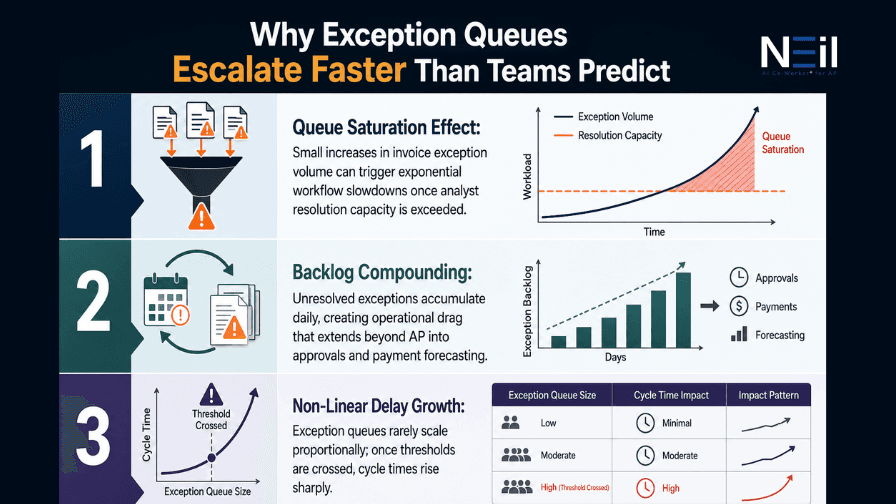
Exception queues rarely grow in a linear way, and this is one of the least understood operational realities in AP transformation. Finance leaders often assume that if exception rates rise by a few percentage points, operational effort will increase proportionally. In practice, AP workflows behave more like queueing systems.
Queueing theory tells us that once workload approaches resolution capacity, cycle time begins rising exponentially rather than incrementally.
Consider a practical example. Suppose an enterprise AP team processes 25,000 invoices each month. If 4 percent require exception handling, that creates 1,000 exception invoices. If the team resolves 50 exceptions daily, operational equilibrium is maintained.
Now imagine invoice complexity rises and exception inflow increases to 65 per day while resolution capacity remains fixed at 50. The daily backlog compounds. After ten working days, 150 invoices remainunresolved. After twenty days, the queue reaches 300. At that stage, delay is no longer isolated to exception handling; it begins distorting approval timelines, payment forecasting, and liability visibility.
This dynamic closely resembles congestion behavior in transportation systems. A highway may operate smoothly at 85 percent capacity, but once traffic density crosses a critical threshold, throughput collapses rapidly. AP workflows behave similarly. Small increases in exception variability can trigger disproportionately large operational slowdowns.
What Causes Exception Queues in Modern AP Automation Workflows?
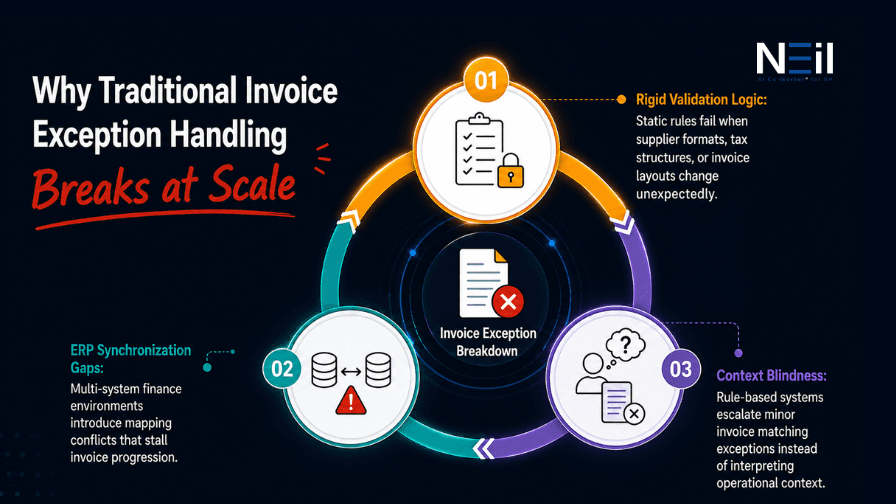
Most exception queues are not caused by automation failure. They are caused by automation rigidity.
Traditional Accounts Payable AP systems were designed around deterministic assumptions. They expect invoice structures to remain stable, validation rules to remain static, and workflow paths to remain predictable. Enterprise finance rarely behaves this way.
Modern payable environments are shaped by continuous operational variance:
- Supplier behavior evolves: Vendors frequently revise invoice layouts, line-item structures, and tax presentation.
- Regulatory requirements shift: Tax treatment changes across jurisdictions often introduce subtle validation complexity.
- ERP ecosystems grow layered: Multi-instance architectures create synchronization and field-mapping challenges.
- Approval governance changes: Organizational restructuring alters workflow ownership and routing logic.
Rule-based systems struggle because they interpret deviation as failure. Instead of reasoning through uncertainty, they escalate it. This creates structural bottlenecks where invoices requiring only contextual interpretation are unnecessarily pushed into manual review.
How Does Exception Handling Affect AP Unit Economics and Invoice Processing Costs?
One of the most overlooked dimensions of exception queues is their economic impact. Most AP automation ROI calculations focus on invoice processing cost reduction by comparing manual processing costs against automated processing costs.
This framing misses the deeper economic variable: exception cost density.
A touchless invoice may cost between $1 and $3 to process. A manually resolved exception invoice may cost $20 to $40 when analyst review time, escalation coordination, reconciliation effort, and audit documentation are included.
At an enterprise scale, this becomes material. An organization processing 200,000 invoices annually with a 6 percent exception rate generates 12,000 exception invoices. At an average handling cost of $25, that represents $300,000 in annual operational drag.
The secondary consequences are equally important:
- Missed discount capture: Delayed approvals reduce early-payment optimization opportunities.
- Working capital distortion: Liability visibility becomes less precise.
- Vendor relationship strain: Payment inconsistency increases supplier friction and affects vendor relationship.
- Month-end pressure: Exception-heavy workflows create reconciliation instability.
This is why reducing exception queues is not simply an efficiency initiative. It is a margin preservation strategy.
How Are Modern Finance Teams Reducing Invoice Exception Queues?
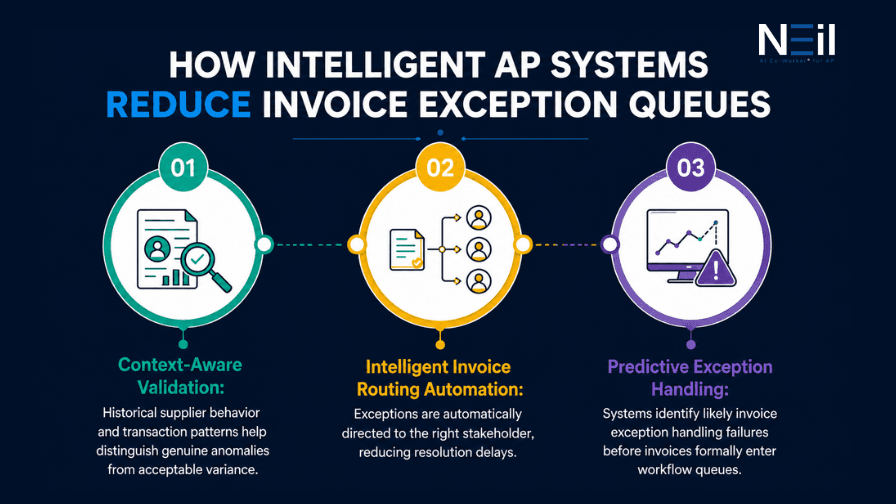
The shift from traditional AP automation to intelligent exception management is driven by contextual decision-making. Modern finance teams increasingly rely on systems capable of understanding workflow relationships rather than simply enforcing static rules.
Neil, an AI Co-Worker for Accounts Payable Transformation is built for this purpose. It integrates into existing workflows to digest context, remember historical patterns, and clear low-risk mismatches without manual intervention.
Three capabilities are proving especially effective:
Context-Aware Validation
Modern systems evaluate invoice fields in relation to historical transactions, supplier behavior, purchase order patterns, and prior approvals. This contextual understanding enables systems to distinguish benign variance from genuine anomalies.
A pricing variance that would trigger escalation in a deterministic workflow may be resolved automatically if historical context shows similar deviations have consistently been approved. This approach significantly improves invoice exception handling accuracy while reducing unnecessary escalations.
Intelligent Exception Routing
Traditional escalation chains often create delay because invoices are routed generically rather than strategically.
Intelligent routing improves workflow efficiency by enabling:
- Faster resolution: Exceptions reach the right stakeholder immediately.
- Reduced handoffs: Fewer routing errors lower operational friction.
- Greater accountability: Resolution ownership becomes transparent.
- Higher first-touch closure rates: Issues are resolved earlier in the cycle.
Continuous Workflow Learning
Sophisticated AP systems capture every manual correction as operational learning, enabling more effective predictive exception handling over time. Resolution logic is internalized and applied to future invoices, reducing recurrence and gradually improving workflow resilience.
This is the point at which automation begins evolving into operational intelligence.
Traditional AP automation vs. intelligent AP automation
The gap between these two approaches isn't just about features. It shows up in operating costs, headcount, and the ability to scale without adding people.
| Dimension | raditional Rule-Based AP | Traditional Rule-Based AP AI-Driven AP Automation |
|---|---|---|
| Validation logic | Fixed rules create rigid invoice exception handling workflows | Reads context — supplier history, contract terms, tolerance bands |
| When exceptions spike | Invoice exception queues expand rapidly and analysts get buried | Routing adjusts dynamically, priority is auto-set |
| Supplier variability | Non-standard formats break matching | Handles format variation through learned patterns |
| What the system learns | Nothing — rules stay the same | Every resolved exception strengthens predictive exception handling |
| ERP sync failures | Invoice stalls, someone gets a ticket | Retry logic and error mapping reduce dead stops |
| Exception rate (typical) | 15–30% of invoice volume | 2–8% with predictive prevention active |
| Cost per invoice | $8–$15 fully loaded | $2–$5 at high automation rates |
| Month-end behaviour | Close delays while queues are cleared | Queues are thin; close runs on schedule |
What Should Finance Leaders Measure to Control Exception Queues?
Exception queues cannot be managed effectively if they are not measured with precision.
The most useful operational metrics include:
- Exception rate: Percentage of invoices requiring manual review.
- Exception aging: Average duration invoices remain unresolved.
- Resolution velocity: Speed of exception closure.
- Repeat exception frequency: Recurrence of structurally similar issues.
- Escalation accuracy: Percentage of exceptions routed correctly on first assignment.
These metrics reveal workflow resilience far more accurately than straight-through processing rates alone.
Why Does Reducing Exception Queues Matter Beyond Accounts Payable?
The strategic impact of exception reduction extends far beyond invoice processing.
Lower exception density improves broader financial performance by enabling:
- Better liability forecasting: Cash outflows become easier to predict.
- Stronger vendor confidence: Payment consistency improves supplier trust.
- Cleaner audit readiness: Exception resolution becomes systematic rather than reactive.
- Faster financial close cycles: Fewer unresolved liabilities reduce reconciliation pressure.
This is why AP exception management increasingly sits at the center of finance transformation strategy.
What Comes Next for Exception Handling in AP?
The next generation of AP automation is moving toward predictive exception handling and exception prevention. Rather than resolving exceptions after they occur, intelligent systems are increasingly identifying likely failure conditions before invoices formally enter workflow processing.
This depends on richer contextual modeling across supplier behavior, transaction history, workflow patterns, ERP state awareness, and historical resolution outcomes. The shift is fundamental. The goal is no longer faster exception handling. It is exception avoidance through operational intelligence.
That is where true Accounts Payable transformation begins.
FAQs
Accounts payable exception handling refers to the process of identifying, analyzing, and resolving invoices that cannot move through automated workflows because of validation mismatches, missing information, routing conflicts, or ERP posting errors.
It is critical because unresolved exceptions create operational bottlenecks that delay approvals, reduce liability visibility, and increase manual effort. In enterprise environments, effective AP exception management determines whether automation delivers long-term scalability or simply shifts manual complexity into exception queues. Platforms like Neil improve accounts payable exception handling by applying contextual intelligence to resolve low-risk invoice anomalies automatically.
What is accounts payable exception handling in accounts payable, and why is it important?
Accounts payable exception handling refers to the process of identifying, analyzing, and resolving invoices that cannot move through automated workflows because of validation mismatches, missing information, routing conflicts, or ERP posting errors.
It is critical because unresolved exceptions create operational bottlenecks that delay approvals, reduce liability visibility, and increase manual effort. In enterprise environments, effective AP exception management determines whether automation delivers long-term scalability or simply shifts manual complexity into exception queues. Platforms like Neil improve accounts payable exception handling by applying contextual intelligence to resolve low-risk invoice anomalies automatically.
Why do invoice exception queues continue to grow after implementation?
Many invoice exception queues grow because traditional automation systems rely heavily on static rule engines. These systems process standard invoices efficiently but struggle when supplier formats change, tax logic varies, or approval workflows evolve.
As invoice complexity increases, rigid automation escalates more invoices into manual review. This creates backlog accumulation and slows workflow throughput. Neil addresses this by functioning as an intelligent AP automation layer that continuously learns from historical resolutions and adapts to operational variance, helping organizations reduce queue growth over time.
How can finance teams reduce invoice exceptions through accounts payable workflow automation?
To reduce invoice exceptions, finance teams need more than basic invoice digitization. Effective accounts payable workflow automation requires contextual validation, intelligent routing, and continuous workflow learning.
The most successful organizations focus on:
- Context-aware validation: Invoice data is evaluated against historical transactions and supplier behavior.
- Intelligent exception routing: Issues are sent directly to the most relevant stakeholder.
- Workflow learning loops: Resolution outcomes continuously improve future decision-making.
- Exception pattern clustering: Recurring anomalies are resolved structurally rather than repeatedly.
Neil enables this by orchestrating invoice processing, validation, routing, and resolution as a continuously learning AP workflow.
What causes invoice exception automation systems to fail?
Many invoice exception automation systems fail because they are designed around deterministic assumptions.
They expect invoice formats, tax structures, ERP mappings, and approval chains to remain predictable. Enterprise finance rarely behaves this way. Supplier-side variability, regional compliance complexity, and evolving approval logic introduce operational uncertainty that static systems cannot interpret.
Neil overcomes this by applying adaptive decision intelligence across invoice validation and exception resolution, enabling more resilient AP exception management in dynamic finance environments.
How does Neil improve AP exception management compared to traditional AP automation tools?
Traditional AP automation tools execute predefined rules and escalate anything outside those boundaries.
Neil improves AP exception management by operating as an AI Co-Worker for Accounts Payable transformation. It combines contextual invoice understanding, workflow memory, intelligent routing, and historical learning to make informed decisions dynamically.
This allows Neil to reduce manual review requirements, improve straight-through processing, and optimize accounts payable workflow automation across complex ERP environments.
What is predictive exception handling in intelligent AP automation?
Predictive exception handling is an advanced capability within intelligent AP automation that identifies likely invoice failures before they disrupt workflow processing.
By analyzing supplier behavior, transaction history, ERP states, and historical exception patterns, systems can anticipate likely friction points and intervene proactively.
Neil applies predictive exception handling to strengthen accounts payable exception handling by preventing avoidable exceptions before they enter workflow queues. This helps finance teams reduce invoice exceptions while improving operational stability at scale.