


If you've automated your accounts payable process and invoices are still ending up in an exception queue, the problem may not be the automation itself. An AP workflow can be automated across multiple stages and still depend on manual intervention when the underlying data is incomplete; matching rules are too rigid, or approvals take too long.
Straight-through processing (STP), often called touchless invoice processing measures the share of invoices that move from receipt to payment without human intervention. It is one of the clearest ways to assess how much of an AP process is actually running without manual effort.
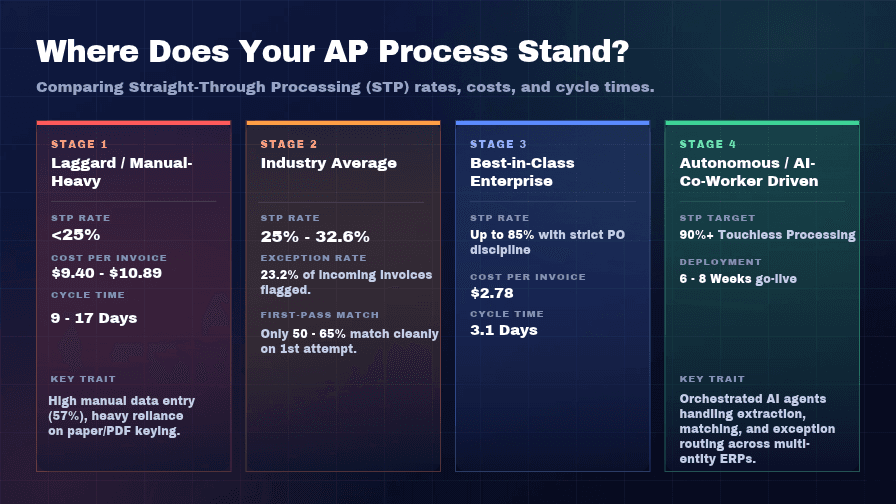
The gap between average and high-performing programs is significant. All-buyer benchmarks put touchless processing at around 25–32.6%, while best-in-class teams reach roughly 35–49%. Some enterprise programs with strong PO discipline report rates as high as 85–89%.
Low STP, therefore, does not automatically mean an AP automation platform is underperforming. In many cases, invoices are leaving the automated workflow because of specific problems in the process or the data being fed into it. Identifying and eliminating these STP challenges is how high-performing teams reduce cost per invoice from upwards of $9–$10 down to under $1.
What Prevents Invoices From Reaching Straight-Through Processing?
Invoices drop out of automated workflows when systems cannot validate incoming data, reconcile line items against purchase orders (POs) or goods received notes (GRNs), or execute policy decisions without a human sign-off.
The root cause of manual intervention in AP typically stems from three core breakdowns:
- Extraction and Data Errors: Nearly 39% of invoices contain data errors prior to matching.
- First-Pass Matching Failures: Invoice matching failures occur on 35–50% of incoming invoices due to missing receipts, mismatched vendor details, or formatting variations.
- Disconnected Systems: Procurement, receiving, and finance operate in silos, creating systemic accounts payable exception handling delays.
These issues are connected. Improving STP means addressing those failure points at their source.
What Are the Major Bottlenecks in AP Straight-Through Processing?
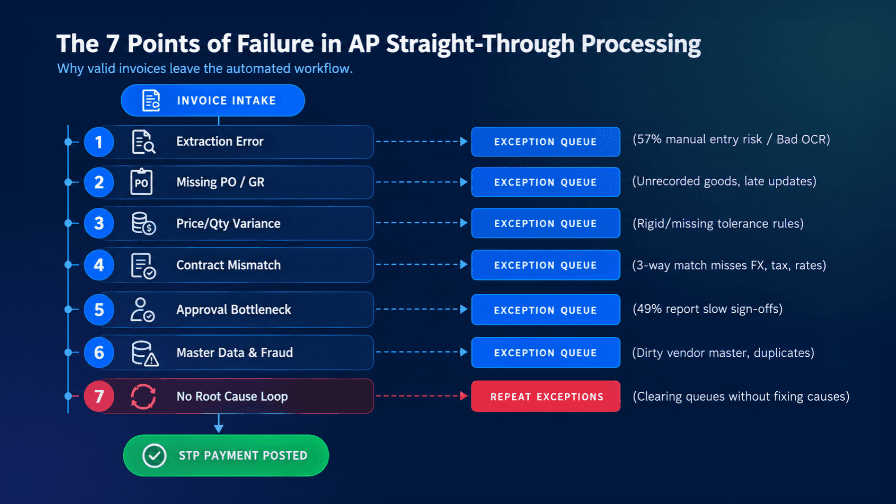
Poor or Inconsistent Data Capture
Legacy Optical Character Recognition (OCR) tools rely on rigid templates. When a vendor updates an invoice layout, or when low-quality scans enter the system, legacy OCR misreads critical fields. Historically, 57% of invoice data has required manual keying. Every manual touch introduces data errors that cascade into downstream matching failures.
How to fix it: Replace legacy, template-based OCR with AI-native document processing using vision-based models and fine-tuned Small Language Models (SLMs). Modern vision-SLMs achieve 99%+ field-level extraction accuracy across any invoice layout, language, or format without needing template configuration. Enforce immediate format and vendor master validation at intake to block bad data before it reaches matching.
Missing or Late Purchase Orders and Goods Receipts
A failed match does not always mean something is wrong with the invoice.
Sometimes the information needed to validate it simply isn't available. A delivery may have been completed, but the goods receipt has not yet been recorded. A supplier may invoice against a PO that was recently changed. In other cases, the invoice may contain an incorrect PO reference or GL account.
When AP, procurement, and receiving work from disconnected systems, these gaps become harder to resolve without manual intervention.
How to fix it: Establish automated PO-before-purchase controls and synchronize real-time data flows between procurement, ERPs, and AP systems. Autonomous AI agents can proactively check receiving logs and sync missing GRN entries prior to invoice intake, ensuring matching data is present the moment the invoice arrives.
Price and Quantity Variances Without Appropriate Tolerances
Not every mismatch requires human review.A supplier may deliver fewer units because an order was split across shipments. A contract price may have changed while the PO still reflects the previous rate. Without contextual logic, legacy systems treat a $0.02 rounding discrepancy with the same severity as a major pricing error.
How to fix it: Configure percentage- or value-based tolerances in the ERP or AP platform. These can be applied at invoice or line level so that small variances within an approved range can continue without manual review.The thresholds should reflect the type of spend involved. Freight, commodities, and other variable-cost categories may require different tolerances from fixed-price purchases.
Rigid Two- or Three-Way Matching
Two- and three-way matching provide important controls, but they do not capture every pricing or compliance issue.
An invoice can agree with the PO and goods receipt and still contain an incorrect tax amount, FX rate, or price that does not match the supplier's contractual rate. If the workflow only checks the PO and receipt, those issues may either pass through or surface later as another exception.
How to fix it: Upgrade to multi-way (N-way) contextual matching that cross-references invoices against underlying contract terms, historical billing patterns, and local tax compliance schemas. Autonomous AI agents can infer correct GL codes and cost centers based on context, bypassing manual intervention while maintaining strict governance.
Approval Workflows That Depend on Manual Sign-Off
An invoice can pass its matching checks and still spend days waiting for an approval.
This remains a common AP problem. One benchmark found that 49% of AP leaders believe invoice approvals take too long. Another 48% identified high exception volumes and manual intervention as their top operational challenge.
Approval policies often contribute to the delay when too many invoices are sent through the same workflow regardless of value, risk, or matching status.
How to fix it: Route invoices according to their value, risk, and exception status. A low-value invoice that has passed all relevant checks may need little or no manual intervention, while a high-value or unusual transaction can be sent to the appropriate approver.This gives reviewers more time to focus on transactions that actually need their judgment.
Duplicate Invoices, Vendor Master Issues, and Fraud Flags
Duplicate submissions, unverified changes to supplier banking details, and vendor record errors represent legitimate operational risks. With 76% of organizations reporting actual or attempted payment fraud annually, security checks cannot be bypassed. However, mixing routine data-entry errors with genuine security flags paralyzes AP teams.
How to fix it: Decouple security risk controls from routine processing. Deploy automated fraud detection at intake and maintain continuous vendor master hygiene. Secure systems utilise automated trust layers, combining segregation of duties, role-based controls, and pattern anomaly detection to intercept actual risk factors while letting legitimate, routine invoices flow through unhindered.
No Feedback Loop From Exceptions to Root Causes
An exception queue can tell AP teams a lot about where their process is breaking down, but only if that information is tracked.
If an invoice is manually corrected and sent on its way, the immediate problem is solved. The same issue may appear again the following week with the same supplier or transaction type. Over time, this creates a cycle where AP keeps clearing exceptions without reducing the reasons they occur.
How to fix it: Categorize exceptions by cause and monitor the trends. Price variance, missing receipt, extraction error, approval delay, duplicate invoice, and vendor master issues are examples of categories worth tracking.
Once the largest sources are visible, AP teams can focus improvement efforts where they will have the greatest effect. Reducing recurring exceptions is generally more valuable than simply increasing the speed at which the queue is cleared.
Achieving 90%+ STP: Where Neil, the AI Co-Worker® for Accounts Payable, Fits In
Solving straight-through processing challenges requires moving away from piecemeal automation software. Disjointed tools simply pass exceptions from one silo to another.
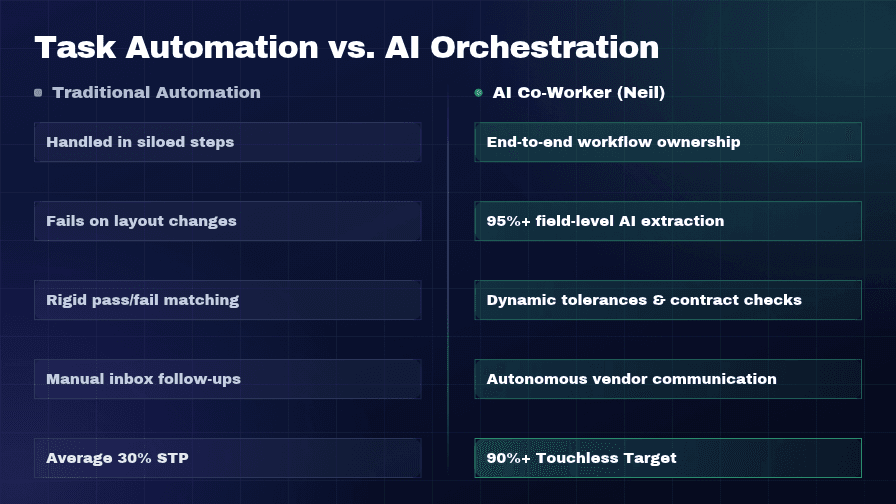
Neil, the AI Co-Worker® for Accounts Payable, is built as a supervised team of specialized AI agents running on fine-tuned Small Language Models (SLMs). Unlike traditional software that requires an operator, Neil acts as the operator; reasoning, deciding, and executing across the end-to-end AP lifecycle:
- Omnichannel Intake & Vision Extraction: Consumes invoices across email, portals, SFTP, EDI, and e-invoice networks. Using vision-SLM architecture, Neil achieves 99%+ field-level extraction accuracy across any format or language without templates.
- Autonomous N-Way Matching: Reconciles invoices against POs, GRNs, contracts, GL codes, and local tax schemas.
- Integrated Vendor Helpdesk: Resolves one of the largest hidden AP costs. Neil includes an autonomous, 24/7 multilingual vendor helpdesk that handles payment status, remittance, and mismatch inquiries instantly across 50+ languages—removing routine inquiry tickets from human teams.
- ERP-Agnostic Integration: Operates across multi-ERP environments (SAP, Oracle, Dynamics) via modern REST APIs and Model Context Protocol (MCP) connectors, going live in 6 to 8 weeks.
- Enterprise Trust Layer: Operates within strict controls—including ISO 27001, SOC 2 Type 2, PII masking, segregation of duties, and audit trails—ensuring safe, compliant execution.
Conclusion
Low straight-through processing rates are not an inevitable cost of doing business; they are a sign of systemic friction across data capture, matching logic, and approval routing. Treating exception queues as routine task lists guarantees your team will spend hundreds of hours clearing the exact same errors month after month.
Reaching best-in-class performance—80–90%+ STP and sub-$1 unit costs—requires looking beyond traditional, rule-based automation software. By addressing bottlenecks at their root cause and deploying agentic AI Co-Workers designed to reason through unstructured data, execute multi-way matching, and handle vendor inquiries, enterprise finance organizations can transform accounts payable from a manual cost center into a modern, autonomous function.
FAQs
Invoices commonly leave the STP workflow because of inaccurate invoice data, missing or mismatched PO and goods receipt information, price or quantity variances, approval requirements, or duplicate and fraud-related controls. Around 23.2% of incoming invoices are flagged as exceptions on average.
Why do invoices fail straight-through processing?
Invoices commonly leave the STP workflow because of inaccurate invoice data, missing or mismatched PO and goods receipt information, price or quantity variances, approval requirements, or duplicate and fraud-related controls. Around 23.2% of incoming invoices are flagged as exceptions on average.
What are the biggest bottlenecks in AP straight-through processing?
The most common bottlenecks include poor data capture, missing or late POs and goods receipts, unsuitable tolerance rules, rigid matching processes, slow approvals, vendor master issues, and recurring exceptions that are not addressed at their source.
How can companies fix invoice matching failures when POs or GRNs are missing?
Missing PO or receipt data is often an operational silo problem between procurement, receiving, and finance. Companies can fix this bottleneck by enforcing PO-before-purchase policies and using AI agents to automatically query and reconcile receiving records before the invoice enters the matching queue.
How do invoice exceptions affect STP?
When an invoice enters an exception workflow, it generally requires manual intervention, which lowers the STP rate. High exception volumes can also increase processing costs and extend payment cycles.
How does rigid approval routing bottleneck AP workflows, and what is the solution?
Sending every invoice through manual approval chains creates severe bottlenecks, with nearly half of AP leaders reporting approval delays. The fix is policy-aware routing: low-risk, perfectly matched invoices below designated thresholds post straight through to the ERP, while human intervention is reserved exclusively for high-value or policy-exception transactions.
Why does task-level software fail to solve STP bottlenecks permanently?
Piecemeal automation tools—like an OCR plugin combined with a separate workflow bot—only solve isolated steps. When an exception occurs downstream, the task software hands the invoice back to a human operator. Permanent STP improvement requires an agentic AI operating model where specialized agents reason, handle exceptions, update ERPs, and communicate with vendors end to end.