


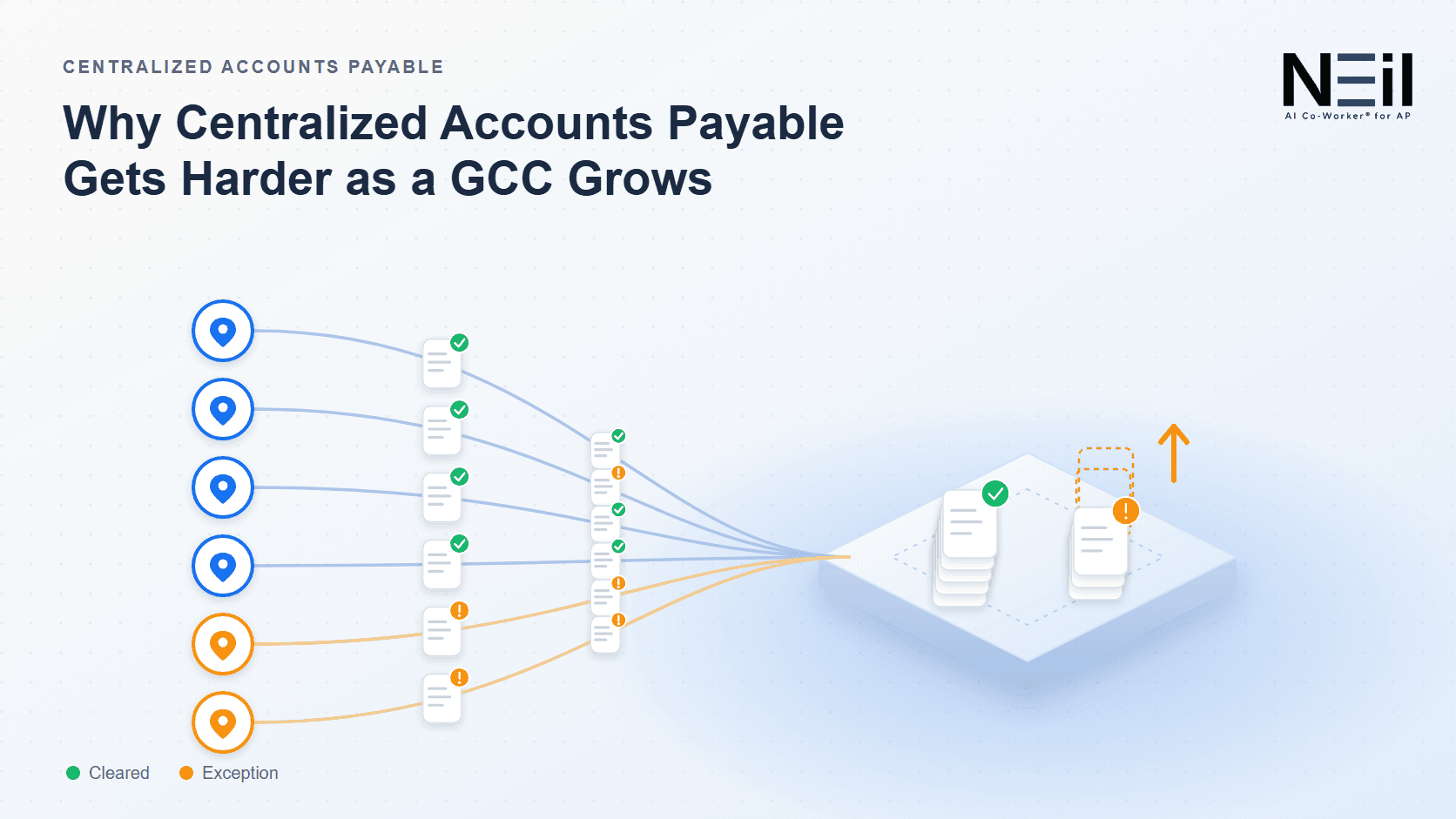
Centralizing accounts payable (AP) in a Global Capability Center (GCC) helps organizations consolidate invoice processing across countries, improve efficiency, and reduce the cost per invoice as volumes grow. But there’s a catch: as you add more countries, invoice exceptions can grow faster than invoice volumes.
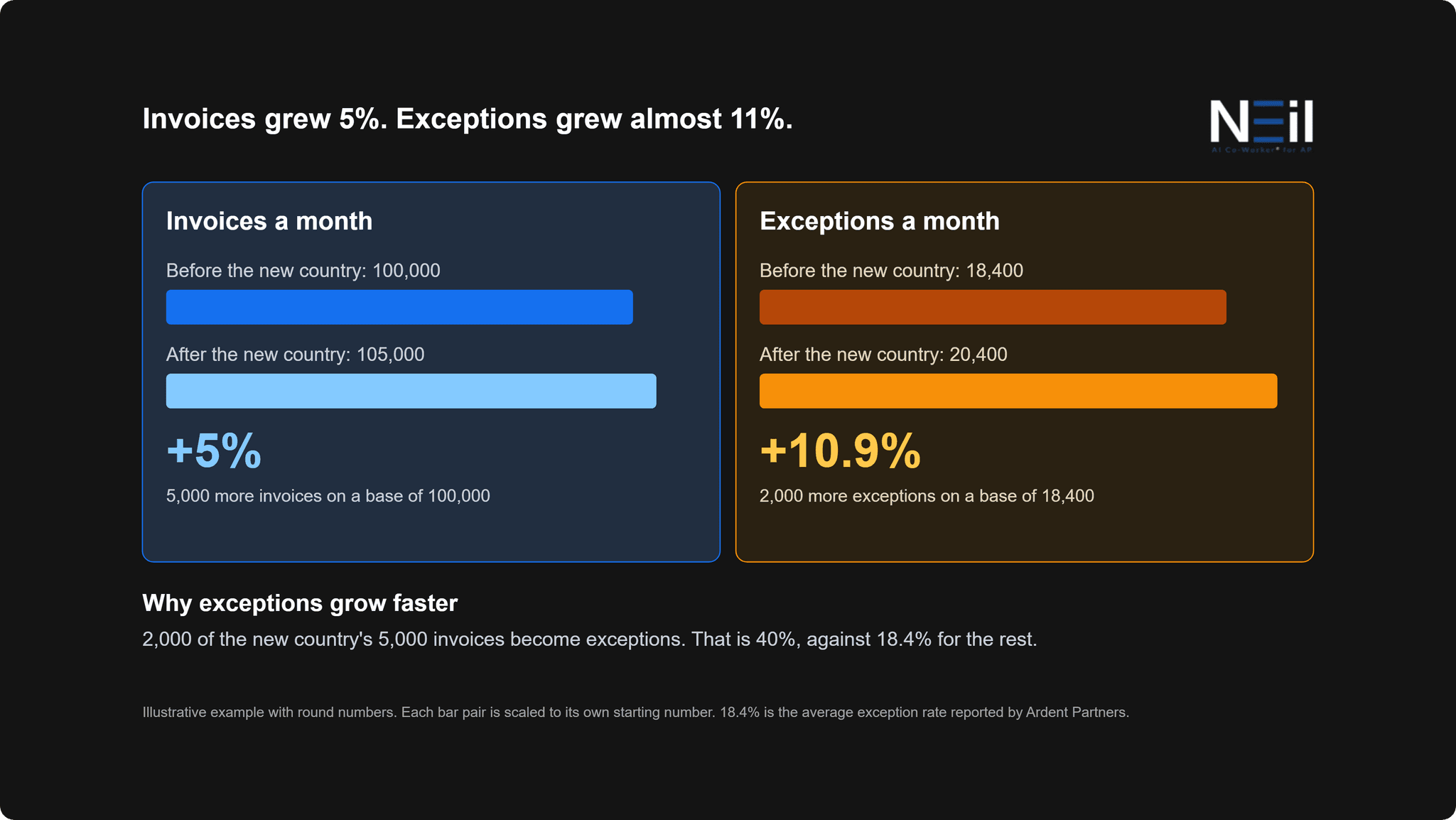
Consider this example. An AP center processes 100,000 invoices a month, with 18,400 requiring exception handling. Now, a new country adds 5,000 invoices, of which 2,000 become exceptions.
While total invoice volume increases by just 5%, exceptions rise by nearly 11%, from 18,400 to 20,400.
The reason is the new country’s higher exception rate. In the existing operation, 18.4% of invoices require exception handling (18,400 out of 100,000). This matches the 18.4% average reported by Ardent Partners.
In contrast, the new country has a 40% exception rate, with 2,000 of its 5,000 invoices requiring intervention. As a result, the new country contributes a disproportionately high number of exceptions relative to the volume of invoices it adds.
For AP and finance leaders, this creates a critical challenge: centralizing more work does not automatically translate into greater efficiency. Even when routine activities, such as invoice data capture, are automated, country-specific rules, process variations and compliance requirements can still create additional exceptions. Those exceptions consume time and resources.
This post shows why exceptions outgrow volume, which rules to set centrally, and how to check your own numbers.
Why do invoice exceptions grow faster than volume?
Invoice count shows how many invoices arrive. It does not show how much work they create. The better measure is how many invoices a person has to handle.
Before and after the new country joins
| Before the new country | After the new country | change | |
|---|---|---|---|
| Invoices a month | 100,000 | 105,000 | +5% |
| Exceptions a month | 18,400 | 20,400 | +10.9% |
Invoices grew 5% (5,000 on a base of 100,000), but exceptions grew almost 11% (2,000 on a base of 18,400). The new country's invoices fail at 40%, against 18.4% for the rest.
Why would a new country fail so much more often? Your process was built around the countries you already run. Its reading templates, matching rules and approver lists all assume invoices that look like yours.
Why this matters for cost and speed
Each exception takes a person’s time to find documents, ask colleagues and update the record. Clean invoices need none of that. As a result, a higher exception rate raises both cost and processing time.
In Ardent’s benchmark, the average invoice costs $9.84 and takes 8.2 days to process. Our guide to invoice exception queues shows how a backlog builds when exceptions pile up.
To see where the extra work comes from, follow one invoice from a new country.
What goes wrong with a new country's first invoices
Say Poland joins your center. The first invoice arrives from a packaging supplier. Before anyone can pay it, five things can go wrong:
- The format. Poland requires suppliers to issue invoices through KSeF, its national e-invoice system, so the invoice your team receives may look nothing like the PDFs you handle today.
- The tax details. It carries a local tax ID, and your supplier records may have no field for it.
- The purchase order. The PO sits in the Polish entity's ERP, which can use a different approval workflow from your main one.
- The approver. The right approver is a plant manager in Poland whom nobody at your center has met.
- The supplier. When the invoice stalls, the supplier writes in Polish to ask where the payment is.
None of these is hard on its own. Together, they turn a routine invoice into a case that needs several people and a trail of emails.
Three countries, three e-invoice rules
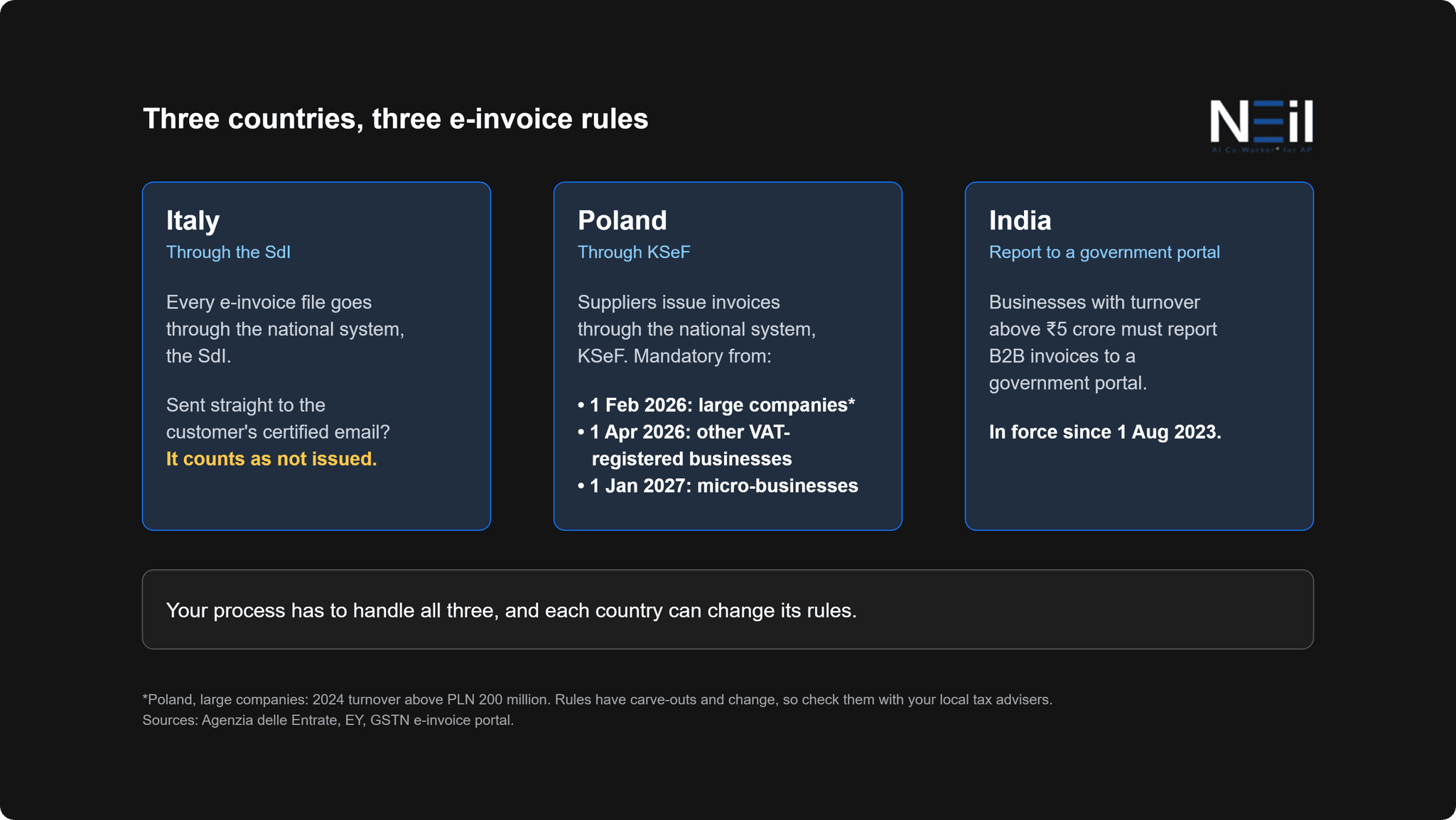
Poland is not the only country with its own rules. Here is how three differ.
In Italy, the tax authority says an electronic invoice file must always go through its national system, the Sistema di Interscambio (SdI). An invoice sent straight to the customer's certified email address counts as not issued.
In Poland, according to EY's summary of the law, KSeF is mandatory from 1 February 2026 for companies with 2024 turnover above PLN 200 million. From 1 April 2026 it covers other VAT-registered businesses, and from 1 January 2027 it covers micro-entrepreneurs.
In India, businesses with turnover above ₹5 crore must report B2B invoices to a government portal. That has applied since 1 August 2023.
These rules have carve-outs and they change, so check them with your local tax advisers. For your team, the point is simple: each country can deliver invoices in a different form, and your process has to handle each one.
Three problems that grow with every country you add
Now the Polish invoice is stuck. What happens next is where three problems show up. All three come from variety, not volume, so adding more invoices from a country you already handle adds little to them.
Country knowledge sits with a few people
The first question is who knows how Polish invoices work. If your center set up Italy last year, the answer is whoever did that, and they may have moved on.
Some knowledge is never written down: who signs off in a given entity, or what mistake a certain supplier always makes. When those people are away or leave, the invoice waits because nobody else knows the next step.
Exception status lives in email threads
Someone at the center emails the plant. The plant emails the supplier. The answer comes back days later, and nobody can see how many other invoices are waiting on the same question.
Suppliers add to the load when they write in different languages to ask where their payment is. Ardent reports that AP staff spend 21.9% of their time dealing with suppliers, and says exceptions cause much of it.
E-invoicing rules change on other people's schedules
Poland's mandate began in 2026. The EU's VAT in the Digital Age (ViDA) programme sets 1 July 2030 as the start of digital reporting for cross-border B2B transactions, which will rely on mandatory e-invoicing.
Each change needs someone to find it, work out what it means for invoice handling, and update your process and tools. More countries mean more deadlines that other people set.
Managing all three problems starts with deciding who decides what.
What should stay local in centralized accounts payable?
Back to the Polish invoice. Should your center decide how it is handled, or the team in Poland?
Standardizing everything ignores local law. Leaving everything local repeats each country's separate process inside one team, which defeats the purpose of centralizing. The practical answer is to split decisions: some are set once for every country, and some stay local but are run by your center.
Three questions to sort each decision
Ask these questions about each decision:
- Does a local law or tax authority set the rule?
- Does the decision depend on a local format, language or supplier relationship?
- Would different answers in different countries create a control or audit risk?
If the answer to question 1 or 2 is yes, the rule stays local, but your center runs it and a named person owns it. If only question 3 is yes, standardize it.
Two examples. Poland's KSeF rule gets a yes on question 1, so it stays local with a named owner. The format of your approval record gets a yes only on question 3, so you standardize it across every country.
A starting point you can adapt
"Standardize centrally" means one rule for every country. "Keep local, run centrally" means the rule differs by country but your center applies it. Use the table as a starting point, not an industry standard.
| Decision | Standardize centrally | Keep local, run centrally |
|---|---|---|
| Approval workflow | Who can approve, who can pay, and the record kept of each approval | Approval limits for each entity |
| Invoice matching | The matching method and the maximum time an exception can stay open | How far a price or quantity can differ before review |
| Tax and statutory checks | How each rule is written down and tested | The rules themselves, each with a named owner |
| Supplier master data | How new suppliers and bank-detail changes are verified | Local tax ID formats and registration data |
| Payment runs | Payment schedule and approval steps | Bank file formats, cut-off times and payment methods |
| Supplier communication | How supplier queries are tracked and answered, and how fast | Language |
Naming an owner for each local rule also fixes the first problem. The knowledge no longer sits only in someone's head.
Why does AP automation not fix growing exceptions?
Once the rules are clear, the natural next move is more automation. It helps, but only with invoices that follow the rules. Faster data capture, approval routing and ERP workflows speed up the invoices that already pass cleanly: 81,600 of the 100,000 in the example.
Why a written rule cannot settle a new case
Take the Polish invoice again. A tool built on fixed rules reads invoices with templates, and nobody has built one for this format yet. So the invoice goes to manual entry, where someone types the data by hand.
Then the amount fails the match. The tool flags the mismatch and waits for a person. The supplier writes to ask about payment, and that email lands in a person's inbox too.
Each of these steps needs someone to decide what to do. A rule written in advance cannot settle a case nobody foresaw.
What this means when you add countries
You can automate well and still need more people with each new country. The routine work gets faster, but the exceptions, local tax questions and supplier follow-ups keep growing.
Before you buy another tool, check whether your own numbers show the same pattern. The next section shows how.
How can you check where your center stands?
You can run most of these checks with data you already have. The results show whether a new tool would pay off.
Six checks you can run this month
- Split last month's invoices by country and count the exceptions in each. Compare each country's rate with your average.
- Work out what an invoice costs you in each country, not on average. An average hides the countries that cost the most.
- Trace your last 20 exceptions to the person who resolved each one. If two names account for most of them, your know-how sits with two people.
- Time each exception from arrival to resolution, and note how many ran through email.
- List the countries where invoices arrive through a government system, and name who keeps those rules current.
- Pick one invoice at random. Check that you can show an auditor who approved it, and why.
How to read the results
- A few countries drive most exceptions. Start with those countries.
- The same two people resolve most of them. Write down what they know before you add another country.
- Exception rates are high everywhere. Look at your process and tools, not at one country.
Test the next country before it goes live
Before the next country goes live, run a sample of its real invoices through your process, for example 50. The share that become exceptions is your own version of the 40% in the example. You then know what that country will cost before you commit.
How does agentic AI handle invoice exceptions, and when don't you need it?
If your checks show high exception rates in some countries, software that investigates exceptions on its own is worth testing. Agentic AI is given a goal, such as resolving an exception, and takes each next step within limits you set.
Take the Polish invoice again, now billed for 100 units while the goods receipt shows 90. A rule-based tool flags the mismatch and waits. An agentic system checks the receiving record and sees that 10 units are still in transit.
It then asks the warehouse for the delivery date and updates the record. It hands the case to a person only when the decision needs judgment or approval.
You may not need it. If your exception rate is low in every country and your last 20 exceptions trace back to many different people, your current tools are probably enough.
What Neil does in a multi-country center
Neil, e42.ai's AI Co-Worker® for Accounts Payable, handles the work around invoice exceptions. It can:
- Read invoices across vendor formats and languages.
- Match them against purchase orders and goods receipts.
- Handle exceptions by flagging duplicates, errors and policy violations and routing them for resolution.
- Answer vendor questions about payments and invoice updates.
- Post to your ERP. Neil is ERP-agnostic and works with SAP, Oracle, Dynamics and custom ERPs.
What Neil needs from you
Neil needs accurate supplier and purchase order data, clear policies and a working ERP connection. It does not replace local expertise, so test any tool on your own countries first.
Before you add the next country, test its first invoice
Every country you add to centralized accounts payable brings more variety, and variety is what turns invoices into exceptions. You can see it coming before the country goes live.
Take that country's first real invoice and walk it through your process on paper. Every step where you would have to ask someone is an exception waiting to happen.
Still deciding whether to centralize? Our post on why AP transformation is the starting point for GCC re-architecture explains why to start with AP.
Ready to see how this works for your countries and ERPs? Talk to Neil
FAQS
The biggest challenges are country-specific tax and e-invoicing rules, several ERPs, exceptions handled over email, know-how held by a few people and supplier questions in many languages. Each grows with every country you add. List which one costs your team the most time, and start there.
What are the biggest challenges of centralized accounts payable in a GCC?
The biggest challenges are country-specific tax and e-invoicing rules, several ERPs, exceptions handled over email, know-how held by a few people and supplier questions in many languages. Each grows with every country you add. List which one costs your team the most time, and start there.
What is the average cost per invoice in accounts payable?
Ardent Partners reports an average of $9.84 per invoice and 8.2 days to process one. Its top performers, the 20% with the lowest costs and shortest cycle times, pay 79% less per invoice. Measure your own cost for each country, because an average can hide where costs rise.
How do you manage accounts payable across multiple ERPs?
Set common standards and controls, then document how each ERP and entity differs. Keep one view of invoice status and exceptions across all of them. Neil is ERP-agnostic and works with SAP, Oracle, Dynamics and custom ERPs, so your entities do not have to move to one platform first.