

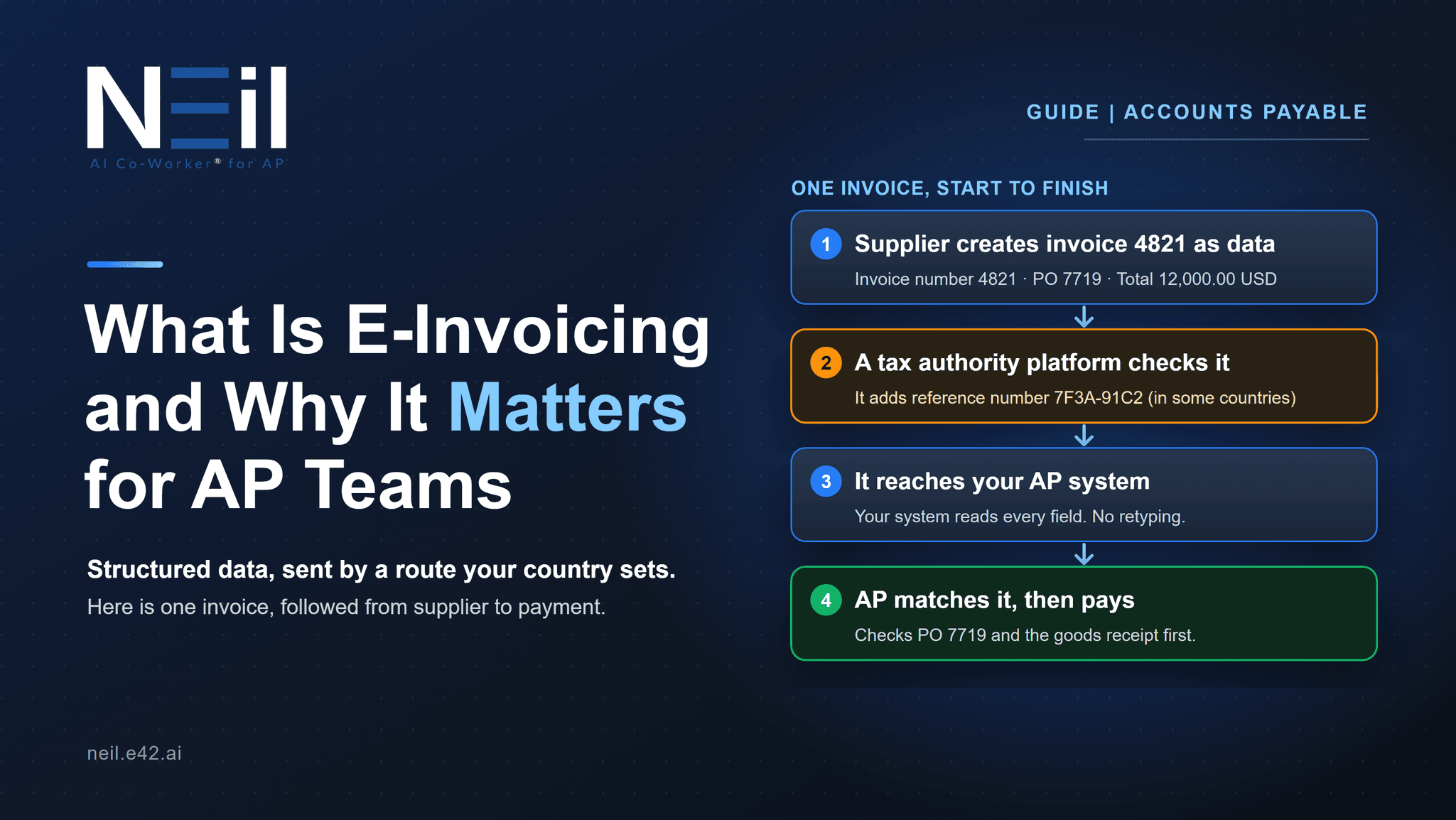
Your supplier sends an invoice. The amounts are right, the purchase order (PO) number is right and the layout is clean. In some countries, that still is not enough.
Depending on where the supplier is based, the invoice may have to be created as structured data and sent through a government platform or a national network. The tax authority may check it, or give it a registration number, before it counts. If that step is skipped, the invoice may not count as an invoice at all.
That is the idea behind e-invoicing. It is not a nicer PDF. It is invoice data that a system can read, often checked by a tax authority on its way to you.
For AP teams, that means some invoices arrive through a portal or network instead of your inbox. Others carry a reference number you must check before you pay.
This guide explains what counts as an e-invoice, how one reaches you and why governments require it. It also shows what to do first.
What is e-invoicing?
E-invoicing means an invoice is created, sent and received as structured data, not as an image of text. It has three parts:
- Structured data. The invoice is stored like a filled-in form, with each detail in its own named box. The file is usually XML, a way of writing data so that every item has a name.
- A defined route. It travels from your supplier's system to yours by the route the supplier's country sets.
- Local rules. In some countries a government platform checks it on the way. In others, no authority sees it first.
Each box on the form is called a field. Here is one invoice stored that way:
| Field (the box name) | Value inside it |
|---|---|
| Invoice number | 4821 |
| Issue date | 2026-10-12 |
| PO number | 7719 |
| Quantity | 100 |
| Total | 12,000.00 USD |
The box name tells your system what each value is.
Now compare the two ways of receiving the same invoice. With a PDF, a person or an OCR tool (software that reads text from an image) has to find "4821" on the page, decide it is the invoice number and copy it across. With an e-invoice, the box named "Invoice number" already holds 4821, so there is no guesswork.
ICAEW defines e-invoicing as the exchange of invoice documents between a supplier and a customer in a structured digital format. Thomson Reuters draws the same line: a digital invoice can be a PDF, but an e-invoice carries structured data.
So the test is not whether an invoice is sent electronically. It is whether its data is structured and follows the rules that apply to it.
How does an e-invoice differ from a PDF, a scan and EDI?
Here is the puzzle: a PDF and an e-invoice can look identical on screen. To your system, they are very different. The table uses the definition in the sources above, and legal definitions differ by country.
| Invoice type | Needs OCR or a person to read it? | Needs OCR or a person to read it? | Counts as an e-invoice? |
|---|---|---|---|
| Paper invoice, scanned | No | Yes | No |
| PDF sent by email | No | Yes | No |
| XML invoice | Yes | No | Yes |
| EDI invoice message | Yes | No | It can, if it meets the format your country requires |
A simple test: can your system read every box without guessing? A PDF is made for a person to read. A structured e-invoice is made for a system to process.
The EU rules for public bodies draw the same line. A note in the European Commission's Directive says a mere image file should not count.
What does an e-invoice look like?
To your system, a PDF is a picture of text. An e-invoice is a list of named boxes, such as invoice number, quantity and price, each with its value inside.
In the EU, the standard that defines those fields has two XML formats that meet it, called UBL and CII, according to the European Commission. Because every invoice follows the same definitions, "quantity" means the same thing on all of them.
How does an e-invoice reach your AP team?
Picture three invoices landing in your AP queue on the same Monday. One comes from a supplier in India, one from Italy and one from the United States. All three are invoices, but they took different routes, and each asks something different of your team.
| Supplier country | How the invoice reached you | What your team does |
|---|---|---|
| India | The supplier registered it on the government portal first. It carries a reference number and a QR code. | Check the reference number is present and store it with the invoice. |
| Italy | It came through the national tax authority system, not your mailbox. | Make sure your system receives the file from that channel. |
| United States | The supplier sent it directly, or over EDI or another network. No government clearance sits in between. | Apply your usual checks. There is no platform response to keep. |
So your AP system has to support both the invoice format and the delivery route that each supplier's country requires. Thomson Reuters and Fonoa group these routes into three types, and some countries combine them.
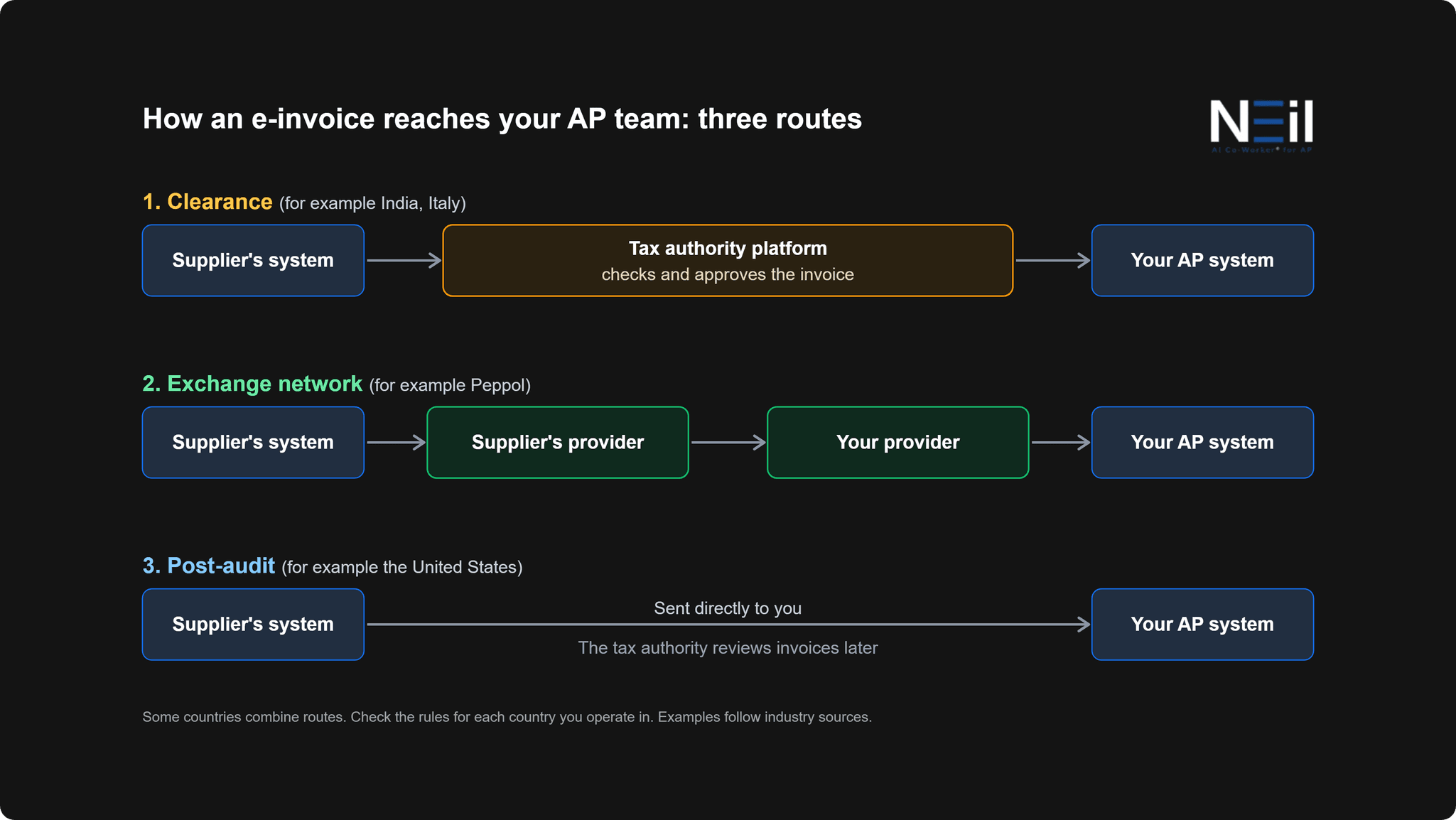
Clearance: the tax authority checks it first
In a clearance model, the invoice goes through a tax authority platform before, or as, it is sent to the buyer. The authority validates it in near real time.
India shows how this works for covered transactions, step by step:
- The supplier's system generates the invoice data.
- It sends that data to the government's Invoice Registration Portal.
- The portal authorizes the invoice, adds a digital signature and a QR code, and returns an Invoice Reference Number (IRN).
- The supplier prints the IRN and the QR code on the invoice.
- The supplier shares the invoice with you.
The GST e-invoice portal describes this sequence. Under Rule 48(5) of the CGST Rules, a covered invoice issued outside the process is not treated as an invoice.
Italy follows the same idea. The invoice file must go through the tax authority's national system to reach the customer. Watch for rejected or undelivered files, and decide who resolves them.
For your AP team, a missing reference number is a red flag, not a formatting detail. In India, an invoice that arrives without an IRN should be queried with the supplier before you process it.
Keep one limit in mind. A government check proves the invoice was registered. It does not prove the goods arrived or the price was agreed.
Post-audit: sent directly and reviewed later
In a post-audit model, the supplier sends the invoice straight to you, without submitting it to the tax authority first. The authority can review records later, for example in an audit.
Both Thomson Reuters and Fonoa name the United States as an example. Even then, keep accurate records, because the authority can ask to see them. No clearance step does not mean the invoice is correct, so keep the original file and run duplicate checks.
Exchange network: providers pass it along
Think of how email works. You and your supplier do not need the same email provider to exchange messages. An exchange network works the same way for invoices: each side connects through its own service provider, and the providers pass the invoice between them.
Peppol is one such network. According to ICAEW, the UK government has said Peppol will be its core interoperability network for e-invoicing, and NHS England suppliers already use it.
Confirm which formats and supplier identifiers your connection supports. A network on its own has no tax authority check, though some countries add reporting on top. Because sources sort a few countries into different models, confirm each country's model with your tax adviser.
Why do governments require e-invoicing?
Why would a government care how your supplier formats an invoice? Because an invoice is also a tax record.
When invoice data arrives in a structured format, an authority can compare what sellers report as sales with what buyers report as purchases. That makes mismatches, and some kinds of VAT fraud, easier to spot.
The scale is large. The European Commission says EU countries lost €99 billion in VAT revenue in 2020. It conservatively estimates that a quarter of the missing revenue comes from VAT fraud linked to trade between EU countries.
Its VAT in the Digital Age proposals aim to help countries collect up to €18 billion more VAT a year, with €11 billion of that from anti-fraud measures. These are forecasts, not results. The cross-border digital reporting rules start on 1 July 2030.
Why does your company need e-invoicing?
There are two reasons: meeting local rules and reducing manual work.
To meet local rules
In some countries, the law decides whether an invoice counts. In Italy, an invoice file sent straight to the customer's certified email address counts as not issued.
In India, the portal signs each covered invoice with an IRN, and an invoice issued outside that process is not treated as an invoice. Confirm the current rules and thresholds with your tax adviser.
In the EU, the eInvoicing Directive requires public bodies to receive e-invoices that follow the European standard. On its own, it does not make every private business send them, although national laws can.
To reduce manual work
Structured fields remove one task completely: reading an invoice and retyping its fields. ICAEW says automated processing reduces errors and processing times, and the GST portal lists less data-entry error and fewer reconciliation gaps.
The gain shows up only if your ERP (your finance system) or AP tool reads the fields directly. If the file still goes through OCR or manual entry, nothing improves.
What stays the same?
An e-invoice improves how the data arrives. It does not tell you whether the goods did. Say a supplier bills 100 units, and your goods receipt shows 90.
| Step | PDF Invoice | E-invoice | |
|---|---|---|---|
| 1 | Invoice arrives | By email or portal | Through a platform or network |
| 2 | Data captured | Read from the document | Taken from the fields |
| 3 | Matched to PO and goods receipt | 100 billed, 90 received | 100 billed, 90 received |
| 4 | Result | Mismatch, flagged | Mismatch, flagged |
| 5 | Who resolves it | A person | A person |
Your system may capture the data perfectly, and the invoice may pass the required exchange process. Neither explains the missing 10 units.
The e-invoice removes the work in step 2. It does not remove steps 3 to 5, or approval routing and payment controls.
Not every failure is the same, and they do not share an owner:
- Platform rejection. The invoice fails a required government step. The supplier or your tax team fixes it.
- Data error. A required field or supplier identifier is missing or wrong. AP queries the supplier.
- Commercial mismatch. Quantity or price differs from the PO or goods receipt. AP runs its normal exception process.
- Duplicate or approval issue. The invoice was submitted twice or lacks approval. AP stops it before payment.
Our guide to reducing invoice exception queues covers how teams handle mismatches. Our guide to accounts payable automation for ERP covers how your ERP's tolerance rules apply.
What should your AP team do first?
You do not need to solve every country at once. Start with four steps:
- List your supplier countries. Pull your supplier list by country, with invoice counts for the last 12 months.
- Check which countries have e-invoicing rules. Look up each one with its tax authority, starting with the highest volume.
- Test your system. Ask IT or your vendor to import a sample e-invoice file in a test system and confirm it reads every field.
- Assign owners. Name who tracks rule changes, who fixes supplier records and who keeps the required files and reference numbers. Ask your tax adviser how long to keep them.
When you talk to a vendor, ask for a live test in one of your countries, not a demo with sample data. It should receive an invoice, handle a rejection, capture the reference and post to your ERP.
Running AP across several countries? Our post on centralized AP in a global capability center shows how the rules differ.
Preparing your AP process for e-invoicing? Talk to Neil
FAQS
Governments want clearer tax data and less VAT fraud. Companies need it because, in countries such as India, an invoice that skips the rules may not count as valid. It can also cut reading errors and processing time
Why is e-invoicing needed?
Governments want clearer tax data and less VAT fraud. Companies need it because, in countries such as India, an invoice that skips the rules may not count as valid. It can also cut reading errors and processing time
Is e-invoicing the same as EDI?
Not exactly. EDI (Electronic Data Interchange) is a way of exchanging structured business messages between systems, and an EDI invoice can count as an e-invoice if it meets the format your country requires. E-invoicing is the broader idea of invoice data in a structured, machine-readable format.
What is e-invoicing in GST?
In India's GST system, a covered supplier's invoice data goes to the government's Invoice Registration Portal. The portal authorizes it, signs it and returns an Invoice Reference Number (IRN) and a QR code. Under Rule 48(5) of the CGST Rules, an invoice issued without following this process is not treated as an invoice.