


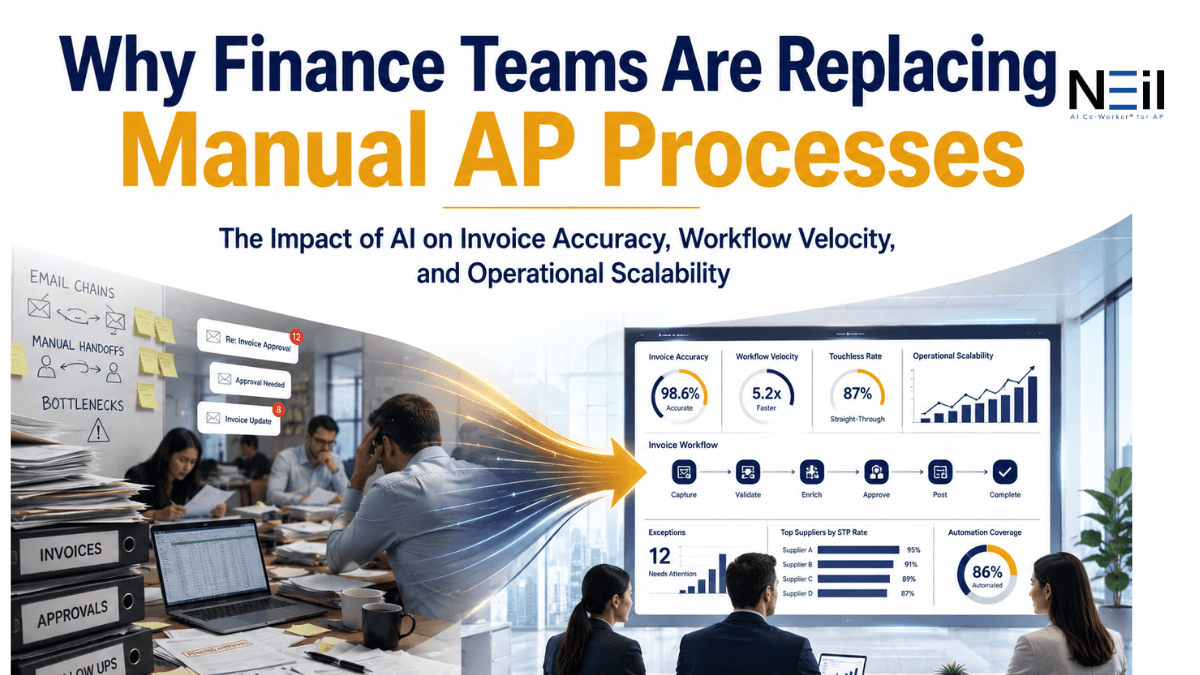
Finance teams today are operating under more pressure than ever before. Invoice volumes are rising, talent shortages are widening, and the expectation to deliver real-time insights while maintainingairtight compliance has never been more demanding. At the same time, manual accounts payable processes are struggling to keep pace.
This is exactly why AI adoption in finance is accelerating. Organizations that once relied on spreadsheets and manual data entry are now turning to intelligent automation to handle the complexity, scale, and speed that modern finance operations require. The benefits of AP automation are no longer a future promise, they are a present-day competitive advantage.
In this guide, we explore what AP automation means, why AI is reshaping finance operations, and the ten core benefits of AP automation that are driving this transformation.
What Is AP Automation?
AP automation refers to the use of technology, particularly AI to streamline and automate the accounts payable process. This includes invoice capture, data extraction, validation, approval routing, reconciliation, and payment processing, all with minimal manual intervention.
AI-led AP automation uses technologies like Intelligent Character Recognition (ICR), machine learning, and natural language processing to capture invoice data, validate it against purchase orders and contracts, route it for approval, and process payments — all with high accuracy and speed. Unlike rule-based systems, AI learns from historical patterns and continuously improves its performance over time.
Why AI Adoption Is Growing in Finance?
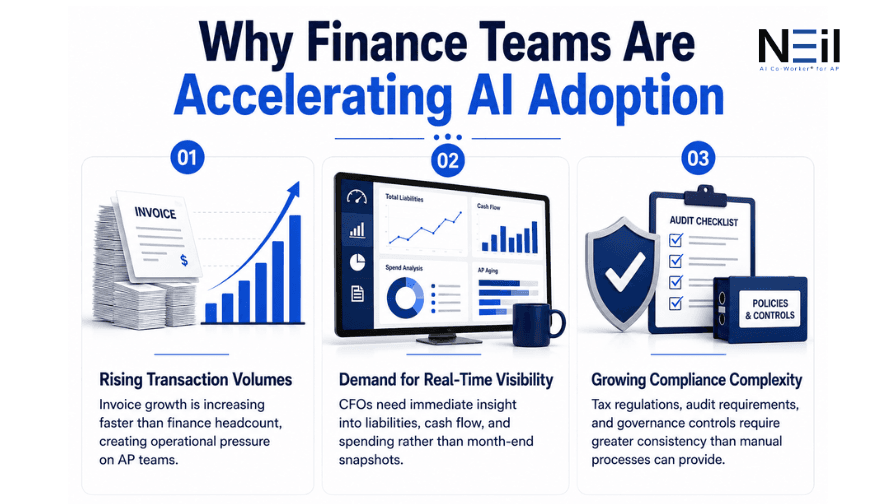
AI adoption is growing in finance because the demands on finance teams have fundamentally changed. Here are the five key drivers:
Rising Transaction Volumes
As businesses scale, the number of invoices, purchase orders, and payment requests grows exponentially. Manual processes simply cannot keep up with this volume without proportional increases in headcount.
Need for Real-Time Insights
Finance leaders need real-time data to make informed decisions about cash flow, vendor relationships, and spending. Manual AP processes create data silos and reporting delays that impede decision-making.
Increasing Compliance Requirements
Regulatory frameworks are becoming more complex and jurisdiction-specific. AI-powered automation builds compliance into every step of the process, reducing the risk of costly errors or audit failures.
What are the Benefits of Accounts Payable Automation in Business?
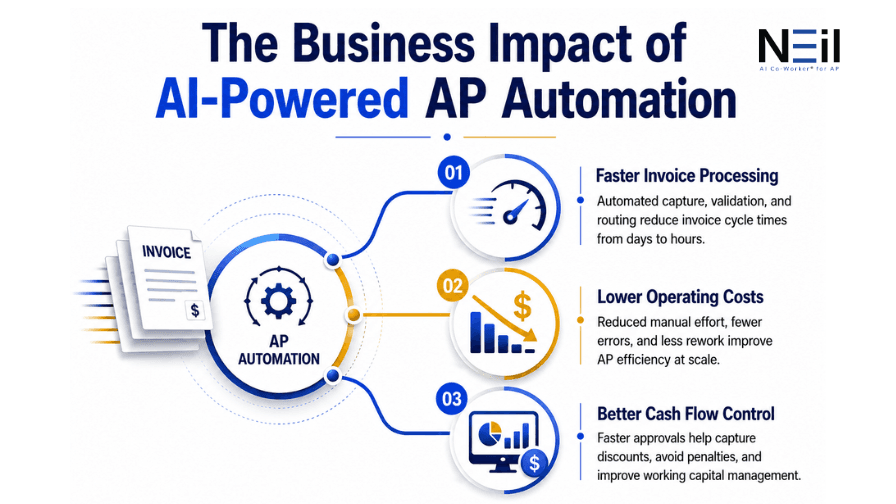
Faster Invoice Processing
According to latest studies, manual invoice processing averages 10 to 14 days from receipt to payment posting. AI-led AP automation compresses that cycle to 24 to 48 hours by eliminating the steps that slow them down.
Neil, our AI Co-Worker for AP Transformation captures invoice data the moment an invoice arrives, regardless of format (PDF, scanned image, email, EDI). Intelligent Character Recognition (ICR) extracts all relevant fields automatically, so no one manually keys in amounts, vendor details, or line items. The invoice is validated and routed before a human need to look at it.
Improved Accuracy and Reduced Errors
Manual invoice processing is inherently error prone. Typos, mis-keyed amounts, duplicate entries, and missed validations are common. One of the core benefits of AI in finance is the dramatic improvement in accuracy that intelligent automation delivers. Neil uses ICR rather than standard OCR, which means it interprets context rather than just reading characters. It cross-checks extracted data against vendor master records, purchase orders, and payment terms before any human review is triggered. Three-way matching, comparing the invoice against the PO and the goods receipt happens automatically.
Duplicate invoice detection is built in. Even when a vendor submits the same invoice twice with minor differences in the date or reference number, Neil flags it before payment is released.
Lower Processing Costs
Finance process automation delivers significant cost reductions across the accounts payable function. Organizations that have deployed AI-led automation report that invoice processing costs can decrease by up to 80–90%.
These savings come from multiple sources:
- Reduced labor costs as manual data entry and routing tasks are automated
- Less rework caused by errors, mismatches, and duplicate processing
- Reduced paper dependency as digital workflows replace physical document handling
- Lower audit and compliance costs due to built-in controls and audit trails
For mid-sized enterprises, these savings can represent millions of dollars annually — freeing up capital for growth investments.
Faster Approval Workflows
Slow approval cycles are one of the most common complaints in accounts payable. Invoices get stuck waiting for approvers, creating bottlenecks that delay payments and damage vendor relationships. The benefits of AP automation for business are most visible in how it transforms approval speed.
Neil automatically routes invoices to the correct approver based on amount, category, department, vendor, and business rules without manual intervention. For routine, low-risk invoices that fall within pre-defined parameters, Neil can apply policy-based auto-approval, completely bypassing human review for those transactions.
With automated escalations, reminders, and mobile approval capabilities, approval cycles shrink from days to hours, ensuring that no invoice sits idle due to an unavailable approver.
Better Cash Flow Management
Late payment penalties and missed early payment discounts are both direct hits to the bottom line. Automating AP processes eliminate both by ensuring every invoice is processed and approved on time.
When payment cycles are predictable and fast, finance teams can make deliberate decisions about payment timing, holding payments strategically to optimize working capital, or releasing them early to capture dynamic discounting opportunities. Real-time visibility into outstanding liabilities also feeds directly into cash flow forecasting, replacing estimates with accurate, live data.
Stronger Compliance and Audit Readiness
Compliance failures in accounts payable can result in financial penalties, audit findings, and reputational damage. AI automation in accounting and finance builds compliance into every step of the process.
- Digital audit trails: Every invoice action like receipt, extraction, validation, approval, and payment is logged automatically with timestamps and user attribution.
- Approval history: Complete records of who approved what, when, and under which authority are available on demand for internal and external audits.
- Regulatory compliance: Neil can be configured to enforce jurisdiction-specific tax rules, payment terms, and documentation requirements, ensuring consistent compliance across all transactions.
Fraud Detection and Risk Management
Financial fraud in accounts payable is a serious and growing risk. The benefits of AI in finance extend powerfully into fraud prevention, where machine learning models can detect patterns that human reviewers would never catch.
- Duplicate invoices: AI flags invoices that appear more than once — even when minor details like dates or invoice numbers have been altered.
- Suspicious transactions: Unusual payment amounts, off-cycle payments, and transactions to unregistered vendors trigger automated alerts for human review.
- Vendor anomalies: AI monitors vendor behavior over time and flags deviations from established patterns such as sudden changes in bank details, addresses, or invoice frequencies.
Real-Time Financial Visibility
A finance team that cannot see its AP backlog in real time is flying blind. How many invoices are outstanding? Which vendors are waiting on payment? Where are approvals stuck? Manual systems cannot answer these questions without a manual count.
Automating AP processes provides live dashboards that show invoice volumes, processing status, approval cycle times, exception queues, and outstanding payment obligations, all updated continuously. Finance leaders can see spend by vendor, department, or category at any moment.
Beyond Accounts Payable: How AI Is Transforming Finance Operations
The benefits of AI in finance extend well beyond accounts payable. Organizations implementing intelligent automation are discovering that the same technologies that power AP transformation can be applied across the entire finance function.
Billing and Collections
AI automates invoice generation, delivery, and follow-up for accounts receivable accelerating collections and improving days sales outstanding (DSO).
Financial Reporting
AI-powered reporting tools synthesize data from multiple systems to produce accurate, timely financial statements — reducing the manual effort involved in month-end and quarter-end close.
Reconciliation
Beyond AP reconciliation, AI can automate bank reconciliation, intercompany reconciliation, and balance sheet reconciliation — dramatically reducing close cycle times.
Expense Management
AI models review employee expense claims, verify receipts, enforce policy compliance, and flag anomalies, reducing the cost and time associated with expense processing.
Forecasting
Machine learning models analyze historical financial data to generate more accurate cash flow forecasts, budget projections, and scenario analyses, supporting more confident financial planning.
How Neil AI Acts as an AI Co-Worker for AP Teams
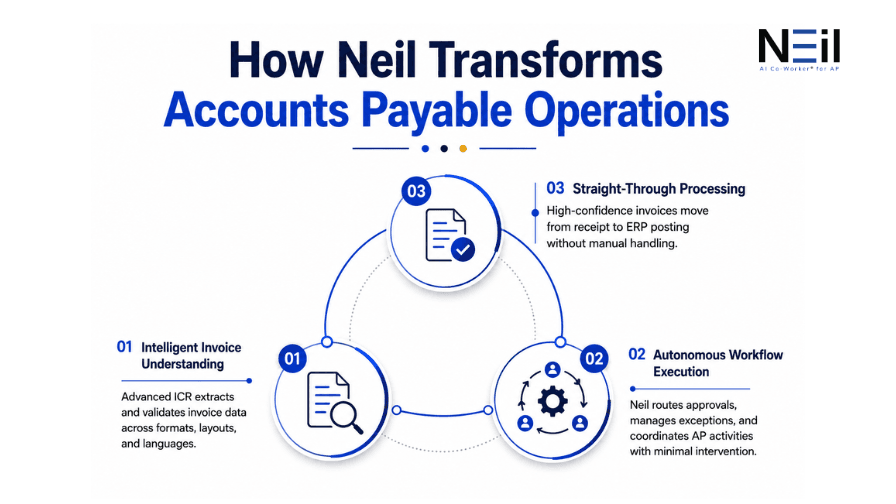
Neil is designed not to replace AP teams, but to work alongside them as an intelligent co-worker that handles repetitive, high-volume tasks while humans focus on judgment, relationships, and strategy.
Understands Invoices with ICR
Neil uses advanced ICR to extract structured data from any invoice format regardless of layout, language, or quality with accuracy that exceeds traditional OCR by a significant margin.
Automates Approval Workflows
Neil maps and executes approval workflows based on organizational policies, invoice attributes, and historical approval patterns — routing the right invoices to the right people at the right time.
Detects Exceptions
When invoices fall outside normal parameters due to price mismatches, missing POs, duplicate detection, or policy violations Neil flags them for human review rather than allowing them to proceedunchecked.
Learns from Historical Patterns
Every invoice that Neil process becomes a data point that improves its models. Over time, extraction accuracy improves, anomaly detection sharpens, and workflow automation becomes more precise.
Integrates with ERP Systems
Neil integrates with leading ERP platforms — enabling seamless data flow between the invoice processing layer and the general ledger, purchase order system, and payment module. This integration enables true straight-through processing for high-confidence invoices.
Delivers Straight-Through Processing
For invoices that meet all validation criteria and fall within policy-defined parameters, Neil AI enables straight-through processing, from receipt to payment posting without any human touch. This is the pinnacle of AP automation efficiency.
Why Businesses Investing in AI Today Will Lead Tomorrow
Organizations that are deploying AI today are building institutional knowledge, refining their models, and compounding the benefits of AP automation with every invoice processed.
- Finance transformation: AI-led AP is a foundation for broader finance transformation, enabling everything from predictive analytics to dynamic cash management.
- Data-driven decisions: Every transaction processed by Neil AI generates structured data that can feed into business intelligence tools, giving finance leaders the insights they need to make better, faster decisions.
- Increased profitability: The combination of lower processing costs, reduced fraud losses, avoided late fees, and captured early payment discounts directly improves the bottom line.
FAQs
AI adoption is increasing because finance teams need greater efficiency, real-time insights, stronger compliance, and the ability to handle increasing transaction volumes without proportionally increasing headcount or costs.
Why is AI adoption growing in finance?
AI adoption is increasing because finance teams need greater efficiency, real-time insights, stronger compliance, and the ability to handle increasing transaction volumes without proportionally increasing headcount or costs.
What are the benefits of AP automation software?
AP automation software helps organizations process invoices faster, reduce costs, improve approvals, prevent fraud, and gain better visibility into spending — all through intelligent, automated workflows that replace manual processes.
What are the benefits of AP automation for business?
Businesses benefit from improved cash flow, lower operational costs, faster approvals, stronger compliance, and increased productivity. AP automation also reduces fraud risk and enables finance teams to operate at a strategic level.
What are the benefits of AP automation for mid-sized businesses?
Mid-sized businesses can scale finance operations without increasing headcount, improve working capital, and eliminate manual bottlenecks. AI-powered AP automation enables them to compete with larger enterprises without the associated overhead.
Can AI detect duplicate invoices and fraud?
Yes. AI models can identify duplicate invoices, suspicious transactions, and unusual vendor behavior to reduce financial risk. Neil AI continuously monitors patterns and flags anomalies for human review before payment is released.
How does AP automation improve cash flow?
By accelerating invoice processing and approvals, businesses can avoid late fees, capture early-payment discounts, and optimize working capital. Real-time visibility into outstanding liabilities also supports more accurate cash flow forecasting.
Can AP automation integrate with ERP systems?
Yes. Modern AI-powered solutions like Neil AI integrate with ERP platforms to enable seamless data flow and straight-through processing — connecting invoice capture, approval, and payment within a single, unified workflow.
Is AP automation suitable for growing enterprises?
Absolutely. AP automation enables organizations to handle higher invoice volumes and scale operations efficiently without proportional increases in staffing. It is particularly valuable for fast-growing mid-sized businesses and multi-entity enterprises.